Posted on — Leave a comment

7 Critical Health Problems in American Akitas: What Every Buyer Must Know Before Choosing a Puppy

Health Guide  ·  Apexx Akitas

7 Critical Health Problems in American Akitas: What Every Buyer Must Know

At 8 weeks, every puppy looks healthy. The difference lies in what happened before you ever met them: OFA testing, health tracking, and breeder transparency.
Ron Durant Founder, Apexx Akitas Sussex County, New Jersey February 2026
Healthy American Akita puppy from Apexx Akitas with parents tested for common American Akita health problems including hip dysplasia
24.8%
Akitas with
Hip Dysplasia (OFA)
15.3%
Akitas with
Elbow Dysplasia
7
Critical Health
Conditions Covered
$14K+
Avg Cost of
Untreated Hip Dysplasia

If you are researching American Akita health problems, you have likely read that they are “generally healthy” or heard breeders claim their puppies are “100% healthy.”

Here is what those statements do not tell you: American Akitas are predisposed to several serious genetic health conditions that can cost tens of thousands of dollars and cause immeasurable heartbreak when breeding decisions are made carelessly.

I am Ron Durant from Apexx Akitas, and over 20 years of breeding champion American Akitas with full OFA health testing, I have learned this critical truth: The health of your future Akita was determined long before you ever met the puppy. Our OFA Health Testing Guide explains exactly what each clearance means and how to verify them yourself. It was determined by the breeder’s commitment to genetic testing, structural evaluation, and multi-generational health tracking.

American Akitas are extraordinary dogs. When bred responsibly, they are stable, loyal, and physically impressive companions. But when bred carelessly, they become medical nightmares that break families financially and emotionally. The difference lies entirely in the breeder. See our complete guide on how to find a reputable American Akita breeder, and our 15 Questions to Ask an American Akita Breeder.

Quick Reference: American Akita Health Problems at a Glance

Health Condition Prevalence Age of Onset Testing Available Preventability
Hip Dysplasia24.8% (OFA data)6 to 18 monthsOFA radiographsHigh (with testing)
Elbow Dysplasia15.3% (OFA data)4 to 12 monthsOFA radiographsHigh (with testing)
Autoimmune Disorders8 to 12% estimated1 to 7 yearsTracking programsModerate (with pedigree analysis)
Eye ConditionsVariableVariesAnnual CAER examsModerate to High
Hypothyroidism7 to 10% estimated2 to 6 yearsThyroid panelModerate (with testing)
Skin and Coat IssuesCommonVariesNone (symptom-based)Low to Moderate
VKH SyndromeRare but serious1 to 4 yearsClinical diagnosisLow (genetic tracking)

01

Hip Dysplasia: The Most Common and Costly American Akita Health Problem

Hip dysplasia is the single most devastating condition in American Akitas, affecting nearly 1 in 4 dogs according to OFA data.

What It Is

Hip dysplasia is a structural malformation where the femoral head (ball) does not fit properly into the acetabulum (socket). This creates abnormal joint wear, progressive arthritis, chronic pain, reduced mobility, and diminished quality of life.

The financial reality: Hip replacement surgery costs $5,000 to $7,000 per hip. Conservative management costs $1,200 to $2,400 annually for life.

Why American Akitas Are Particularly Susceptible

  • Rapid growth rate: American Akitas grow quickly, putting stress on developing joints during the critical 4 to 12 month period
  • Large frame: Adult males typically weigh 100 to 140-plus pounds, placing significant load on hip joints
  • Genetic predisposition: Hip dysplasia is highly heritable with a heritability estimate of approximately 60 percent
  • Poor breeding selections: Many breeders prioritize head size and coat color over joint health

What Responsible Breeders Do

  • OFA radiographs at 24 months minimum
  • Breed only dogs with Fair, Good, or Excellent ratings
  • Review pedigree hip data across 3 to 5 generations
  • Avoid pairing dogs with borderline results even if they technically pass
Critical buyer question: “Can you provide me with the OFA hip certification numbers for both parents so I can verify them on the OFA website?” If the breeder says the dog “has good hips” but cannot provide OFA numbers, walk away.

Real-World Impact

Families I have spoken with who purchased Akitas from untested breeders have faced: a 14-month-old requiring bilateral hip surgery, $18,000 in surgeries and rehabilitation before age 3, dogs too painful to walk by age 5, and euthanasia decisions at 6 to 7 years old due to unmanageable pain. Every single case traced back to breeders who did not OFA test.

02

Elbow Dysplasia: The Earlier-Onset Joint Disorder

Elbow dysplasia often manifests between 4 and 12 months of age, making it particularly devastating for families bonding with their young Akita.

Warning Signs in Young American Akitas

  • Limping or favoring a front leg, especially after rest
  • Stiffness when getting up
  • Reluctance to exercise or play
  • Rotating the affected leg outward while walking
  • Swelling around the elbow joint

The Genetic Component

Elbow dysplasia is highly heritable and manifests as several related conditions: ununited anconeal process (UAP), fragmented medial coronoid process (FCP), and osteochondritis dissecans (OCD). Unlike hip dysplasia, elbow problems cannot be effectively managed with exercise restriction alone. Surgery is often the only option, and outcomes are less predictable.

OFA data shows only 84.7 percent of American Akitas submitted for elbow evaluation receive passing grades. This means 15.3 percent fail. Breeders who test hips but not elbows are taking shortcuts. Joint health is not optional in large breeds.
03

Autoimmune Disorders: The Silent Threat in American Akitas

American Akitas have a genetic predisposition to autoimmune diseases that often do not appear until well after puppyhood.

Vogt-Koyanagi-Harada (VKH) Syndrome

Also called uveodermatologic syndrome. Affects eyes and skin pigmentation. Can cause blindness if untreated. Requires lifelong medication. Often appears between 1 and 4 years old.

Hypothyroidism

Thyroid gland dysfunction causing weight gain, lethargy, behavioral changes, and coat deterioration. Requires daily medication for life and may affect temperament and trainability.

Immune-Mediated Skin Disorders

Including sebaceous adenitis, pemphigus foliaceus, and chronic inflammation and infection.

The Late-Onset Challenge

Your dog may be completely healthy at 8 weeks and at 1 year, then show first symptoms at 2, 3, or 4 years old. This is why health testing the parents is not enough. Responsible breeders must track multi-generational health outcomes, maintain contact with puppy families, and remove dogs from breeding programs when patterns emerge.

Ask your breeder: “Have any autoimmune conditions appeared in dogs from your breeding program? If so, which ones, and what did you do in response?” A response of “Never had any problems” means the breeder is either not tracking outcomes or not being honest. Both are unacceptable.
04

Eye Conditions: What You Cannot See at 8 Weeks

Common Eye Issues in the Breed

  • Progressive Retinal Atrophy (PRA): Gradual degeneration of the retina leading to blindness. No cure. Genetic testing available for some forms.
  • Entropion: Eyelids roll inward, lashes irritate the cornea. Causes pain, tearing, and potential scarring. Requires surgical correction.
  • Uveitis: Inflammation of the eye’s middle layer, can be a component of VKH syndrome, and may lead to glaucoma and blindness.

Why Annual Eye Exams Matter

Some conditions develop with age. Early detection prevents progression. Breeding dogs should be examined regularly, not just once. CAER certifications are valid for 12 months only.

Ask your breeder: “When was the last CAER eye exam performed on each parent, and can I see the results?” A routine vet check is not the same as an examination by a board-certified veterinary ophthalmologist.
05

Skin and Coat Problems: Usually Genetic, Not Environmental

When an American Akita has chronic skin issues, owners often blame food allergies, environmental allergies, or grooming products. While these factors can contribute, most persistent skin problems in American Akitas have genetic or autoimmune origins.

Common Skin Issues in the Breed

  • Sebaceous adenitis: Destruction of sebaceous glands leading to dry, scaly skin and hair loss. Genetic condition.
  • Persistent hot spots: Recurring moist dermatitis often linked to immune system function with frequent secondary infections.
  • Zinc-responsive dermatosis: Particularly in heavily marked or dilute-colored Akitas. Requires lifelong zinc supplementation.
  • Coat quality degradation: Brittle, thin coat often linked to thyroid or immune issues.

Dogs with chronic skin conditions should never be bred, even if they are visually impressive. Yet many breeders overlook skin issues to preserve certain head types, colors, or body structures. At Apexx Akitas, we maintain contact with families specifically to track these issues. Find all our health and buyer guides on the American Akita Resources page. and adjust breeding decisions accordingly.

06

Thyroid Disorders: The Hidden Impact on Temperament and Health

Hypothyroidism affects an estimated 7 to 10 percent of American Akitas and often goes undiagnosed for years.

How Hypothyroidism Affects American Akitas

  • Physical symptoms: Unexplained weight gain, lethargy, coat deterioration, skin problems, cold intolerance
  • Behavioral symptoms: Increased reactivity or aggression, anxiety or fearfulness, cognitive changes, reduced trainability

The behavioral component is particularly significant in American Akitas, a breed that requires stable temperament and clear thinking. Many owners attribute symptoms to the dog getting older or being less active, while the dog is actually suffering from a treatable medical condition.

A dog can be visually stunning, move beautifully, and have perfect structure but if thyroid levels are off, breeding that dog passes on metabolic dysfunction and potential temperament instability.
07

Why “Healthy American Akita Puppies” Is a Meaningless Marketing Phrase

Every breeder claims their puppies are healthy. Every single one. That statement alone means absolutely nothing.

An 8-week-old puppy can look perfectly healthy while carrying hip dysplasia genes, elbow abnormalities that will not manifest for months, predisposition to autoimmune disease, eye conditions that develop later, and thyroid dysfunction that appears at 2 to 3 years old.

What Actually Matters

  • OFA hip and elbow certification numbers verifiable at ofa.org
  • Current CAER eye exam results within the past 12 months
  • Thyroid panel including TgAA antibody testing
  • Cardiac evaluation
  • Long-term outcome tracking across placed dogs
  • Written health guarantee with specific terms
  • Lifetime return-to-breeder policy

How Reputable American Akita Breeders Actually Reduce Health Risks

The difference between a responsible American Akita breeding program and a negligent one comes down to systems, transparency, and accountability.

  1. Test before breeding, not after problems appear. Every breeding dog at Apexx Akitas undergoes OFA hip and elbow radiographs, annual CAER eye examinations, complete thyroid panels, and cardiac evaluation. These are ongoing evaluations throughout a dog’s breeding career, not done once and forgotten.
  2. Breed selectively, not frequently. Responsible breeders do not breed every heat cycle, do not breed dogs just because they have champion titles, wait until dogs are fully mature at 2-plus years, and limit the number of litters per dog. Volume breeding and quality breeding are mutually exclusive.
  3. Track puppies for life. The only way to truly evaluate breeding decisions is to see long-term outcomes. At Apexx Akitas, we maintain contact with approximately 80 percent of placed families, tracking health outcomes through senior years. This data informs every breeding decision.
  4. Require return-to-breeder contracts. Every Apexx Akitas puppy contract includes a lifetime return policy. If a family cannot keep their dog at any point, for any reason, the dog comes back to us. If a breeder does not want their dogs back, they do not care about the dogs.
  5. Invest in continuous education. The world of canine genetics and health screening is constantly evolving. Responsible breeders stay current with research, attend seminars, and collaborate with veterinary specialists. See our complete health testing and breeding standards.

The Cost Comparison: Responsible Breeding vs Health Problems

Breeder Investment in Health Testing

  • OFA hip radiographs: $200 to $400
  • OFA elbow radiographs: $200 to $400
  • Annual CAER eye exam: $50 to $150
  • Complete thyroid panel: $150 to $250
  • Cardiac evaluation: $100 to $300

Total per dog: $700 to $1,500 annually

Owner Cost When Testing Is Skipped

  • Hip replacement (bilateral): $10,000 to $14,000
  • Elbow surgery per elbow: $3,000 to $5,000
  • Autoimmune disease (lifetime): $2,000 to $5,000 per year
  • Eye surgery (severe): $3,000 to $5,000 per eye
  • Conservative hip management: $1,200 to $2,400 per year

Potential total: $20,000 to $50,000-plus

A puppy from a health-tested, responsibly bred American Akita has a higher initial cost but dramatically lower lifetime health costs. The cheapest puppy is often the most expensive dog. See How Much Does an Akita Puppy Cost? for a full breakdown.

The Questions You Must Ask Before Choosing an American Akita Puppy

Health Testing Questions

Good answer to “Can I verify the OFA hip and elbow certification numbers for both parents?”

Provides OFA numbers immediately without hesitation.

Red flag response

“The vet said their hips are good” or “We’re getting that done soon” or “We do our own X-rays.”

Good answer to “When was the last CAER eye exam performed on each parent?”

Within the past 12 months, provides documentation.

Red flag response

“The vet checked their eyes” or “Never had any problems.”

Good answer to “Have you run complete thyroid panels on the parents?”

Yes, provides results including TgAA antibody values.

Red flag response

“They have lots of energy, so thyroid must be fine.”


Red Flags and Green Flags: How to Read Any Breeder

Red Flags That Signal an Irresponsible Breeder

Cannot provide OFA certification numbers

Every normal OFA result is publicly verifiable at ofa.org. No numbers means no clearances.

Claims “the vet checked them”

A wellness exam is not OFA testing. These are completely different things.

Tests hips but not elbows, or only one parent

Incomplete testing is not responsible testing.

Always has puppies available

Volume production and quality breeding are incompatible.

Claims “never had a single health problem”

Either not tracking outcomes or not telling the truth.

Focuses on rare colors or markings

Color-focused breeding almost always involves compromises elsewhere.

Green Flags That Signal a Responsible Breeder

Readily provides OFA certification numbers and encourages verification

Transparent breeders have nothing to hide.

Discusses past health issues honestly

Transparency about health issues is a sign of responsibility, not a weakness.

Provides references from families with adult dogs

Long-term relationships indicate a breeder who tracks outcomes.

Has a lifetime return-to-breeder policy

The strongest possible signal of genuine accountability.

Requires application and interviews prospective buyers

Responsible breeders interview you as carefully as you interview them.


Frequently Asked Questions About American Akita Health

Are American Akitas generally healthy dogs?

When bred responsibly with proper health testing, American Akitas can be healthy, long-lived companions. However, the breed is predisposed to several significant genetic health conditions. The health of your American Akita is primarily determined by your breeder’s testing protocols and breeding decisions.

Is it worth paying more for a puppy from health-tested parents?

Absolutely. The price difference between an irresponsibly bred and responsibly bred American Akita is minimal compared to potential health costs. More importantly, health testing dramatically increases your chances of enjoying 10 to 13 years with a stable, sound companion.

Can good nutrition and exercise prevent genetic health problems?

No. While proper nutrition and exercise support overall health, they cannot prevent genetic conditions like hip dysplasia, elbow dysplasia, or autoimmune disease. These conditions are inherited and determined at conception. Prevention requires responsible breeding selection.

At what age do most health problems appear in American Akitas?

Joint problems typically manifest between 6 and 18 months. Autoimmune conditions often appear between 1 and 7 years. Thyroid disorders commonly develop between 2 and 6 years. This is why long-term health tracking by breeders is essential.

How can I verify that a breeder’s health testing claims are legitimate?

Visit ofa.org and search for the dog’s registered name or registration number. You will see all submitted health clearances with dates. If a breeder claims testing but results are not publicly available, they are either not testing or have poor results they are hiding.

Can a puppy from champion parents still have health problems?

Absolutely. Championships are awarded for conformation, not health. A dog can have a gorgeous head, perfect proportions, and beautiful movement while carrying genes for hip dysplasia, autoimmune disease, or other conditions. Health testing is separate from and more important than titles.


The Apexx Akitas Health Commitment

At Apexx Akitas, we do not view health testing as a checklist to complete. We view it as the foundation of every breeding decision.

Before a dog enters our breeding program, every dog undergoes OFA hip evaluation (minimum Good rating), OFA elbow evaluation (Normal rating), annual CAER eye examinations, complete thyroid panel including Free T4, Total T4, T3, and thyroid antibodies, and cardiac evaluation.

Throughout the breeding career, we conduct annual eye exams, periodic thyroid monitoring, physical evaluations before each breeding, and track offspring health outcomes. After breeding, we maintain lifetime tracking of offspring health, provide immediate notification to families if patterns emerge, and remove dogs from the breeding program if concerns develop.

Every puppy from Apexx Akitas comes with a hips and elbows health guarantee, lifetime return-to-breeder policy, and direct access to health records. Learn more about life with an American Akita as a family dog. View our complete health testing protocols.

Read verified reviews from placed families on our Apexx Akitas testimonials page to see long-term health and temperament outcomes.

Apply Today

Ready for an Apexx Akitas Puppy?

Every breeding dog carries full verifiable OFA clearances. Every puppy is placed with lifetime support. Applications are reviewed personally by Ron Durant.
Apply for a Puppy
Posted on — Leave a comment

How to Find a Healthy, Well-Bred Akita Puppy in the United States

American Akita puppy from a health-tested breeding program showing correct structure and coat
A well-bred American Akita puppy raised with early socialization and responsible breeding standards.

Akita Puppies for Sale: How to Find a Healthy, Well-Bred Akita Puppy in the United States

Searching for Akita puppies for sale can feel overwhelming. A single Google search returns hundreds of listings, directories, and breeder ads, many of which look legitimate at first glance. Unfortunately, not all Akita puppies are bred with health, temperament, or long-term responsibility in mind.

This guide is written from the perspective of an experienced American Akita breeder, with one goal: to help you understand how to identify a well-bred Akita puppy, avoid costly mistakes, and confidently choose a breeder who stands behind their dogs for life. Whether you are looking for a family companion, a future show prospect, or a loyal guardian, understanding what separates ethical breeders from mass listings is critical.

Are “Akita Puppies for Sale Near Me” Always the Best Choice?

Many buyers start with “Akita puppies for sale near me,” assuming proximity equals quality. While local breeders can be excellent, distance alone tells you nothing about breeding standards.

A reputable Akita breeder prioritizes:

    • Proven health testing
    • Stable, predictable temperament
    • Structured early development
    • Proper placement not impulse sales

Well-bred Akita puppies are often worth traveling for or safely transporting. Ethical breeders place puppies nationwide and focus on the right home, not the fastest sale.

How Much Do Akita Puppies Cost?

One of the most common questions buyers ask is price and it’s also where misinformation spreads fastest.

Typical price range for responsibly bred Akitas:

This pricing reflects real investments, including:

    • Orthopedic and genetic health testing
    • Carefully selected breeding pairs
    • Veterinary prenatal care
    • Early neurological stimulation
    • Quality nutrition and socialization
    • Lifetime breeder support

Listings offering Akita puppies far below this range often cut corners leading to higher long-term costs in veterinary bills, behavioral issues, or heartbreak.

What Makes a Reputable Akita Breeder?

A truly reputable breeder does not rely on vague claims or flashy listings. They document their program clearly and transparently.

Key markers include:

 Health Testing

Responsible breeders test breeding dogs for conditions common in Akitas, such as hip and elbow dysplasia, thyroid issues, and hereditary disorders.

 Temperament Selection

Akitas should be confident, stable, and discerning, not fearful or unstable. Temperament is shaped by both genetics and early handling.

 Early Development & Socialization

Structured exposure during the first eight weeks dramatically influences adult behavior.

 Accountability After Sale

Ethical breeders provide guidance for the life of the dog and remain a resource and not just a seller.

This is why families looking for Akita puppies for sale from health-tested parents consistently choose established breeders over anonymous listings.

Why Large Puppy Listing Websites Can Be Risky

Mass marketplaces and directory sites may look authoritative, but they often operate as advertising platforms and not quality control systems.

Common issues with large listing sites:

    • Minimal breeder verification
    • No enforcement of health testing standards
    • Limited accountability after placement
    • Puppies treated as inventory rather than lives.

Available Akita Puppies at Apexx Akitas

Apexx Akitas is a dedicated American Akita breeding program based in the United States, focused on producing dogs with sound structure, stable temperament, and long-term health.

Our program emphasizes:

    • Purpose-bred pairings
    • Health-tested parents
    • Early neurological development
    • Careful family placement
    • Ongoing breeder support

If you are researching Akita puppies for sale and want transparency, education, and accountability not just a listing you can view available Akita puppies for sale directly through our program.

Choosing the Right Akita Puppy for Your Lifestyle

Akitas are not a “one-size-fits-all” breed. A responsible breeder helps match puppies to homes based on:

    • Household structure
    • Experience level
    • Activity expectations
    • Long-term goals

A good breeder may decline a placement if the match isn’t right. This is a sign of integrity and not inconvenience.

Frequently Asked Questions About Akita Puppies for Sale

Are Akitas good family dogs?

Yes when bred and raised correctly. Well-bred Akitas with stable temperaments often thrive in structured family environments with clear leadership.

Are Akita puppies aggressive?

Aggression is not a breed trait. Poor breeding, lack of socialization, and irresponsible ownership are the real risk factors.

Do Akitas require experienced owners?

Akitas do best with confident, consistent leadership. First-time owners can succeed when supported by a responsible breeder.

What health testing should an Akita breeder perform?

At minimum, hips, elbows, and thyroid should be evaluated, along with breed-relevant genetic screening.

Posted on — Leave a comment

What Health Testing Should a Responsible American Akita Breeder Perform?

American Akita attending a veterinary health evaluation as part of responsible breeding practices

What Health Testing Should a Responsible American Akita Breeder Perform?

Choosing an American Akita breeder is not just about appearance or bloodlines it’s also about verifiable health testing. A responsible American Akita breeder performs specific orthopedic, genetic, and wellness screenings to protect the future of the breed and ensure puppies are set up for long, healthy lives. This article explains exactly what tests matter, why they matter, and how buyers can verify them.

Why Health Testing Matters in American Akitas

American Akitas are a powerful, large-boned working breed. Without proper health testing, breeders risk passing on orthopedic issues, autoimmune disorders, and hereditary weaknesses that may not appear until adulthood.Health testing is not optional it is the foundation of:

  • Ethical breeding
  • Breed preservation
  • Puppy longevity
  • Buyer trust

Reputable programs invest years and thousands of dollars into screening breeding dogs before a litter is ever planned.

Core Orthopedic Testing Every Responsible Akita Breeder Should Perform

OFA Hip Dysplasia Evaluation

Hip dysplasia is one of the most significant concerns in large breeds.Responsible breeders:

  • Submit hip radiographs to the Orthopedic Foundation for Animals (OFA)
  • Breed only dogs with acceptable or passing scores
  • Avoid breeding young dogs without mature evaluations

A simple “vet check” is not a replacement for OFA certification.

OFA Elbow Evaluation

Elbow dysplasia can severely impact an Akita’s quality of life.Proper testing includes:

  • Official OFA elbow certification
  • Breeding decisions based on results and not convenience

Skipping elbow testing is a major red flag.

Thyroid & Autoimmune Screening

American Akitas are predisposed to autoimmune thyroiditis. Responsible breeders screen for thyroid health to reduce the risk of:

  • Hormonal imbalance
  • Behavioral changes
  • Long-term metabolic disease

Testing is typically performed through OFA-approved laboratories and documented for transparency.

Eye Examinations (CAER)

Annual eye exams performed by board-certified veterinary ophthalmologists help detect:

  • Hereditary eye conditions
  • Progressive issues that may not be visible in puppies

Ethical breeders stay current on these exams, even when results are normal.

General Health & Reproductive Evaluations

Beyond formal certifications, responsible programs evaluate:

  • Structural soundness
  • Stable temperament
  • Reproductive health
  • Overall vitality and movement

Health testing is not one test, it’s a system that ensures quality.

Tests Unethical Breeders Often Skip (Buyer Warning)

Buyers should be cautious of breeders who:

  • Claim “vet checked” instead of OFA certified
  • Refuse to share documentation
  • Breed dogs under two years old
  • Avoid discussing autoimmune risks
  • Rely solely on appearance or color

Skipping health testing lowers costs but transfers risk directly to the puppy buyer.

How Buyers Can Verify Health Testing Results

Responsible breeders welcome verification.

Buyers should:

  • Ask for OFA numbers
  • Look up results directly at ofa.org
  • Request copies of certifications
  • Ask how results influenced breeding decisions

Transparency is the hallmark of ethical breeding.

How Apexx Akitas Aligns With Responsible Health Testing Standards

At Apexx Akitas, health testing is part of a documented breeding philosophy, not a marketing phrase. All breeding decisions are guided by:

  • Verified orthopedic testing
  • Temperament evaluation
  • Structural integrity
  • Long-term breed preservation goals

Our full testing protocols and ethical framework are detailed on our dedicated standards page.

 Learn more here:
Health Testing & Breeding Standards
https://apexxakitas.com/health-testing-breeding-standards

Posted on — Leave a comment

What Makes a Reputable Akita Breeder

American Akita from health-tested bloodlines calmly interacting with breeder during early development and socialization
PUPS "HEAD" AND SHOULDERS ABOVE THE REST AT 5 Months Old

Reputable American Akita Dog Breeder Dedicated to Excellence

Apexx Akitas is a trusted American Akita breeder specializing in sound temperament, strong structure, and responsibly bred Akita puppies from proven bloodlines. Our program is built on health testing, early development, and lifelong breeder support, 

setting us apart from the average Akita dog breeder.

At Apexx Akitas, we are more than Akita breeders! We are caretakers of the breed’s future. Every Akita puppy we produce is the result of careful planning, ethical breeding practices, and a commitment to preserving the true American Akita: loyal, confident, stable, and powerful.

Families searching for a reputable Akita breeder choose Apexx Akitas because we prioritize health, temperament, and structure first,never shortcuts. Whether you are seeking a devoted family companion or a potential show prospect, our breeding program is designed to produce Akitas that thrive in real homes.

 Explore our breeding philosophy, health standards, and available puppies below.

 Why Apexx Akitas Is a Reputable Akita Breeder

What Sets Our Akita Breeding Program Apart

Not all Akita breeders are the same. Apexx Akitas operates with a long-term vision for the breed, not short-term profit.

  • Comprehensive health testing of breeding dogs
  • Carefully selected bloodlines with strong temperaments
  • Early neurological stimulation and structured socialization
  • Limited, well-planned litters
  • Ongoing breeder support for every family

Our approach reflects what informed buyers look for when searching for the best Akita breeders, transparency, experience, and accountability.

 Ethical American Akita Breeding Standards

A Thoughtful, Proven Approach to Breeding Akitas

As an experienced Akita dog breeder, we focus on producing dogs that are not only impressive in appearance, but dependable in temperament. Our Akitas are raised in a hands-on environment, exposed to daily interaction, routine handling, and early confidence-building exercises.

We do not mass-produce puppies. Each litter is intentionally planned to protect the health of the parents and the quality of the puppies.

 Learn more about our current litters on our
Akita Puppies for Sale page.

 Health, Temperament & Structure Come First

Raising Akitas for Real Life

A truly reputable Akita breeder understands that temperament is just as important as appearance. Our breeding dogs are selected for:

  • Stable, confident dispositions
  • Strong bone structure and correct conformation
  • Clear health testing results
  • Predictable, family-appropriate temperaments

This is why Akitas bred by Apexx Akitas consistently adapt well to family environments when properly trained and socialized.

 Read more in our educational resource:
Are Akitas Good Family Dogs?

 Trusted Akita Breeder Recognized by Leading Organizations

Transparency & Accountability Matter

Responsible Akita breeders stand behind their dogs and their practices. Apexx Akitas supports transparency and ethical breeding standards promoted by trusted organizations.

These resources align with the values we uphold as a professional American Akita breeder.

 Serving Families Nationwide

Akita Breeder Serving the United States

While Apexx Akitas is based in the United States, we work with families across the country. Many people searching for “Akitas for sale near me” ultimately choose a breeder based on quality, not distance.

We frequently work with families in:

  • New Jersey
  • Texas
  • California
  • Florida
  • Colorado
  •   Visit our location-specific pages: 

Start With Education

Learn How to Choose the Right Akita Breeder

We believe informed buyers make better decisions—for themselves and for the dogs. Our blog answers the most common questions families ask before choosing a breeder.

   Visit the Apexx Akitas Blog to explore:

  • How much does an Akita puppy cost?
  • Are Akitas aggressive?
  • What makes a breeder reputable?
  • American Akita vs Japanese Akita

Section Title

Early Neurological Stimulation for American Akita Puppies: What We Do Before 8 Weeks

Early Neurological Stimulation for American Akita Puppies: What We Do Before 8 Weeks Early...

American Akita vs German Shepherd: A Breeder’s Honest Comparison

American Akita vs German Shepherd: A Breeder’s Honest Comparison By Ron Durant · Apexx Akitas...

American Akita Colors and Coat Patterns: The Complete Visual Guide

American Akita Colors and Coat Patterns: The Complete Visual Guide By Ron Durant · Apexx Akitas ·...

What to Feed an American Akita: A Breeder’s Complete Feeding Guide

What to Feed an American Akita: A Breeder’s Complete Feeding Guide RD Ron Durant Founder &...

How Big Do American Akitas Get? A Breeder’s Complete Size Guide

How Big Do American Akitas Get? A Breeder’s Complete Size Guide By Ron Durant, Apexx Akitas...

How to Train an American Akita: What Actually Works From 20+ Years of Experience

How to Train an American Akita: What Actually Works From 20+ Years of Experience By Ron Durant...

First 30 Days with an American Akita Puppy: The Complete Owner’s Guide

Ownership Guide  ·  Apexx Akitas First 30 Days with an American Akita Puppy: The Complete Owner’s...
Posted on — Leave a comment

Are Akitas Aggressive?

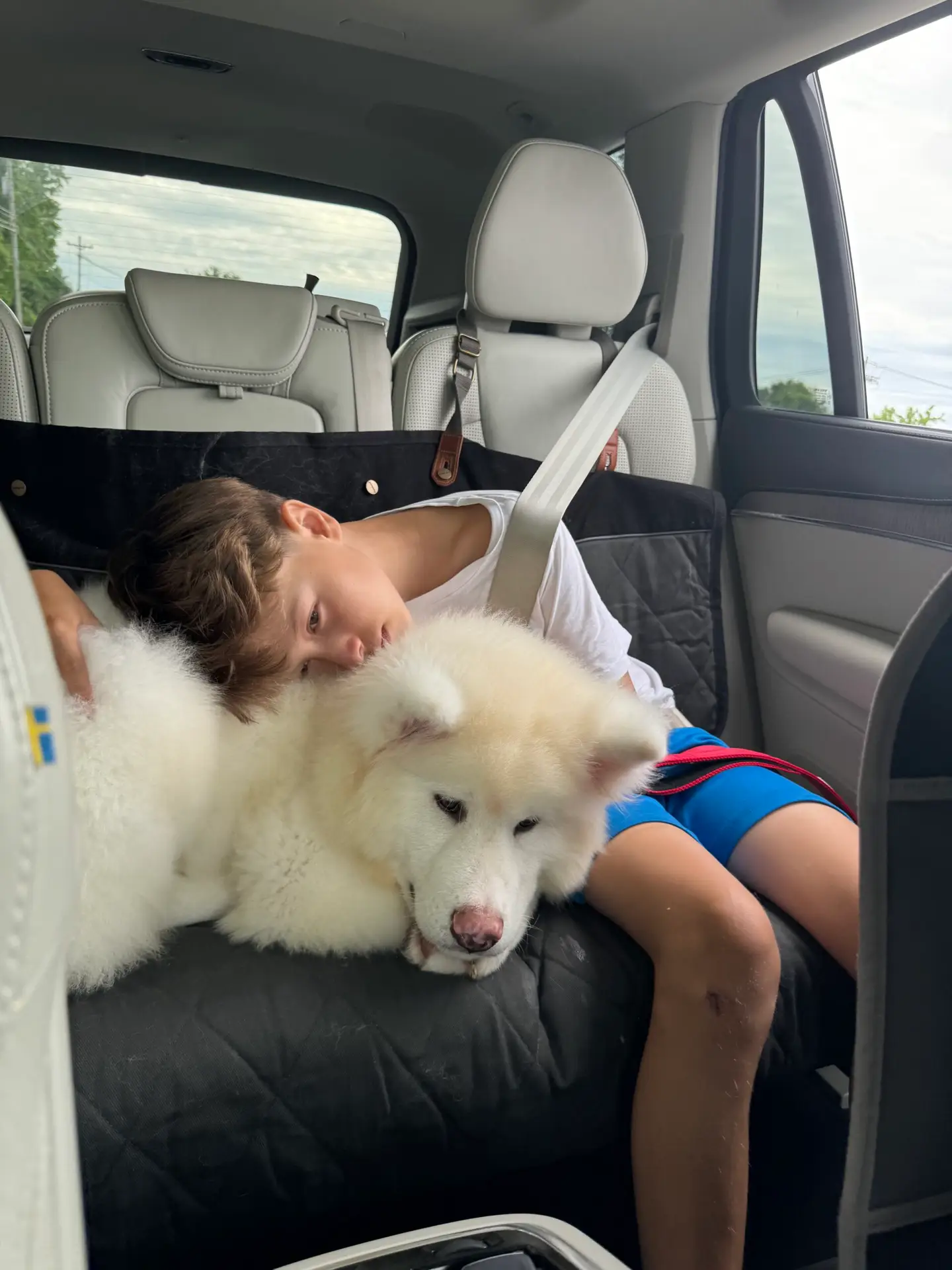
Blizzard, a calm and confident white American Akita male from Apexx Akitas, riding home with his adolescent companion, showing the stable temperament of a well-bred guardian breed

Are Akitas Aggressive? An Honest Answer From a 20 Year Breeder

No, well-bred American Akitas are not naturally aggressive. The American Akita is a powerful, intuitive guardian breed with strong protective instincts, and those instincts are often mistaken for aggression by people who do not understand what they are looking at. A well-bred Akita from a serious program is calm, watchful, deeply bonded to family, and naturally reserved with strangers rather than reactive or dangerous. However, a poorly bred Akita raised by an inexperienced owner can absolutely develop into a dangerous dog. The same is true of any large guardian breed. The real question is whether the dog in front of you came from a program that selected for stable temperament and whether the owner is doing the work the breed requires.

Blizzard, a calm and confident white American Akita male from Apexx Akitas, riding home with his adolescent companion
Blizzard, an Apexx Akitas white male, on his ride home with his adolescent companion. Calm, observant, completely at ease. This is what sound temperament looks like in the breed.

This is probably the most common question I get from people researching the breed. Are American Akitas aggressive? Are they dangerous? Should I be worried about bringing one into my home?

I have been breeding American Akitas in Sussex County, New Jersey for over twenty years, and I am going to give you a direct answer.

No. American Akitas are not naturally aggressive. They are a powerful, intuitive guardian breed with strong protective instincts, and those instincts are often mistaken for aggression by people who do not understand what they are looking at.

That said, this is not the whole answer, because the breed is not for everyone. A poorly bred Akita raised by an inexperienced owner can absolutely develop into a dangerous dog. The same is true of any large guardian breed. The question is not really whether Akitas are aggressive. The question is whether the dog in front of you came from a serious breeding program and whether the owner is doing the work the breed requires.

What Aggression Actually Looks Like, and What It Doesn't

Most of what gets labeled aggression in this breed is something else entirely. Let me walk you through what people misread, because this matters.

Look at the dog in the photo above. Blizzard is a full grown white Apexx Akita male, riding home in a car with his adolescent companion. There is nothing tense in his body. His eyes are soft. He is paying attention to his surroundings the way Akitas always do, but he is completely relaxed in the presence of his person. That is the breed. That is what we breed for.

An American Akita watching a stranger walk up to your front door with calm, focused attention is not aggressive. That is the breed doing its job. Akitas were developed in Japan as guardians, and that watchful presence is the entire reason the breed exists.

An American Akita that does not run up to strange dogs at the park wagging its tail is not aggressive. That is the breed showing the same-sex selectivity and dignified reserve that has always been part of its character. Akitas tend to prefer the company of their family over the company of unknown dogs. That is a feature, not a flaw.

An American Akita that signals discomfort when a strange child reaches over its head or hugs it tightly is not aggressive. That is a dog using the only language it has to tell you it is uncomfortable, and a smart owner reads that signal and adjusts.

Actual aggression looks like a dog that bites without warning, attacks family members, or shows persistent unprovoked reactivity in normal situations. In twenty years of breeding, I have never produced a dog like that, because the breeding decisions I make are designed to prevent it.

Where Akita Aggression Actually Comes From

When you do see a dangerously aggressive Akita, it almost always traces back to one or more of these failures:

  • Poor breeding decisions. Breeding dogs with unstable temperaments to other dogs with unstable temperaments produces puppies that inherit the problem. Reputable breeders screen for temperament as rigorously as they screen for health.
  • No early socialization. The window between 8 and 16 weeks is when the dog learns whether the world is a safe place. A puppy raised in isolation during that window will be a fearful, reactive adult.
  • Backyard breeders and puppy mills. Volume breeders selling Akitas as a product have no incentive to select for temperament. The dogs that come out of those programs are a coin flip at best.
  • Inexperienced owners. An Akita placed with an owner who cannot be the calm, consistent leader the breed needs will struggle. Akitas do not respond well to chaos, harsh corrections, or unpredictable handling.
  • Mistaken rescue placements. Rescue Akitas often come with unknown histories, unknown genetics, and unaddressed fear. Calling that aggression and blaming the breed is not fair to the breed.

I explain this in more depth in Why Temperament Starts Before the Puppy, which covers exactly how the breeding decision is the temperament decision.

The Difference a Serious Breeding Program Makes

At Apexx Akitas, every breeding pair is selected for temperament first. Not coat. Not size. Not pedigree alone. Temperament. The dogs I keep in my program have to demonstrate the calm, stable, family-suitable disposition that defines the breed at its best. The ones that do not, no matter how impressive they look on paper, do not get bred.

That selection process compounds. Each generation of Apexx Akitas inherits stable temperament from both sides, and that inheritance shows up in every puppy I produce. Combine that genetic foundation with eight weeks of in-home raising, daily handling, exposure to children, exposure to normal household noise, and the result is a puppy that arrives at its new family already wired for stability.

This is why families with toddlers, school-age children, and other dogs can confidently bring an Apexx Akita into their home. The dog is not a guess. The dog is the product of two decades of decisions designed to produce exactly the temperament their family needs.

Are Akitas Good With Children?

Yes, when the dog comes from sound genetics and is introduced to the children correctly. This is one of the questions where the gap between a well-bred Apexx Akita and a poorly bred dog from an irresponsible breeder is the widest. A properly bred American Akita is one of the most devoted child guardians you will ever own. A poorly bred one is a liability.

I cover the full answer to this question in Are American Akitas Good With Children? A Breeder's Honest Answer, including how to handle the first introduction between your new puppy and your child.

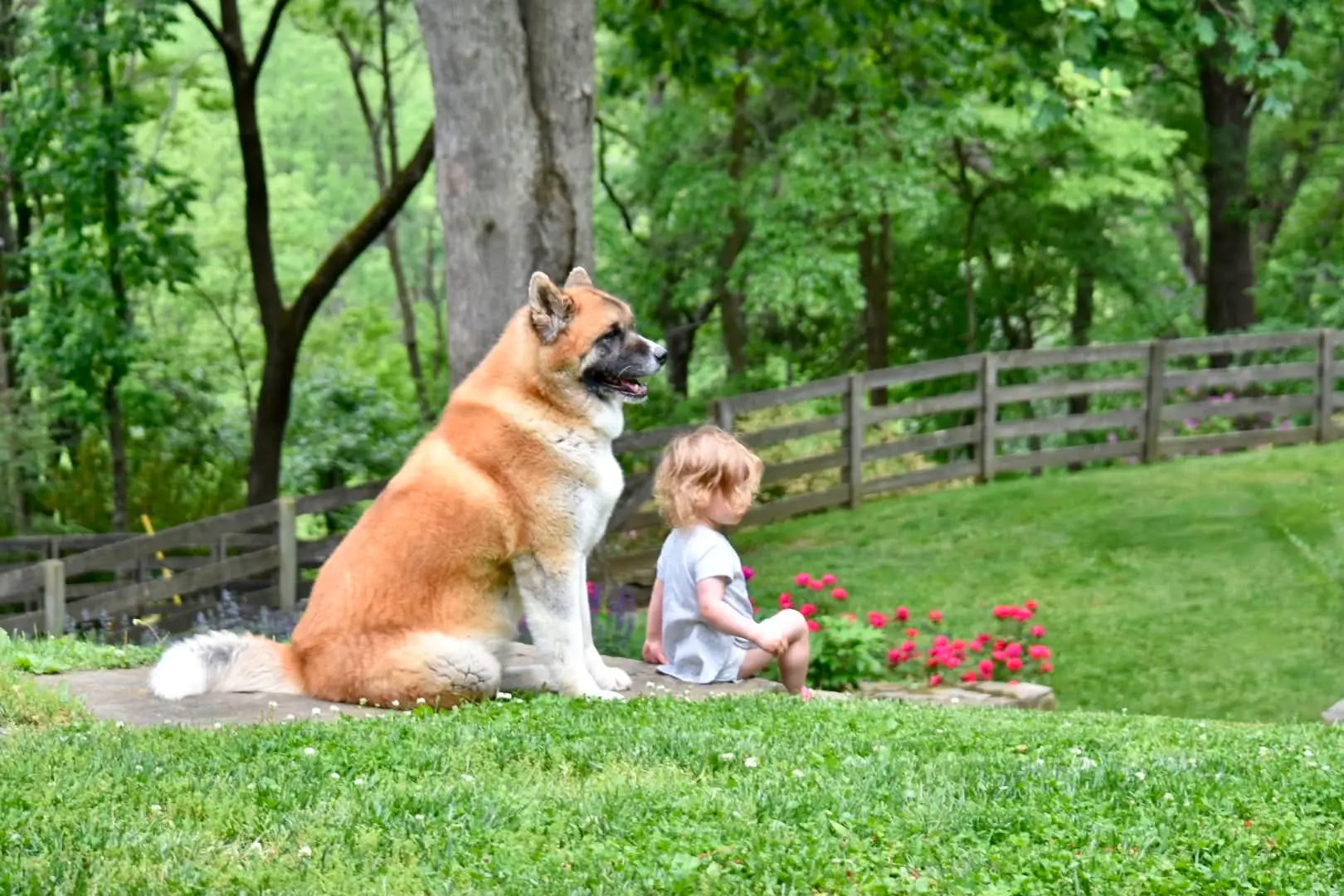
Sadie the Guardian, a 10-year-old American Akita from Apexx Akitas, sitting watchfully behind her young charge in the garden, demonstrating the calm protective nature of the breed
Sadie the Guardian, an Apexx Akita at 10 years old, watching over her young charge in the garden. This is what a well-bred American Akita's protective instinct actually looks like. Watchful, present, calm.

Are Akitas Aggressive With Other Dogs?

This is the one area where the breed's reputation has some truth behind it, and I will be honest about it. American Akitas can show same-sex selectivity, especially between two females or two intact males in the same household. It is in the breed's history as a hunting dog, and even careful breeding does not eliminate it entirely.

What this means practically is that a well-bred Akita is usually fine with the family dog it grew up with, fine with the dogs it meets on a leashed walk, and fine in supervised public settings. The friction tends to show up in two specific situations. Two same-sex dogs sharing a home, and unsupervised interactions with unfamiliar dogs.

This is a manageable trait, not a dealbreaker. A serious breeder will be honest with you about your specific household and whether a particular puppy is the right match for it.

What Owning an American Akita Actually Requires

I am going to be direct with you here, because I would rather you walk away than buy a dog from me you cannot live with for the next twelve years. American Akitas are not the breed for everyone. They require:

  • Calm, consistent leadership from the adults in the home
  • An owner who can read body language and respect the dog's signals
  • Commitment to early socialization in the first four months of life
  • A home that is not chaotic, loud, or full of constant unpredictable activity
  • Willingness to supervise interactions with unfamiliar people and dogs
  • An honest understanding that this is a guardian breed, not a Labrador

If you can offer those things, the American Akita will give you back loyalty, protection, and dignity that no other breed can match. If you cannot, please look at a different breed. Both you and the dog will be better off.

The Bottom Line on Akita Aggression

Are Akitas aggressive? No. They are a powerful guardian breed with strong instincts, and those instincts demand respect from the people who own them. In the wrong hands and from the wrong breeder, any large guardian breed can become dangerous. In the right hands and from a serious breeding program, the American Akita is one of the most stable, trustworthy, and loyal family dogs you will ever own.

That is the honest answer. Twenty years in the breed has not changed it, and twenty more will not either.

Frequently Asked Questions About Akita Aggression

Are American Akitas dangerous?

A well-bred American Akita from a serious breeding program is not dangerous. They are large, powerful, protective dogs that require calm, consistent leadership from their owners, but stable temperament is the standard in responsible breeding programs. Danger arises when a poorly bred Akita is raised by an inexperienced owner without socialization or structure. That combination can make any large guardian breed dangerous, not just the American Akita.

Do American Akitas bite their owners?

A well-bred, properly raised American Akita does not bite its owner. In over 20 years of breeding, we have never produced a dog that bit its family. The Akita is naturally deeply loyal and protective of its household. When bites do occur, they almost always trace back to poor breeding, no early socialization, an inexperienced owner missing warning signals, or an environment that is chaotic or unpredictable. Bites are not a breed trait, they are a breakdown in one of those areas.

Are Akitas aggressive with other dogs?

American Akitas can show same-sex selectivity, especially between two females or two intact males in the same household. This trait comes from the breed's history as a hunting and guardian dog, and even careful breeding does not eliminate it entirely. A well-bred Akita is usually fine with the family dog it grew up with, fine with dogs on leashed walks, and fine in supervised public settings. Same-sex dogs sharing a home and unsupervised interactions with unfamiliar dogs are the two specific situations that require honest evaluation and careful matching by the breeder.

Why do American Akitas have an aggressive reputation?

The breed's reputation comes from a combination of misread breed traits (protective watchfulness misinterpreted as aggression), poorly bred dogs from irresponsible programs, undersocialized rescues with unknown histories, and inexperienced owners who could not provide the calm consistent leadership the breed requires. A properly bred, well-raised American Akita from a serious breeding program looks nothing like the reputation. Judging the entire breed by its worst representatives is not fair to the many families who have owned stable, family-oriented Apexx Akitas without a single incident.

Can Akita aggression be trained out?

Genuine aggression in an adult American Akita is very difficult to train out, which is why the answer lies in prevention rather than correction. Aggression prevention starts with the breeder selecting for stable temperament across generations, continues through early socialization during the 8 to 16 week window, and requires ongoing calm consistent leadership from the owner throughout the dog's life. Working with a genuinely aggressive adult Akita requires a highly experienced trainer and honest evaluation of whether the dog can be safely rehabilitated. Choosing a well-bred puppy from a serious breeding program is the far better path.

Are female Akitas less aggressive than males?

Neither sex is more aggressive than the other in a well-bred American Akita. Females tend to be slightly smaller and often bond more intensely with one primary caretaker, while males tend to be larger with more openly protective instincts. Stable temperament is the goal for both sexes in responsible breeding. Where sex does matter is in same-sex living situations. Female-female and male-male combinations in the same household require more careful matching than male-female combinations because of natural same-sex selectivity in the breed.

Are American Akitas safe around babies and toddlers?

A well-bred American Akita from a serious breeding program can be a devoted and gentle companion to babies and young children in its family, as long as introductions are handled correctly and interactions between young children and any large dog are always supervised. The gap between a properly bred Apexx Akita and a poorly bred dog from an irresponsible breeder is wide, and it matters most in this exact situation. Never assume a large guardian breed is safe with a small child without doing full due diligence on the breeder first.

How can I tell if a specific Akita puppy has aggressive tendencies?

A young puppy does not reliably show adult aggression tendencies during the 8 to 12 week evaluation window. What you can and should evaluate is the temperament of both parents, the multi-generational track record of the breeding program, the breeder's early socialization protocols, and honest documentation of any temperament issues in offspring across previous litters. A serious breeder should be able to speak specifically about the dogs they have produced, where they went, and how those dogs turned out as adults. This is why the breeder matters more than any individual puppy assessment.

If you are still researching the breed, read The Truth About American Akita Temperament, Are American Akitas Good With Children?, and Are Akitas Good Family Dogs? next.

When you are ready to talk seriously about a puppy from a breeder who selects for temperament first, our Available Dogs page is the place to start.

Posted on — Leave a comment

Are Akitas Good Family Dogs? What 20 Years of Family Placements Has Taught Me

Well-bred American Akita with family showing stable calm temperament Apexx Akitas

Are Akitas Good Family Dogs? What 20 Years of Family Placements Has Taught Me

Yes, well-bred American Akitas are excellent family dogs. They are calm indoors, deeply bonded to their immediate family, gentle with children they grow up with, capable of coexisting with other pets when matched and introduced correctly, and remarkably respectful with elderly or fragile family members. However, "family dog" for an Akita means something specific: it is a discerning guardian breed that treats its own family with unshakeable loyalty and is naturally reserved with strangers. Success depends on the breeder behind the dog, the household the dog lives in, and how introductions to existing pets are handled. This is the honest answer from a breeder who has placed American Akitas with families for over twenty years.

Calm and confident American Akita from Apexx Akitas in a family setting
An Apexx Akita in a family setting, displaying the calm temperament that has defined our breeding program for over twenty years.

I have been placing American Akitas with families in Sussex County, New Jersey and across the country for over twenty years. In that time I have answered this exact question hundreds of times. Are Akitas good family dogs? Will this breed work in my home? Can my kids, my other dog, my elderly parent all live with one of these dogs?

I am going to give you the honest answer, and then I am going to walk you through what the answer actually depends on. Because the truth is more useful than the headline.

Yes. A well-bred American Akita from a serious breeding program is one of the best family dogs you will ever own. But "family dog" means more than just good with kids. It means fit for your specific household, your other pets, your routine, and your lifestyle. The right Apexx Akita does all of that. The wrong dog from the wrong breeder does none of it.

If you are specifically researching how this breed does with children, I have a dedicated answer for that question in Are American Akitas Good With Children? A Breeder's Honest Answer. This post is the broader picture. Family fit is not just about the kids. It is about everyone and everything in your home.

What "Family Fit" Actually Means for This Breed

Most articles online treat "family dog" as a binary trait. The dog is either good with families or it is not. That framing is too simple for a breed like the American Akita.

A well-bred American Akita is a discerning, deeply bonded guardian dog. The dog you bring home will treat your immediate family as the most important beings in its world. Your spouse, your kids, your elderly parents who live with you, the dog that already lives in your house, the cat that has been there since before the puppy arrived. All of them are inside the circle the dog will protect and love.

What that means practically is that the question is not really "is this breed good with families." The question is "will the dog I bring home recognize my specific family as its family." And the answer to that question depends on three things: the genetics behind the dog, the early socialization in the breeder's home, and the introductions you handle in the first few weeks.

This is why the breeder you choose matters more than almost anything else. A poorly bred Akita can struggle to bond, struggle to recognize its people, and struggle to coexist with the other animals in your home. A properly bred Apexx Akita arrives wired for stable, deep family bonding from day one.

Akitas With Children

The short answer is yes, well-bred American Akitas are excellent with the children in their family. They are watchful, tolerant, and remarkably gentle with the kids they live with. In twenty years of placements, the bond between an Apexx Akita and the kids it grows up with has been one of the most consistent and reliable patterns I have seen.

This question deserves more space than I can give it in one section of a broader post, so I covered it in full elsewhere. Read Are American Akitas Good With Children? for the complete answer, including how to handle the first introduction between your puppy and your child, and the rules every child in the house needs to learn.

Akitas With Other Dogs and Pets

This is where I want to spend real time, because this is the question most breeders avoid being honest about. Akitas with other dogs is the area where breed-specific traits show up most clearly, and prospective owners deserve a clear-eyed answer instead of marketing copy.

Here is the honest version. American Akitas can absolutely live successfully with other dogs. I have placed Apexx puppies into homes with golden retrievers, with German shepherds, with smaller breeds, and with other Akitas. Those placements have worked beautifully when three conditions were met.

  • The other dog already in the home has a stable, non-reactive temperament. A dog that picks fights or escalates tension will be a poor match for any Akita.
  • The two dogs are opposite sex when possible. American Akitas, like several other primitive guardian breeds, can show same-sex selectivity. Two intact males in one household, or two females, is a more challenging dynamic than male and female. Not impossible, but harder.
  • The introduction is handled correctly. Neutral territory first, slow exposure, no forced face-to-face confrontations, supervised interactions in the first weeks.

For cats and small pets, the conversation is about prey drive. The breed was developed in part as a hunting dog, and that drive does not entirely disappear just because the dog is in a family setting. The key is early exposure. An Apexx Akita raised from eight weeks alongside a cat will almost always treat that cat as part of the family for life. An adult Akita meeting an unfamiliar cat in a new context is a different conversation, and one that requires honesty about the individual dog.

When you talk to me about a puppy, I will ask about every other animal in your home. Not to filter you out, but to find the right match. Some pairings in my litters are better suited to multi-dog households than others. That selection happens at the breeder level, not at the new-owner level.

An Apexx Akita relaxed and bonded with its family in a household setting
An Apexx Akita in its family environment. This is what twenty years of breeding for stable, family-suitable temperament produces.

Multi-Generational and Multi-Adult Households

One of the most overlooked questions in breed research is how the dog handles a household with multiple adults, kids, and sometimes elderly parents or grandparents all sharing the same space. American Akitas thrive in these settings, but the dynamic deserves explanation.

An Apexx Akita will treat the whole family unit as its pack. It will not "choose" one adult to the exclusion of others, the way some single-owner breeds tend to. What it will do is recognize the calm, consistent leader in the home and look to that person for direction first. In households with multiple adults, the dog usually settles on whichever person is most reliable about feeding, walking, and setting boundaries. That is the dog's reference point. But the affection and loyalty are spread across the whole family.

For elderly family members living with the family, this breed is one of the most respectful and gentle large dogs you will find. They sense fragility. I have placed dogs into multi-generational homes where the elderly parent was the dog's quiet companion all day while the working adults were at the office, and those pairings have been some of the most touching relationships I have witnessed across two decades.

What you need from the household side is consistency. If multiple adults are giving the dog different rules, different signals, and different expectations, even a well-bred Akita will struggle. The dog is not the problem in that situation. The household is. A unified approach to training, boundaries, and routine produces a dog that fits seamlessly into a busy multi-adult home.

Real Apexx Akitas in Family Contexts

I want to give you specific examples rather than generic claims, because over the years I have taken many of our dogs into public settings, family events, and busy environments. This is what those experiences have actually looked like.

Toro has come with me into busy public spaces and educational events for children. Strangers approach him expecting tension and find him calm. Kids walk up to him and he stands quietly while they pet him. He has spent his life around our family and other animals and treats everyone in his orbit the same way. With dignity and patience.

Arctic is the embodiment of the watchful family guardian. In her home, she has lived alongside children growing up, other dogs, and the normal chaos of family life, and her response to all of it has been steady presence. She is the dog who notices everything and reacts to almost nothing.

Tice and Bengal have both demonstrated the breed's natural ease with children of different ages, in public and at home. People are repeatedly surprised by their calm in busy environments, especially given the size and presence of the dogs.

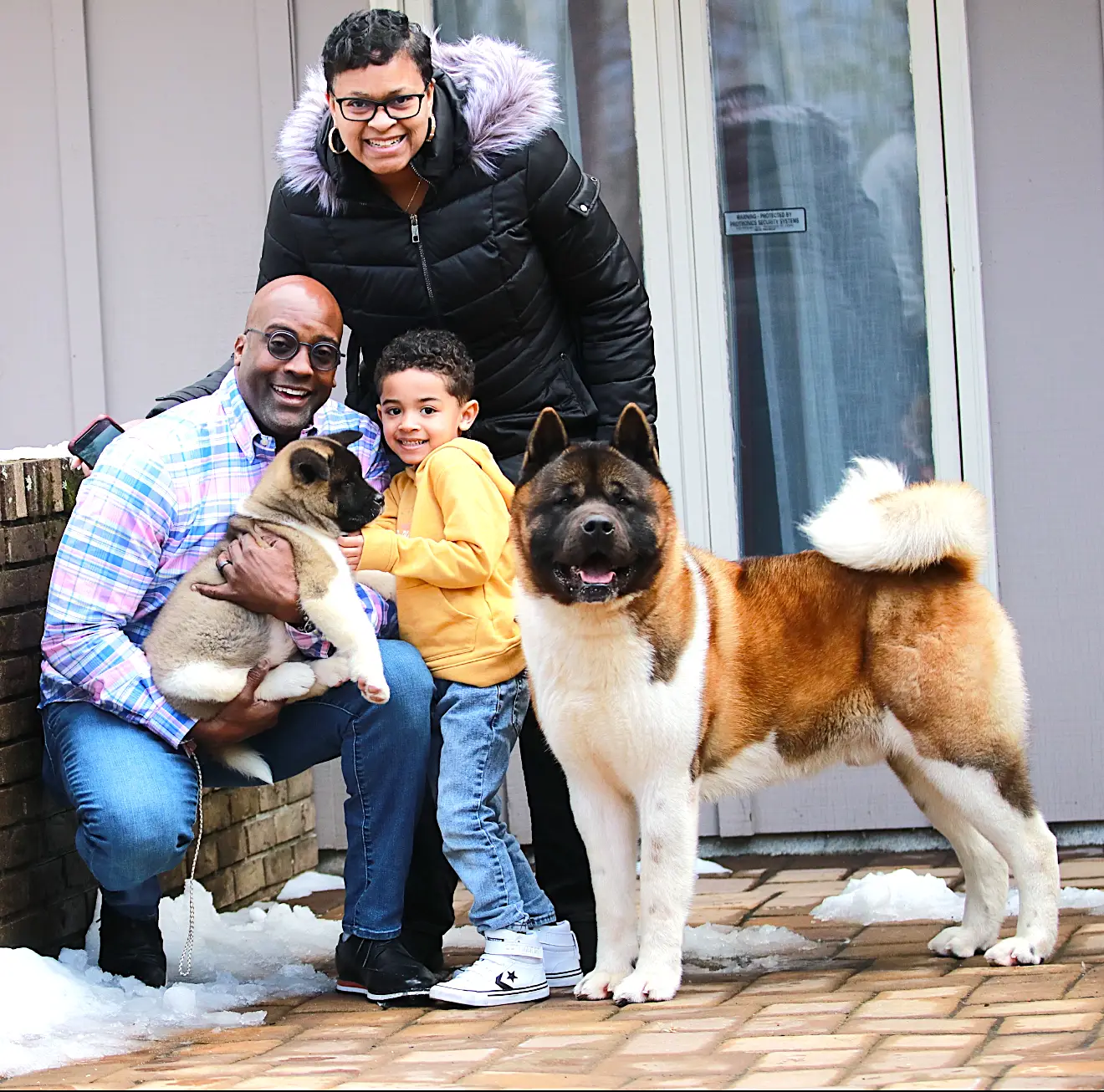
A beautiful family with their new white American Akita from Apexx Akitas champion bloodlines, with children showing the deep affection and bond a well-bred Akita inspires in its family
A new Apexx Akitas family with their white American Akita. The bond is unmistakable, and it starts on day one when the dog comes from champion bloodlines bred for temperament.

Domino, Astra, and Swatt have all shown the same pattern in different family placements. Deep bonding with their immediate family, tolerance with other animals introduced correctly, and the kind of stable nervous system that lets them function in the real world without the anxiety or reactivity people expect from large guardian breeds.

None of this is accidental. These dogs come from generations of selective breeding for exactly the temperament they display. The breeding decisions I make are designed to produce dogs that look like Toro, Arctic, Tice, Bengal, Domino, Astra, and Swatt. The fact that we see this pattern reliably across our placements is the proof that the breeding program is doing what it is supposed to do.

Who Should Not Get an American Akita

I am going to be direct here, because helping you decide against the breed is just as valuable as helping you decide for it. American Akitas are not the right family dog for every household. Specifically:

  • Households without time for training and structure. This breed needs consistent leadership in the first year. If your schedule does not allow daily attention and a clear routine, choose a different breed.
  • Families wanting a social butterfly. If you want a dog who runs up to every stranger at the park wagging its tail, an Akita is not it. They are reserved with strangers by design.
  • Owners who want an off-leash dog around unknown people and animals. This breed has guardian instincts and prey drive. Off-leash work happens in controlled environments only.
  • Chaotic households without clear boundaries. Akitas thrive in calm, structured homes. A constantly chaotic environment will produce a stressed, reactive dog regardless of how well it was bred.
  • First-time large breed owners without willingness to learn. First time is fine. Unwilling to learn is not.

If any of these describe your situation honestly, please look at a different breed. Both you and the dog will be better off, and I would rather you walk away than buy a puppy from me you cannot live with for the next twelve years.

The Bottom Line on American Akitas as Family Dogs

Are American Akitas good family dogs? Yes, when the dog comes from a serious breeding program and the family is genuinely prepared for the breed. They are calm indoors, deeply bonded to the family unit, tolerant of children they grow up with, capable of coexisting with other pets when matched and introduced correctly, and remarkably respectful with elderly or fragile family members.

What separates an excellent family Akita from a difficult one is almost always the breeder behind the dog and the household the dog lives in. Get both of those right, and you will have a family member who will be the calm, loyal, watchful presence at the center of your home for the next decade or more.

That is the answer twenty years of family placements has taught me. And it is the answer every Apexx Akita is bred and raised to fulfill.

Frequently Asked Questions About Akitas as Family Dogs

Are American Akitas good family dogs?

Yes. Well-bred American Akitas are excellent family dogs. They are calm indoors, deeply bonded to their immediate family, gentle with children they grow up with, capable of coexisting with other pets when matched and introduced correctly, and remarkably respectful with elderly household members. The breed is naturally reserved with strangers, which is a guardian trait, not aggression. Success depends on the breeder behind the dog, the household the dog lives in, and how introductions are handled.

Is an American Akita a good house dog?

Yes. American Akitas are one of the calmest large breeds inside the home. They are dignified rather than exuberant, watchful rather than reactive, and generally quiet indoors. A well-bred American Akita in a family home spends most of the day relaxed and observant, activating only when there is a genuine reason to. This indoor calm is a hallmark of the breed and one of the reasons families with children specifically often find the Akita fits their household better than more excitable large breeds.

Are American Akitas good with young children and toddlers?

Well-bred American Akitas are typically gentle and tolerant with the children in their own family, including young children they grow up alongside. However, all interactions between toddlers and any large breed dog should be supervised. American Akitas from a serious breeding program are selected for stable temperament, and the bond between an Apexx Akita and the kids in its home is one of the most consistent patterns we have seen across two decades of placements. Teaching children to interact with the dog respectfully is essential, as with any large breed.

Will an American Akita turn on its owner?

A well-bred American Akita from a serious breeding program with full health clearances and stable temperament will not turn on its owner. The breed is characterized by deep, unshakeable loyalty to its family. Cases where any breed shows aggression toward its owner are almost always the result of poor breeding, lack of socialization, medical issues, or resource guarding that was never properly addressed. Choosing a breeder who tests for temperament stability across multiple generations, provides full OFA health clearances, and offers lifetime breeder support is the single most important step a buyer can take to prevent this concern.

Is the American Akita considered an aggressive dog?

No, a well-bred American Akita is not aggressive. The breed is a discerning guardian, meaning it is naturally reserved with strangers and deeply loyal to family, but reservation is not aggression. Same-sex selectivity toward other dogs is a known breed trait that responsible breeders manage through selective placement. Reactive or aggressive Akitas typically come from breeders who did not test for temperament stability, did not perform health clearances, or did not socialize puppies during the critical development window. Genetics and early development determine adult temperament far more than any training program.

Are American Akitas good with kids?

Yes. Well-bred American Akitas are excellent with the children in their own family. They are watchful, tolerant, and remarkably gentle with kids they live with and grow up around. The key factors are early socialization, sound temperament from health-tested parents, and teaching children how to interact with the dog respectfully. As with any large breed, interactions between young children and any dog should always be supervised.

Do American Akitas get along with other dogs?

American Akitas can live successfully with other dogs when three conditions are met: the other dog has a stable non-reactive temperament, the two dogs are opposite sex when possible (Akitas can show same-sex selectivity), and introductions are handled correctly on neutral territory with slow exposure. The right breeder will help match puppies to multi-dog households based on individual temperament, not just breed generalizations.

Are Akitas good with cats?

American Akitas can live peacefully with cats when raised alongside them from puppyhood. The breed retains prey drive from its hunting history, so early exposure starting at eight weeks is essential. An Apexx Akita raised with a resident cat will almost always treat that cat as family for life. An adult Akita meeting an unfamiliar cat is a different situation that requires honest evaluation of the individual dog.

Are American Akitas good for first-time dog owners?

American Akitas can work for first-time large breed owners who are genuinely committed to learning the breed, providing consistent training, and setting clear boundaries from day one. What matters is not previous dog experience but willingness to learn and follow through. First-time owners who want a social butterfly, an off-leash dog around strangers, or a low-maintenance breed should choose differently. Ongoing breeder support during the first year is essential for a successful first-time placement.

How much space does an American Akita need?

American Akitas do best with access to a securely fenced yard and a home with enough space for a large, dignified breed to move comfortably. However, indoor calm is a hallmark of the breed. Well-bred Akitas are surprisingly settled inside the house. What matters more than square footage is daily physical exercise, mental engagement, and structured time with the family. Apartment living is not ideal for the breed but is possible with committed exercise routines and consistent enrichment.

Are American Akitas protective of their family?

Yes. The American Akita is a natural guardian breed with deep loyalty to its family. They are watchful, discerning, and naturally reserved with strangers, which makes them one of the most reliable family protection dogs when properly bred and socialized. This protective instinct is instinctive rather than trained, but it must be channeled through consistent socialization and clear leadership to produce a stable adult dog. A well-bred Akita distinguishes between a genuine threat and a normal visitor without needing to be taught the difference.

What is the temperament of a well-bred American Akita in a family home?

A well-bred American Akita in a family home is calm indoors, deeply affectionate with immediate family, gentle with children and elderly household members, tolerant of other pets when introduced correctly, and reserved with strangers. They are dignified rather than exuberant, watchful rather than reactive, and loyal without being clingy. Temperament comes from generations of selective breeding, structured early development, and consistent leadership in the new home.

If you are still researching the breed for your family, read Are American Akitas Good With Children?, Are Akitas Aggressive?, and Is an American Akita Right for You? next.

When you are ready to talk seriously about a puppy from a breeder who selects for temperament first, our Available Dogs page is the place to start.