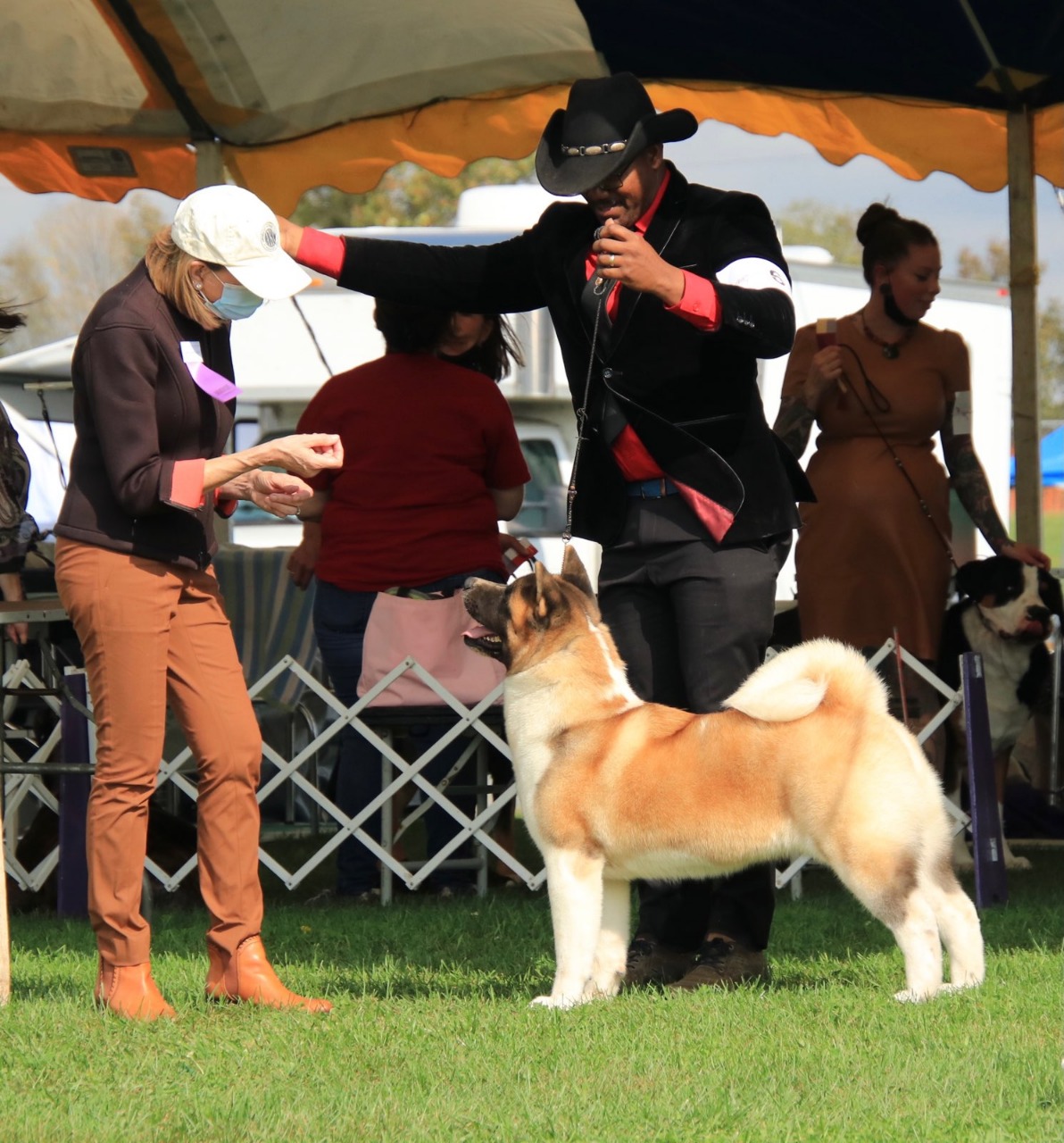
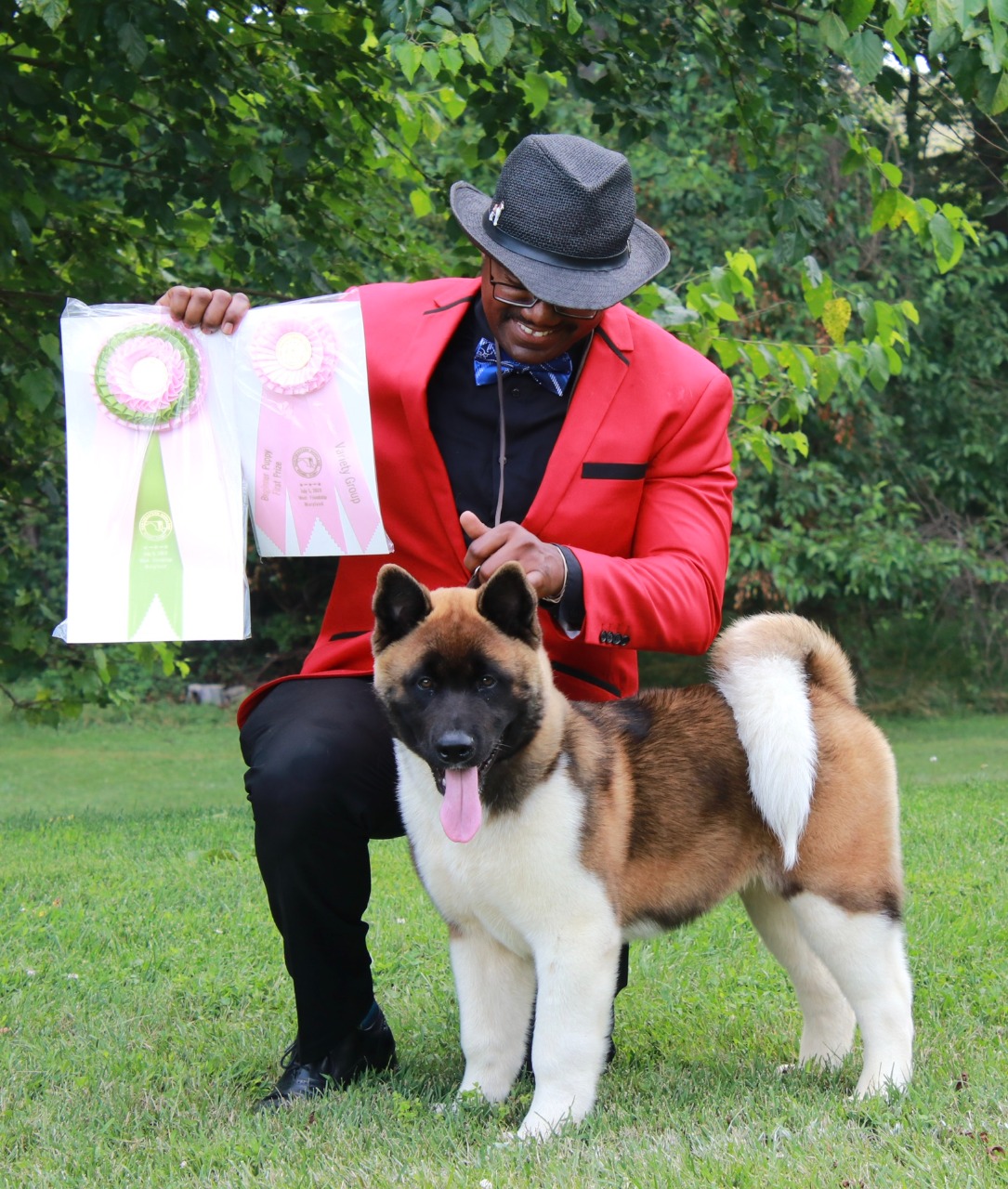
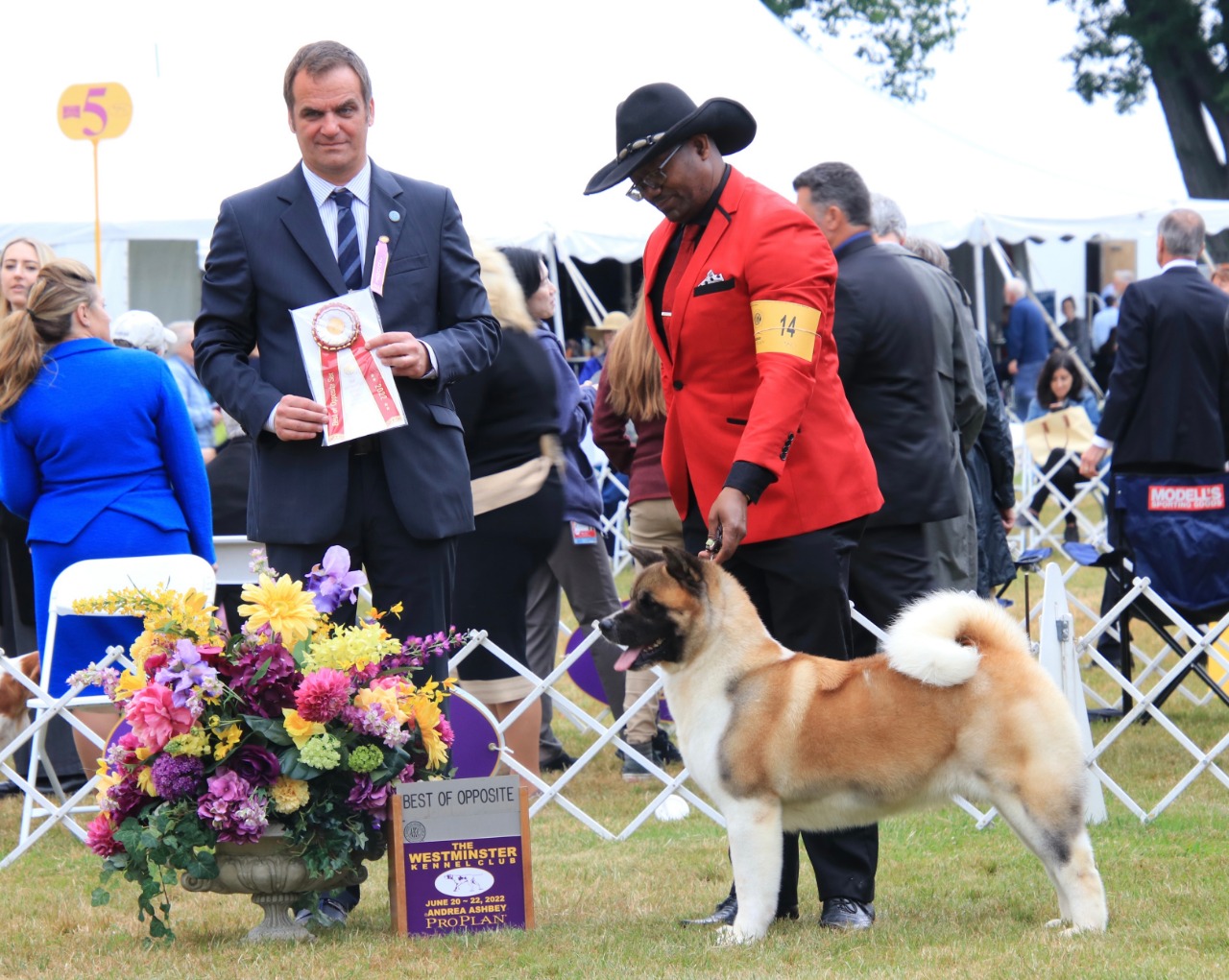
Early Neurological Stimulation for American Akita Puppies: What We Do Before 8 Weeks
Early Neurological Stimulation (ENS) is a set of five brief handling exercises performed once a day on puppies between day 3 and day 16 of life: tactile stimulation between the toes, holding the puppy head up, head down, and on its back, and a few seconds on a cool, damp towel. At Apexx Akitas, every American Akita puppy has received ENS since 2007, alongside Early Scent Introduction (ESI), as the first stage of how we raise every litter.
Ron Durant Founder and head breeder, Apexx Akitas. Breeding AKC registered American Akitas since 2003, with 10 AKC Champions produced.
2007ENS in our program since
Day 3 to 16The developmental window
5Exercises, once a day
3 to 5 secPer exercise
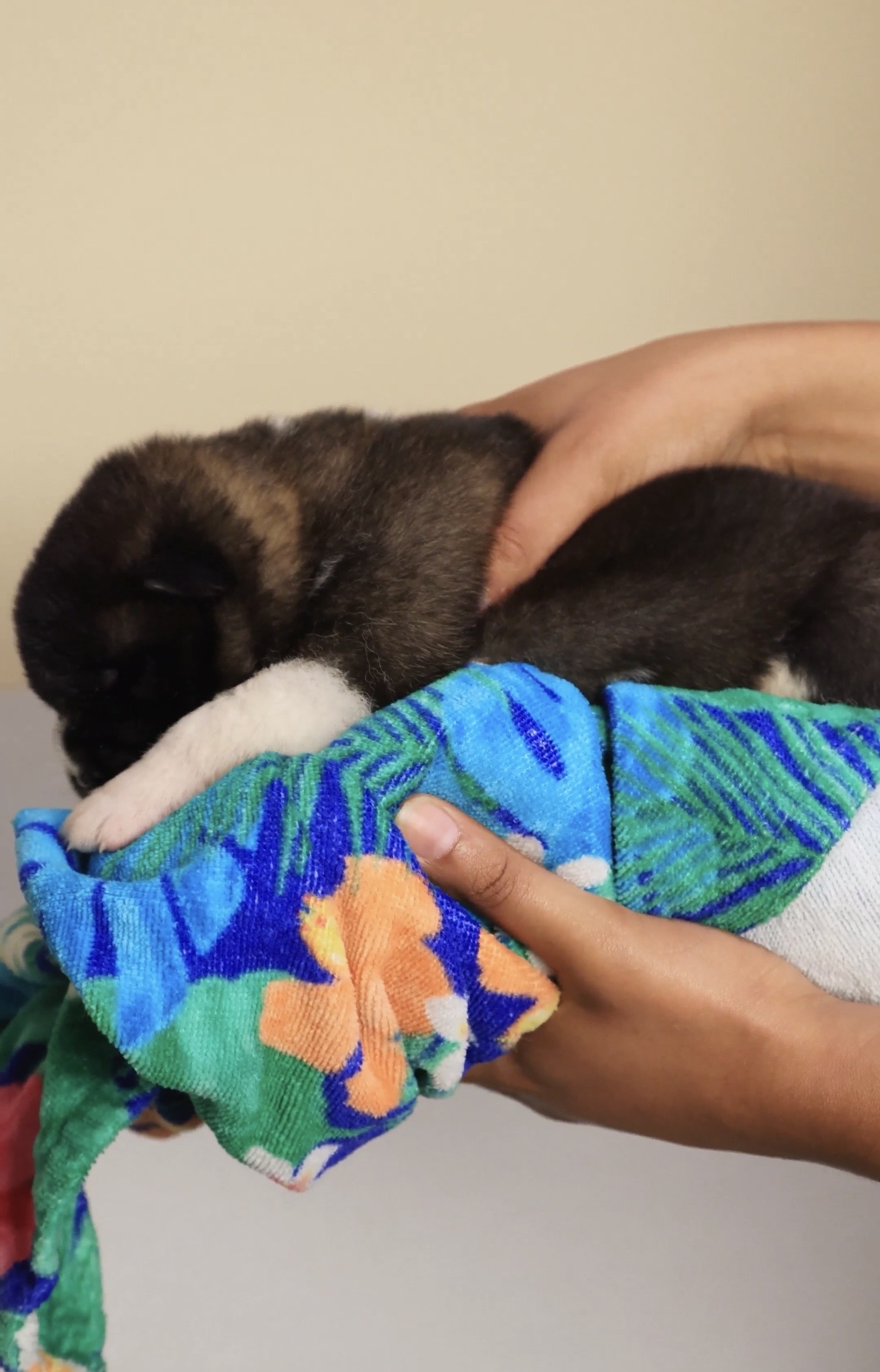
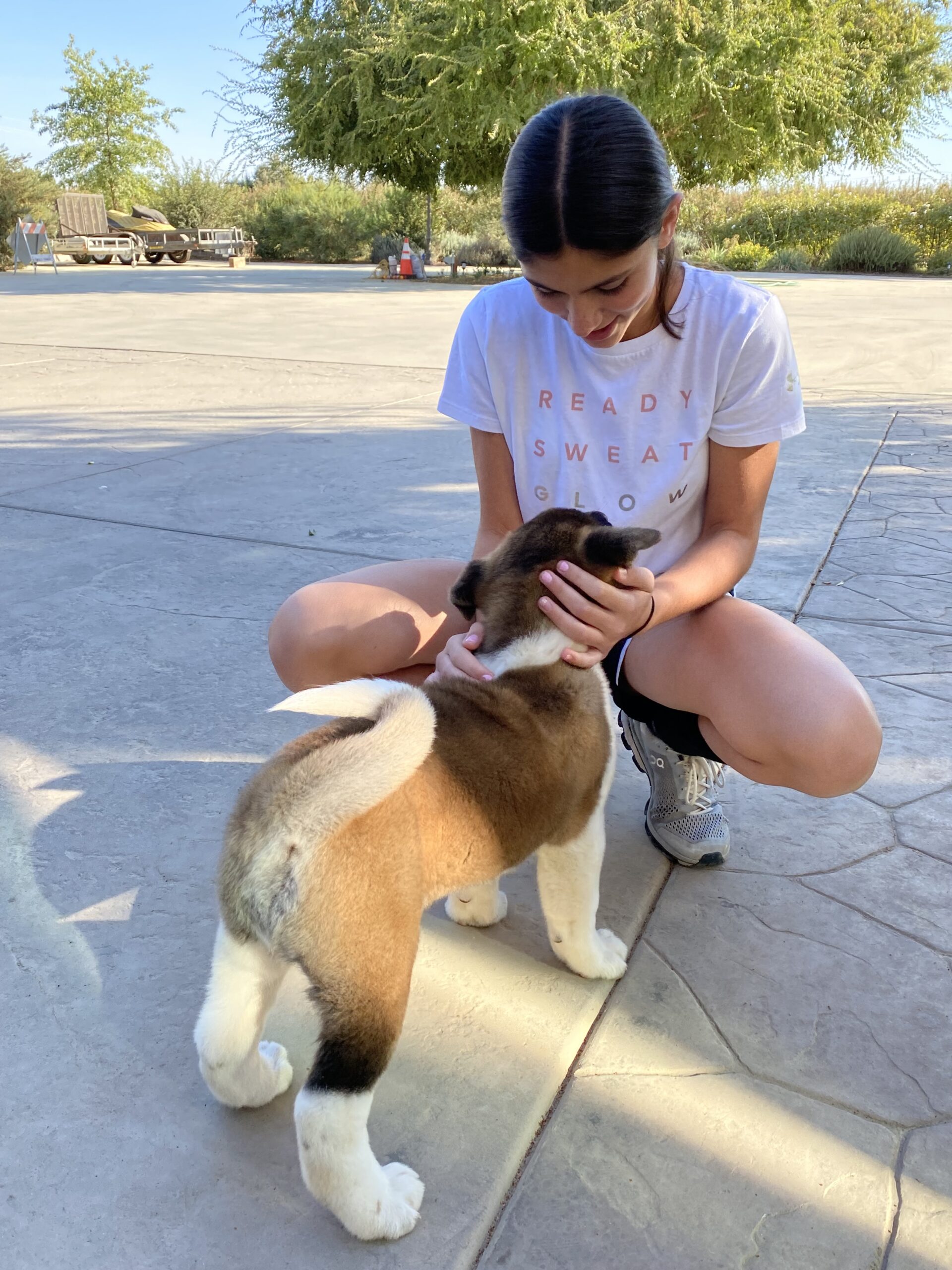
A puppy in the first days of life, the start of the ENS window.
What is Early Neurological Stimulation?
Early Neurological Stimulation is a short daily routine of gentle, mild stressors applied to very young puppies. The method traces back to the United States military's "Bio Sensor" program, which studied how early stimulation affected the development of working dogs, and it was brought to dog breeders largely through the writing of Dr. Carmen Battaglia.
The routine is built around a specific window. Between day 3 and day 16, a puppy's eyes and ears are still closed and its nervous system is developing rapidly. ENS introduces small, controlled sensations during that period, each lasting only seconds, so the puppy experiences a mild stress and recovers from it.
1 to 2
ENS and ESI
Sounds, surfaces, handling, car rides, visitors
Day 1Day 3 to 16Day 56, about 8 weeks
How we do ENS at Apexx Akitas
My daughter Sarah-Cassidy and I do the exercises together every evening at 7:30. Every puppy in the litter goes through the full routine, one puppy at a time, once a day from day 3 through day 16. One of us handles the puppy while the other keeps the routine moving, so no puppy is away from its mother and littermates for more than a minute or two.
Exercise
What it involves
Time
Tactile stimulation
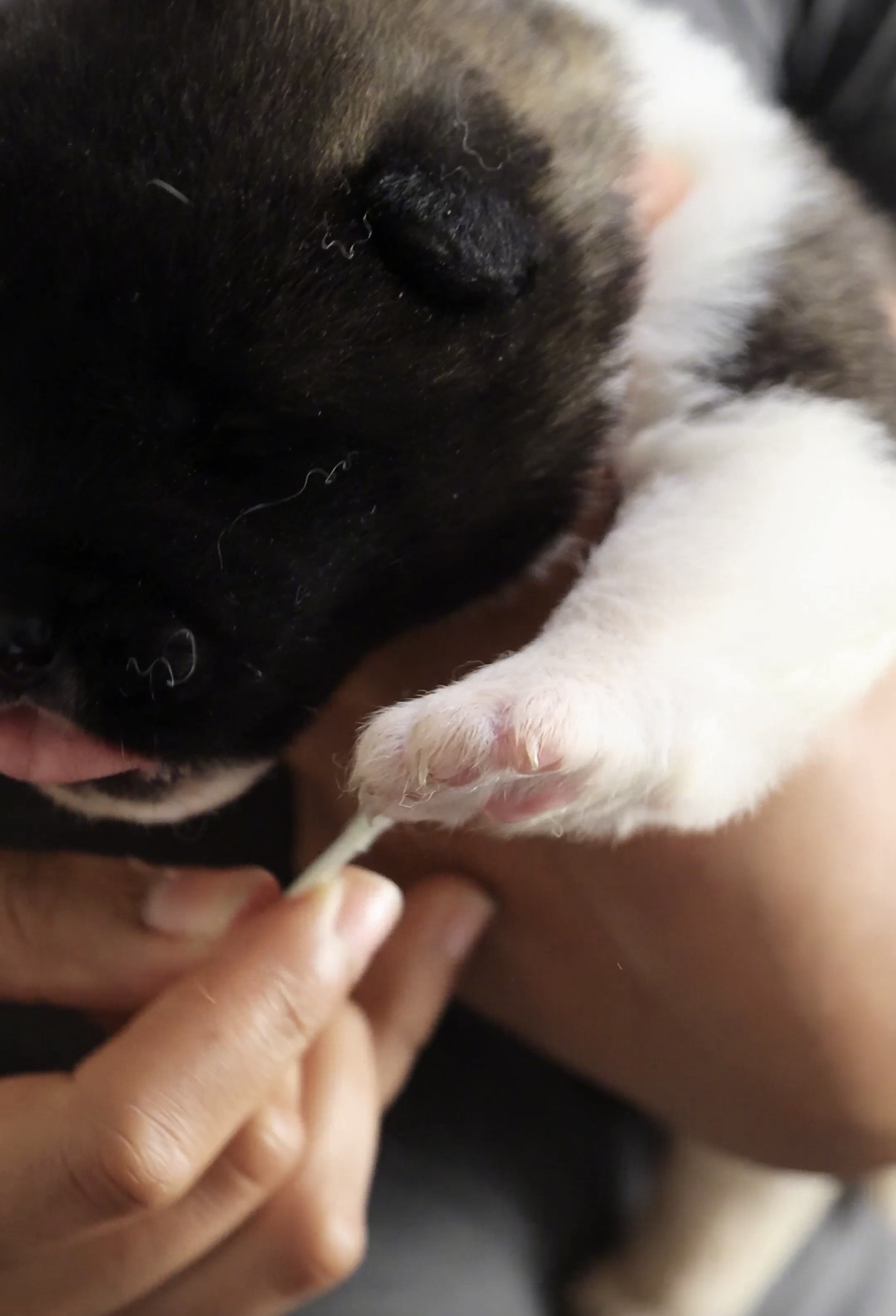
Gently tickling between the toes of one paw with a cotton swab.
3 to 5 seconds
Head held up
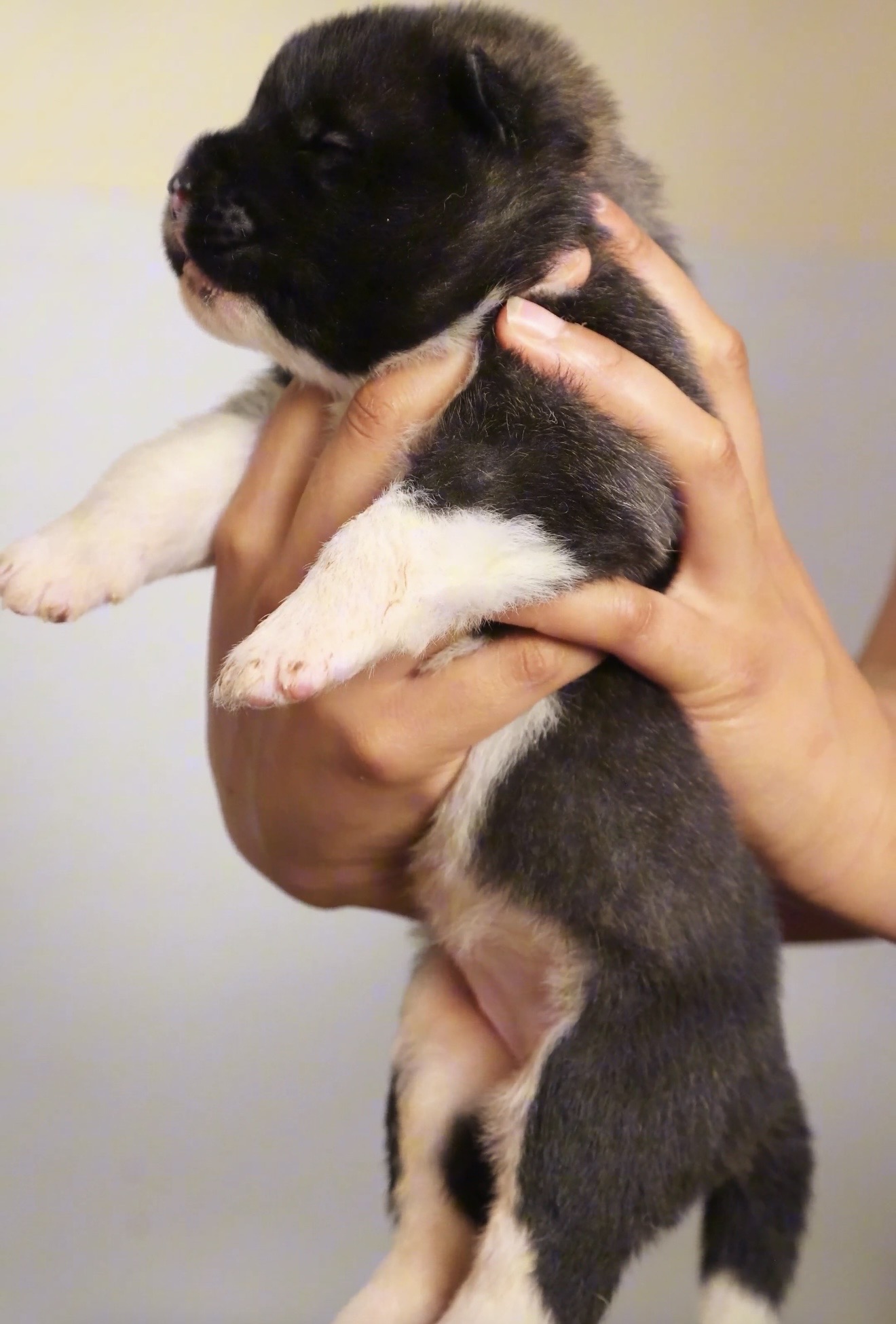
Holding the puppy securely with both hands, upright, with its head directly above its tail.
3 to 5 seconds
Head held down
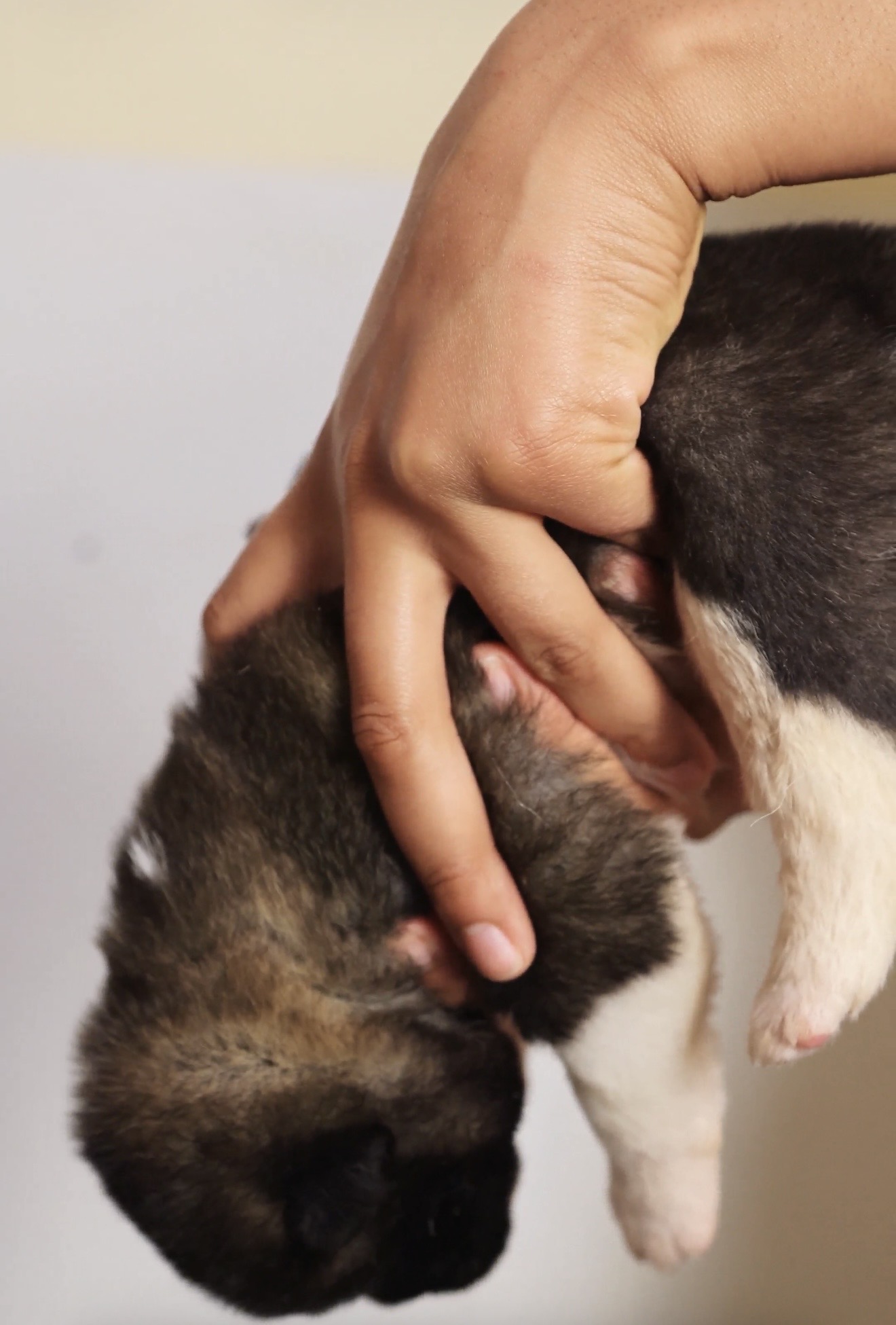
Holding the puppy securely with both hands, head pointed toward the ground.
3 to 5 seconds
On its back
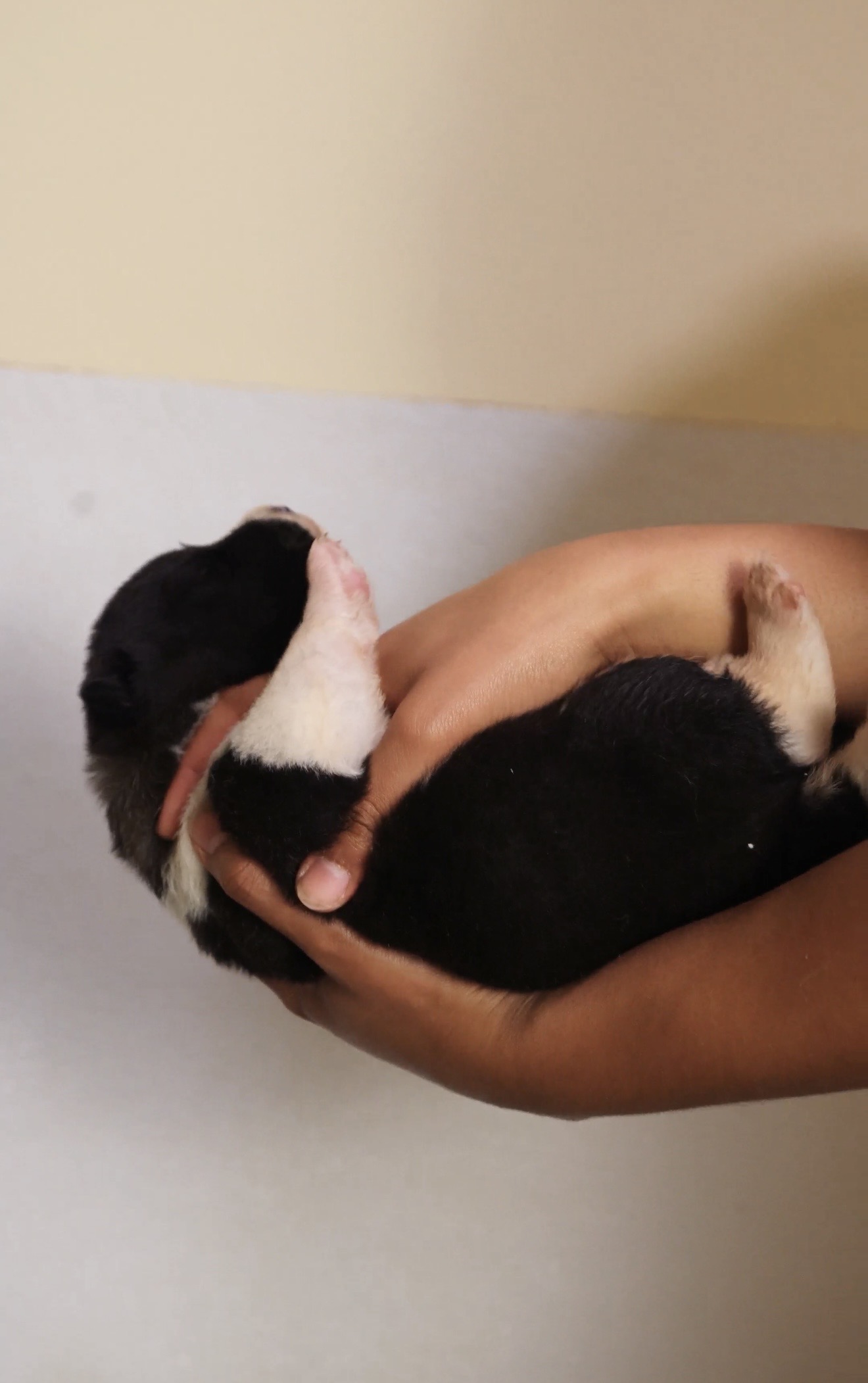
Cradling the puppy on its back in both palms, muzzle facing up.
3 to 5 seconds
Thermal stimulation
Setting the puppy feet down on a cool, damp towel, without restraining it.
3 to 5 seconds
TactileHead upHead downOn its backThermal
More is not better. ENS is meant to be brief. Each exercise lasts a few seconds, the routine happens once a day, and it stops at day 16. Longer or more frequent stimulation can overwhelm a newborn puppy, which is why the protocol is so specific. Every puppy is handled with both hands, close to the body, and returned to its mother right after.
What is Early Scent Introduction?
Early Scent Introduction (ESI) is a companion exercise done during the same window. A puppy is offered a single scent held near its nose, and we simply observe the response. At Apexx, we rotate scents such as pine, leather, herbs, and deer.
Puppies respond in different ways. One may move toward the scent, another may pull away, and another may barely react. There is no right or wrong response. ESI gives each puppy a new kind of sensory experience at an age when its sense of smell is already working, and it gives us one more look at each puppy as an individual.
Early Scent Introduction. The only job is to let the puppy investigate.
What we have seen since 2007
I want to be straightforward here. ENS is one part of a larger program, and I can't separate its effect from everything else we do, from genetics and health testing to the socialization that follows. What I can tell you is what we have seen across our litters since we made ENS part of every puppy's routine.
We have seen a marked difference. Puppies that are confident and train smoothly, easy vet visits and examinations, puppies that cooperate when their nails are ground, and dogs that seem to have a stronger bond with their families and a real sense of awareness.
For an American Akita, that matters. This is a large, powerful guardian breed. A dog that accepts handling calmly, from a vet exam to a nail grind, is a safer and easier dog to live with for its whole life. If you want to understand what an Akita's temperament is really like, read The Truth About American Akita Temperament.
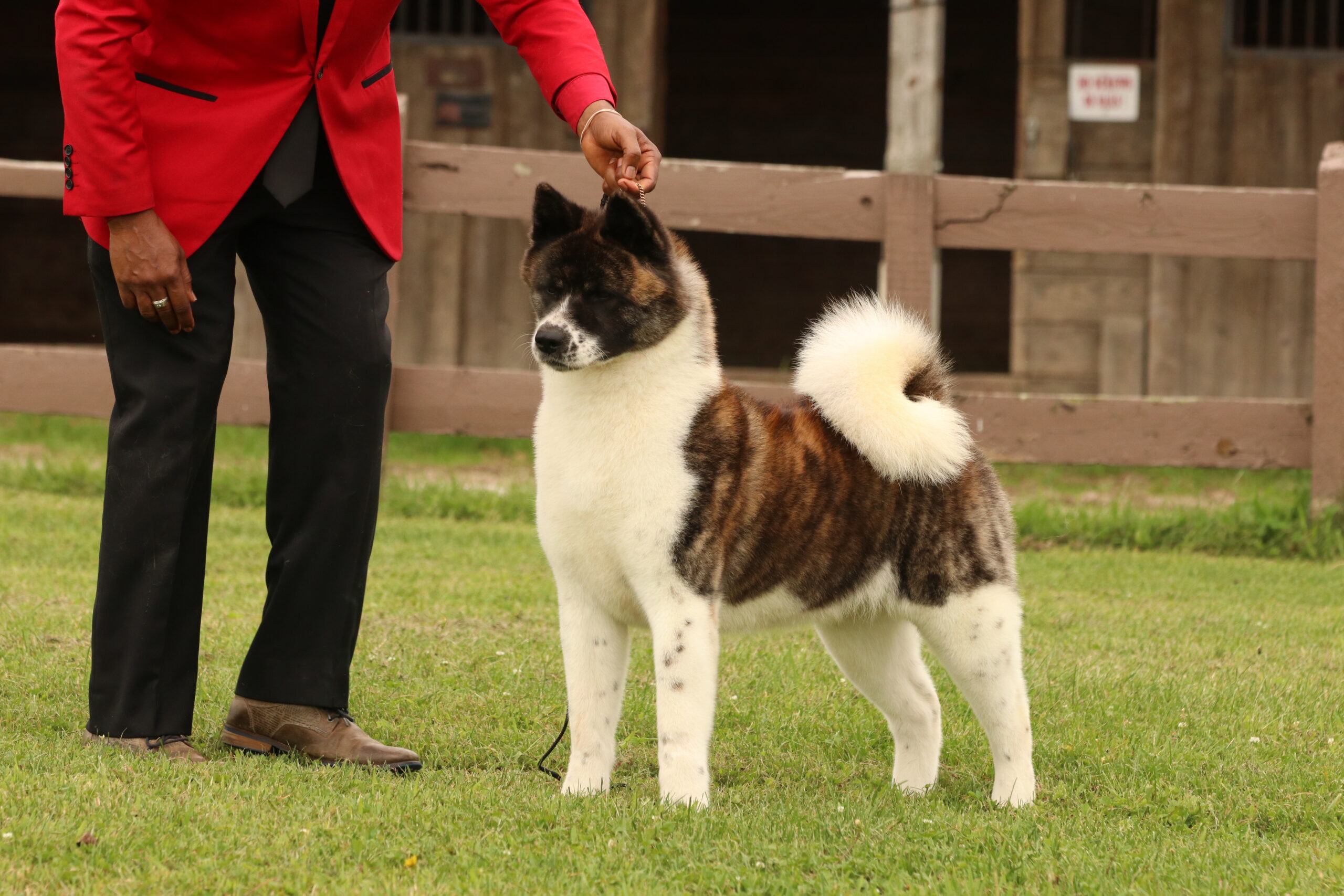
Champion Bengal. Where it leads: a calm, confident adult Akita.
What the research shows
ENS is widely recommended in the breeding world, and some of what is said about it online goes further than the evidence. Here is an honest summary.
Dr. Battaglia's writing describes the Bio Sensor program's view that there are specific periods early in life when stimulation has its greatest effect, and that early stimulation can have positive results but must be used with caution.
A 2008 study by Gazzano and colleagues compared handled and unhandled puppies raised in family homes and in a breeding kennel. At 8 weeks, the handled puppies were calmer in both environments, and the authors concluded that deliberate gentle handling in early puppyhood benefits emotional development and welfare.
A 2022 study from Purdue University's Croney Research Group followed 76 small breed puppies in a commercial kennel. Puppies that received ENS did not respond to stress tests differently from puppies that were simply held for the same 30 seconds a day. The researchers' practical takeaway was that daily gentle early handling is beneficial and recommended, whether or not a specific protocol is used.
Our reading of the research: gentle, consistent, early human handling clearly matters. Whether the specific ENS exercises add something beyond that is still being studied. That is why we do both. Every puppy gets ENS and ESI, and every puppy also gets a great deal of calm, daily handling from the people raising it.
What comes after day 16
ENS ends at day 16, but development does not. Once the window closes, our puppies move into a broader socialization program: household sounds, different surfaces underfoot, regular handling of paws, ears, and mouths, car rides, and visitors coming into the home. By the time an Apexx puppy goes home at around 8 weeks, it has already met a wide range of people, places, and experiences.
That foundation is also why we put so much weight on what happens before a puppy is born. Every breeding dog in our program is fully OFA health tested, and every pairing is chosen for structure and temperament.
An Apexx litter in the whelping box.
Frequently asked questions
What is Early Neurological Stimulation for puppies?
Early Neurological Stimulation (ENS) is a set of five brief handling exercises done once a day on puppies from day 3 to day 16 of life: tactile stimulation between the toes, head held up, head held down, lying on its back, and thermal stimulation on a cool, damp towel. Each exercise lasts 3 to 5 seconds.
At what age is ENS done?
ENS is done between day 3 and day 16 of a puppy's life. This early window is when the protocol is designed to have its effect, so it is performed by the breeder before puppies are old enough to go home.
Is ENS safe for puppies?
When done correctly, ENS is gentle and very brief: a few seconds per exercise, once a day, with the puppy held securely in both hands. Doing more is not better. Longer or more frequent stimulation can overwhelm a newborn puppy, so the protocol should be followed exactly.
Does ENS make puppies smarter or healthier?
Some claims about ENS go beyond the evidence. Research supports the value of gentle early handling for puppies' emotional development, but a 2022 Purdue University study found ENS puppies responded to stress no differently than puppies that were simply held each day. At Apexx Akitas, we present ENS as one part of our early development program, not a guarantee of specific outcomes.
What is Early Scent Introduction?
Early Scent Introduction (ESI) is a companion exercise done during the same day 3 to day 16 window. A puppy is offered one scent near its nose, such as pine, leather, herbs, or deer, and the breeder observes its response. There is no right or wrong reaction.
Do all Apexx Akitas puppies receive ENS and ESI?
Yes. Every puppy in every Apexx Akitas litter goes through ENS and ESI each evening from day 3 to day 16. Ron Durant has included ENS in the program since 2007.
Should I do ENS with my puppy after I bring it home?
No. The ENS window closes at day 16, weeks before a puppy is ready to go home at around 8 weeks. Once your puppy is home, focus on calm daily handling, positive socialization, and early training.
What happens after day 16?
After day 16, Apexx Akitas puppies move into a broader socialization program that includes household sounds, different surfaces, regular handling of paws, ears, and mouths, car rides, and visitors, continuing until they go home at around 8 weeks.
The Bottom Line
Early Neurological Stimulation is five brief exercises, a few seconds each, done once a day from day 3 to day 16. At Apexx Akitas, every puppy has received ENS since 2007, along with Early Scent Introduction, followed by a full socialization program until it goes home. The research clearly supports gentle early handling, and across our litters we have seen confident, trainable puppies that accept handling and bond strongly with their families. ENS is not a guarantee on its own. It is one part of a foundation built on genetics, health testing, and the work we put into every puppy from its first days.
American Akita vs German Shepherd: A Breeder's Honest Comparison
By Ron Durant · Apexx Akitas · 20+ Years Experience · Sussex, New Jersey
20+Years Breeding American Akitas
150+Nationwide Placements
10AKC Champions Produced
100%OFA Health Tested
The American Akita and the German Shepherd are both large, powerful, intelligent breeds with strong guardian instincts. That is where the similarities end. These two breeds think differently, bond differently, move through a household differently, and require completely different types of owners. This guide compares them honestly across every category that matters to a family making a decision, written from over 20 years of breeding American Akitas and placing them with families, including many who came to us specifically because they had owned a German Shepherd first and wanted something different.
The Short Answer: Who Each Breed Is For
The German Shepherd is for the owner who wants a working partner. A dog that thrives on tasks, obedience training, structured activities, and constant engagement. The GSD wants to be told what to do. It wants a job. Without one, it gets anxious, destructive, and vocal.
The American Akita is for the owner who wants a calm, independent guardian. A dog that watches, assesses, and acts on its own judgment. The Akita does not need a job to be happy. It needs a family to protect, a stable routine, and an owner who respects its intelligence without trying to micromanage it.
If you want a dog that follows you from room to room and hangs on your every word, get the German Shepherd. If you want a dog that sits quietly in the corner of the room, watches everything that moves, and only gets up when something actually requires its attention, get the Akita.
Size and Build: The Physical Differences
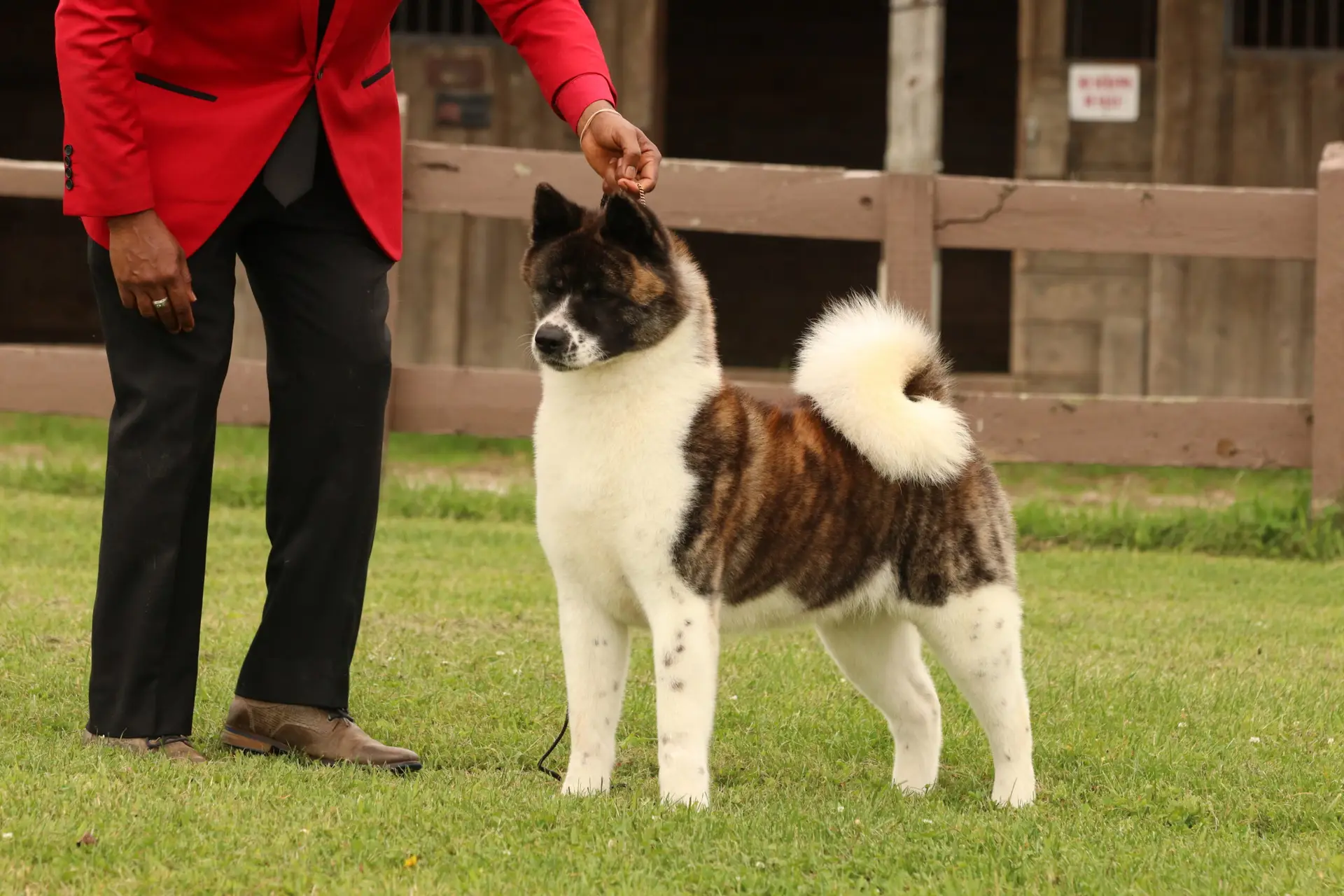
American Akita male showing breed standard size next to handler
The American Akita is a substantially larger dog than the German Shepherd. Males stand 26 to 28 inches tall and weigh 100 to 130 pounds. Females stand 24 to 26 inches and weigh 70 to 100 pounds. The build is broad, heavy boned, and powerful with a large bear like head and thick double coat. You can read the full size breakdown in our guide: How Big Do American Akitas Get.
The German Shepherd is narrower and lighter. Males stand 24 to 26 inches and weigh 65 to 90 pounds. Females stand 22 to 24 inches and weigh 50 to 70 pounds. The build is athletic and angular, designed for speed and agility in working roles.
This size difference matters in practical terms. The Akita takes up more space, eats more food, and requires a stronger handler on leash. But the Akita's lower energy indoors means it often feels like less dog in the house despite being physically bigger. The German Shepherd's constant motion and engagement seeking can make it feel larger in a home than its actual weight suggests.
Temperament: This Is Where Everything Changes
Quiet, independent indoor temperament is the Akita's defining trait
The German Shepherd is a herding breed at its core. It was developed to work all day alongside a handler, responding to commands, anticipating direction, and staying in constant communication with its person. That heritage shows up in every aspect of daily life. The GSD follows you around the house. It watches you for cues. It vocalizes frequently. It wants engagement, and when it does not get it, it tells you.
The American Akita is a guardian breed. It was developed to work independently, making its own decisions about threats and responses without waiting for human direction. That heritage shows up just as clearly. The Akita chooses a vantage point in the house and settles there. It watches doors and windows rather than watching you. It rarely barks without reason. It does not need you to entertain it or direct it every moment of the day.
This difference is not about one breed being smarter than the other. Both are highly intelligent. The difference is in what they do with that intelligence. The German Shepherd uses its intelligence to please you. The American Akita uses its intelligence to protect you. One takes direction. The other makes decisions.
American Akita showing gentle, steady guardianship with a child
Both breeds can be excellent family dogs. Both can be terrible family dogs. The outcome depends entirely on breeding, socialization, and the match between dog and household.
The German Shepherd tends to be active and mouthy with children, especially as a puppy. It herds. It nips. It plays at high energy levels. It means well, but the herding instinct can overwhelm small children who do not understand why the dog keeps circling them and pushing them with its nose. With training and maturity, most GSDs settle into reliable family companions.
The American Akita, when well bred, is different with children. It tends to be still. It positions itself near the children rather than engaging them in high energy play. It watches. Multiple families who have come to us after owning German Shepherds describe the Akita as a "calmer presence" around their kids. Not less protective. Not less bonded. Just quieter about it. The Akita guards without the herding behavior, the nipping, or the constant motion.
This is one of the most important distinctions for families with young children. The GSD expresses its bond through activity and engagement. The Akita expresses its bond through proximity and watchfulness. Both are genuine. They just look completely different in a home with a toddler.
Independence vs Clinginess: The Biggest Lifestyle Difference
This is the comparison point that every former GSD owner brings up first. The German Shepherd is, by nature, a velcro dog. It wants to be in physical contact with you. It follows you to the bathroom. It lies on your feet. It watches the door when you leave and loses its composure when you come back. For some owners this is endearing. For others it becomes exhausting.
The American Akita is independent. It loves its family deeply but it does not need to be physically attached to you at all times. It will be in the same room as you, but it will be on its own terms, in its own spot, watching its own things. It greets you when you come home but it does not fall apart when you leave. It is loyal without being needy.
"Several families who switched from German Shepherds to American Akitas have told me the same thing. The Akita is a quieter dog, more independent, far less clingy, but at the same time extremely loyal and protective of the family, especially the young children."
Ron Durant, Apexx Akitas
This is not a better or worse distinction. It is a lifestyle match question. If you work from home and want a dog glued to your side all day, the GSD fits that desire. If you want a dog that keeps you company without demanding your attention, the Akita is the better fit.
Guarding and Protection: Two Completely Different Approaches
Natural guardian instinct requires no specialized training
The German Shepherd is the world's most popular police and military dog for a reason. It excels at trained protection work. It can be taught to bite on command, release on command, track suspects, and perform complex scenarios under pressure. That trainability is the GSD's greatest asset in professional settings.
The American Akita does not work that way. Its protective instinct is not trained. It is innate. The Akita assesses situations on its own, determines whether its family is at risk, and responds accordingly. You do not teach an Akita to protect your home. You do not need to. The breed was developed for exactly this purpose over centuries, and the instinct is hardwired.
For a family that wants a natural deterrent and a dog that will instinctively position itself between a stranger and a child, the Akita provides that without any specialized training. For someone who wants a dog that can be trained to perform specific protection commands on cue, the German Shepherd is the clear choice.
Energy and Exercise Requirements
The German Shepherd is a high energy dog that needs 60 to 90 minutes of vigorous exercise daily, plus mental stimulation through training, puzzle toys, or structured activities. Without it, the GSD becomes restless, vocal, and destructive. This is a dog that needs a committed, active owner who is willing to provide that level of engagement every single day, rain or shine, for 10 to 13 years.
The American Akita has moderate exercise needs. A 30 to 45 minute walk once or twice daily, combined with yard time, is typically sufficient for an adult Akita. The Akita is not a marathon dog. It does not need fetch sessions, agility courses, or constant physical challenges. It is content with a structured routine and access to outdoor space. This makes the Akita a realistic choice for owners who value a calm household but do not have the time or desire for intensive daily exercise commitments.
One thing to be honest about: the Akita's lower exercise needs do not mean it is a lazy dog. It is alert and active when something requires its attention. It simply does not manufacture energy for the sake of it the way a GSD does.
Coat and Grooming
The Akita's thick double coat is denser and heavier than the GSD's
Both breeds have double coats and both breeds shed. A lot. But the shedding profiles are different.
The German Shepherd sheds consistently year round with two heavier seasonal blows. The hair is medium length, tends to stick to furniture and clothing, and seems to find its way into everything. Daily brushing helps but does not eliminate the issue.
The American Akita also sheds year round with two seasonal blows, but the undercoat is denser and the hair comes out in larger clumps during blow coat rather than a constant scatter. Many Akita owners find the shedding easier to manage because the hair tends to tumble into collectible clumps rather than embedding itself in fabric. The Akita's coat is also naturally odor resistant, which means less bathing is required compared to the GSD.
The German Shepherd is one of the most trainable breeds in the world. It learns quickly, retains commands reliably, and is eager to repeat behaviors that earn approval. If you have ever trained a GSD, you know the feeling of a dog that is almost trying too hard to get it right.
The American Akita is intelligent but it is not eager to please in the same way. The Akita understands what you are asking. It simply decides whether the request is worth complying with. This is not stubbornness. It is independence. Training an Akita requires patience, consistency, and an understanding that this is a thinking dog that will not blindly repeat a command 50 times because you asked it to.
First time dog owners often do better with a German Shepherd because the training feedback loop is more immediate and rewarding. Experienced owners who have already trained other breeds often prefer the Akita because the relationship feels more like a partnership than a command structure.
The German Shepherd has significant breed wide health challenges. Hip and elbow dysplasia rates are among the highest of any breed. Degenerative myelopathy, a progressive spinal condition, is common. Bloat, pancreatic insufficiency, and allergies are also prevalent. The average lifespan is 9 to 13 years, but many GSDs from poorly tested lines develop mobility issues by age 7 or 8.
The American Akita faces its own health challenges including hip dysplasia, autoimmune disorders, and bloat. However, in a program that performs full OFA testing on every breeding dog (hips, elbows, eyes, thyroid, cardiac), the incidence of these conditions drops significantly. At Apexx Akitas, Sheba from our bloodline lived 15 years and 8 months. Average lifespan for the breed is 10 to 13 years.
The key takeaway is that health in both breeds is determined by the breeder's testing practices, not by the breed itself. A health tested Akita from a responsible program will likely outlive an untested GSD from a puppy mill, and vice versa. Always verify OFA results regardless of which breed you choose.
Over 20 years I have placed American Akitas with dozens of families who previously owned German Shepherds. The pattern in their feedback is consistent enough to report here.
The most common observation is that the Akita is a quieter dog in the home. Not quieter as in timid or withdrawn, but quieter as in calm, settled, and not constantly seeking stimulation. GSD owners are often surprised by how little noise an Akita makes. The barking is minimal. The whining is nearly nonexistent. The pacing and restlessness that they had normalized with their GSD simply is not there.
The second most common observation is about the independence. Former GSD owners consistently describe the Akita as "less clingy" while being "equally or more protective." They note that the Akita gives them space without giving up its watchfulness. It does not follow them from room to room, but it always knows where they are and where the children are.
The third observation is about the Akita's behavior with young children specifically. Multiple families have told me that their Akita is gentler and more patient with toddlers than their GSD was. Not because the GSD was aggressive, but because the GSD's herding energy and mouthiness created friction with small children that the Akita's calm, stationary guardianship does not.
Multi Dog Households
Successful multi dog households require proper matching and introduction
German Shepherds are generally more tolerant of other dogs and can integrate into multi dog households with less friction. Their pack oriented herding instinct makes them relatively flexible around other breeds and sizes.
American Akitas are more selective. Same sex aggression is a real consideration in the breed, and not every Akita will coexist peacefully with every other dog. Successful multi dog Akita households require careful matching, proper introductions, and an owner who understands the breed's social dynamics.
This is an area where the German Shepherd has a genuine advantage for families who already have dogs or plan to add more. If a multi dog household is a priority, that factor should weigh into your breed decision. For guidance on how Akitas handle multi dog homes: Are Akitas Good Family Dogs.
Which Breed Is Right for You
Choose the American Akita if you want a quiet, independent, naturally protective companion that does not need constant direction or stimulation. If you value a calm household, if you appreciate a dog that thinks for itself, and if you want a guardian that provides security through presence rather than performance, the Akita is your dog.
Choose the German Shepherd if you want an active working partner that thrives on training, obedience, and structured engagement. If you enjoy daily training sessions, if you want a dog that responds instantly to commands, and if you prefer a breed that is openly affectionate and constantly engaged with you, the GSD is your dog.
Neither breed is better. They are different dogs built for different lives. The right choice depends entirely on the life you actually live, not the one you imagine.
American Akita vs German Shepherd: Quick Reference
Category
American Akita
German Shepherd
Height (Males)
26 to 28 inches
24 to 26 inches
Weight (Males)
100 to 130 pounds
65 to 90 pounds
Temperament
Independent, calm, reserved
Eager to please, active, vocal
Energy Level
Moderate
High
Exercise Needs
30 to 45 minutes daily
60 to 90 minutes daily
Barking
Minimal
Frequent
Trainability
Intelligent but independent
Highly trainable, eager
Guarding Style
Innate, instinctual
Trainable, command based
With Children
Calm, watchful guardian
Active, playful, may herd
Independence
High
Low (velcro dog)
Multi Dog Homes
Selective, requires matching
Generally adaptable
Lifespan
10 to 13 years
9 to 13 years
Shedding
Heavy (seasonal clumps)
Heavy (constant scatter)
AKC Colors Accepted
All colors
Limited palette
American Akita vs German Shepherd FAQ
Is an American Akita bigger than a German Shepherd?
Yes. American Akita males weigh 100 to 130 pounds and stand 26 to 28 inches tall. German Shepherd males weigh 65 to 90 pounds and stand 24 to 26 inches. The Akita is a broader, heavier, more powerfully built dog.
Are American Akitas calmer than German Shepherds?
Yes. American Akitas are significantly calmer indoors than German Shepherds. The Akita is a quiet, independent breed that does not require constant stimulation or engagement. German Shepherds are high energy dogs that need structured activities and attention throughout the day.
Which is a better family dog, an Akita or a German Shepherd?
Both can be excellent family dogs when well bred and properly socialized. Families who prefer a calm, quiet guardian that watches over children without high energy herding behavior tend to prefer the Akita. Families who want an active, engaged companion that participates in play and training activities tend to prefer the German Shepherd.
Are American Akitas good guard dogs compared to German Shepherds?
Both breeds are excellent guardians but in different ways. The German Shepherd excels at trained protection work with commands and structured responses. The American Akita is a natural guardian whose protective instincts are innate and do not require specialized training. For families wanting a natural home deterrent, the Akita's instinctual approach requires no professional training to be effective.
Do American Akitas bark less than German Shepherds?
Yes. American Akitas are known for being a quiet breed that rarely barks without reason. German Shepherds are more vocal and bark more frequently in response to sounds, visitors, excitement, and boredom. For owners who value a quiet household, the Akita's minimal barking is a significant advantage.
Are Akitas harder to train than German Shepherds?
Akitas are not harder to train, but they require a different approach. German Shepherds are eager to please and respond well to repetitive command based training. Akitas are independent thinkers that understand commands but decide whether to comply based on their own assessment. Training an Akita requires patience, consistency, and mutual respect rather than repetition and treats.
Which breed needs more exercise, the Akita or the German Shepherd?
The German Shepherd needs significantly more exercise. GSDs require 60 to 90 minutes of vigorous daily exercise plus mental stimulation. American Akitas are content with 30 to 45 minutes of daily walking plus yard access. The Akita's moderate exercise needs make it a more realistic choice for owners who cannot commit to intensive daily exercise.
Can an American Akita live with a German Shepherd?
It is possible but requires careful management. American Akitas can be selective about other dogs, particularly same sex pairs. An opposite sex pairing with proper introductions and supervision has a higher chance of success. Both breeds should be well socialized and the household should have an experienced owner who understands the dynamics of multi breed management.
Which breed lives longer, the American Akita or the German Shepherd?
Both breeds have similar average lifespans of 10 to 13 years, though German Shepherds from poorly tested lines often develop mobility issues earlier. In health tested programs, American Akitas can exceed 13 years. Sheba from the Apexx Akitas bloodline lived 15 years and 8 months.
Why do people switch from German Shepherds to American Akitas?
The most common reasons cited by families who switched include wanting a quieter, calmer indoor dog, needing a less clingy companion that still provides strong protection, preferring a dog that is gentle and still with young children rather than active and mouthy, and wanting a lower maintenance exercise commitment while keeping the size and guardian presence of a large breed.
The Bottom Line
The American Akita and the German Shepherd are both exceptional breeds. They are not interchangeable. The German Shepherd is a working dog that needs a job, an active lifestyle, and an owner who enjoys daily training. The American Akita is a guardian that needs a family to watch over, a stable routine, and an owner who respects its independence. The right choice is the one that matches the life you actually live. If you are considering an American Akita and want to learn more about what daily life with this breed looks like, start with our guide: Is an American Akita Right for You.
American Akita Colors and Coat Patterns: The Complete Visual Guide
By Ron Durant · Apexx Akitas · 20+ Years Experience · Sussex, New Jersey
10+Color Varieties Shown
20+Years Breeding Experience
150+Nationwide Placements
AllColors AKC Accepted
The American Akita is accepted in every color under the AKC breed standard, making it one of the most color diverse large breeds in the world. Common colors include red with black mask, brindle in shades from dark to gold, pinto, solid white, fawn, silver with black overlay, and sable. Every color can appear with or without a black mask and with or without white markings. Puppies frequently change color as they mature, and a single litter can produce multiple different colors from the same parents. Every dog shown in this guide is a real, named dog from the Apexx Akitas breeding program. None of the images below are stock photos.
Why American Akitas Come in More Colors Than Almost Any Other Breed
Most people picture one look when they think of an American Akita. A big red dog with a black mask. That image is not wrong, but it only tells a small part of the story. The American Akita is accepted in every color under the AKC breed standard. That means reds, brindles, pintos, whites, fawns, silvers, sables, and everything in between. No restriction. No disqualification. Every color is correct.
This is one of the things that sets the American Akita apart from the Japanese Akita Inu, which is limited to red, brindle, and white under its standard. If you are deciding between the two, that color range is one of many differences worth understanding. You can read the full comparison in our guide: American Akita vs Japanese Akita.
I want to be clear about something before we go any further. Color does not affect temperament. Color does not affect health. Color does not determine the quality of a dog. What you are about to see in this guide is a celebration of the breed's diversity, not a ranking. The right dog for your family is the one whose temperament fits your household, regardless of coat color.
In over 20 years of breeding I have produced nearly every color the standard allows. Every dog you see on this page is a real dog from my program. They are titled champions, active breeding dogs, or dogs I have raised and placed with families across the country. Not a single image below is a stock photo.
Red with Black Mask: The Classic American Akita
Grand Champion Asa, foundation sire of the Apexx Akitas program
Red with a black mask is the color most people associate with the American Akita, and for good reason. It is the most common color in the breed and arguably the most iconic. But the word "red" covers a wide range. Some dogs are a deep, dark mahogany. Others are a warm golden red. Some lean toward orange. The shade varies from dog to dog, and all of them are correct under the standard.
Grand Champion Asa is our foundation sire and one of the finest examples of a classic red American Akita you will find anywhere. His coat is a rich, saturated red with a well defined black mask and clean white markings on his chest, legs, and tail. When people tell me they want "that classic Akita look," they are usually describing a dog that looks like Asa.
Champion Ash, Best in Show winner at 4 months old
Champion Ash sits at the darker end of the red spectrum. His coat is a deep mahogany that reads almost brown in certain light. He won Best in Show at just four months old, one of the youngest dogs to accomplish that in the breed. His mahogany coloring gives him a richness and depth that photographs do not fully capture. In person, his coat has a warmth that you can only appreciate when you see him in sunlight.
The variation between Asa's classic red and Ash's deep mahogany is a perfect example of how much range exists within a single color family. Both are "red." Both are correct. And yet they look like completely different dogs.
Champion Esther, Westminster Best of Opposite Sex winner
Champion Esther adds another dimension. Her coat is a yellowish red that sits lighter than either Asa or Ash. She won Best of Opposite Sex at Westminster, which means her color was evaluated under the most scrutinizing judging conditions in American conformation, and she excelled. Esther proves that red does not have to be deep or dark to be beautiful and correct.
Brindle American Akitas: No Two Patterns Are the Same
Champion Stone, dark brindle
Brindle is not a color. It is a pattern. Dark stripes lay over a lighter base, creating a layered, complex appearance that varies dramatically from dog to dog. No two brindle American Akitas look the same. The pattern is as unique as a fingerprint.
Champion Stone is the most visually striking dog I have ever produced. His brindle combines brown, black, grey, and red in a wild arrangement that people stop and stare at. He is a dark brindle, meaning the stripes are dense and the overall appearance reads dark from a distance. Up close, the individual colors emerge and the complexity of his coat becomes apparent. I have been doing this for over 20 years and I have never produced another dog that looks like Stone.
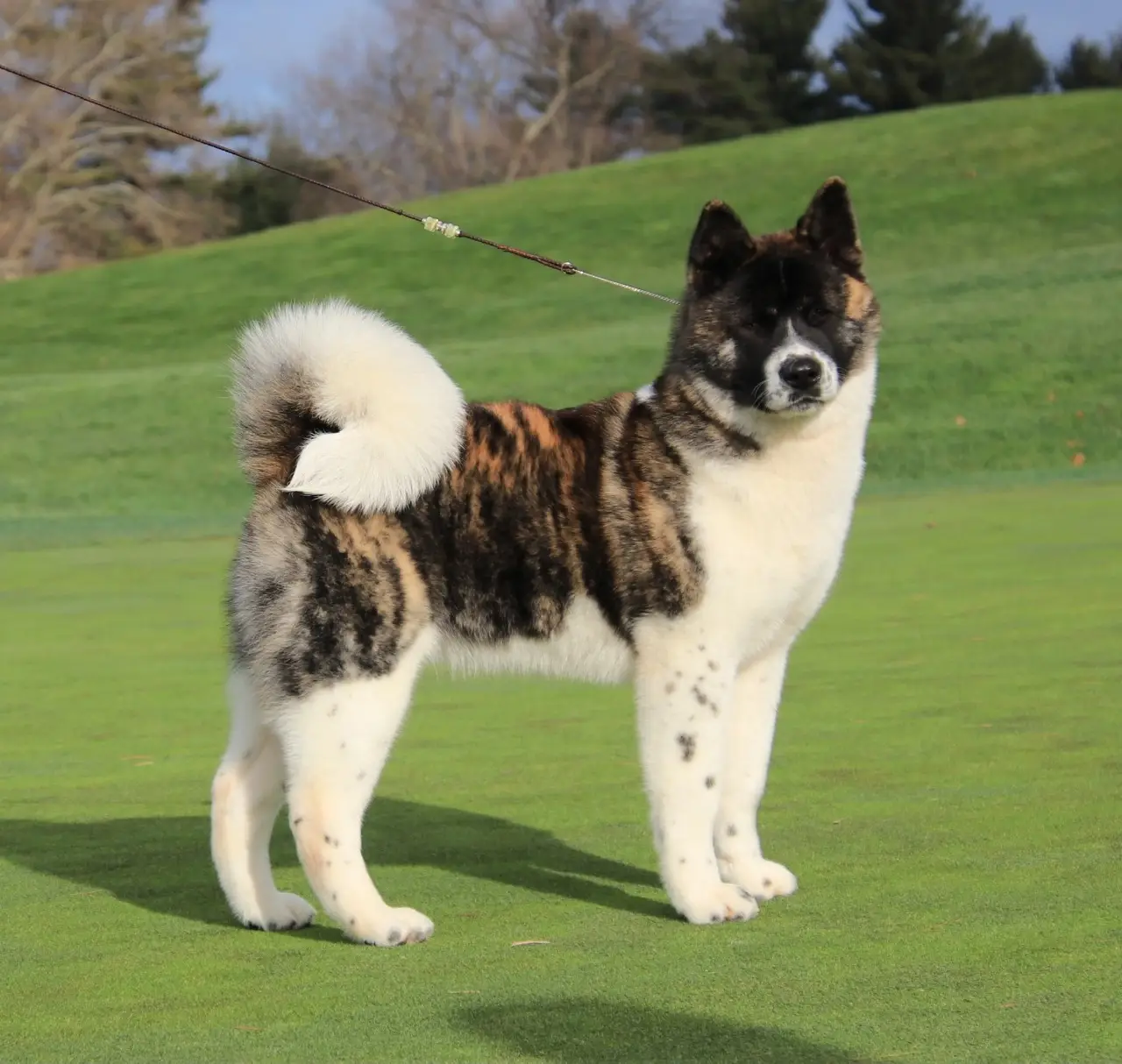
Champion Bengal, gold brindle
Champion Bengal is the opposite end of the brindle spectrum. Her coat is a gold brindle mixed with white, arranged so delicately that people assume she was painted. Where Stone's brindle is dark and intense, Bengal's is light and airy. The striping sits over a warm gold base and the white portions of her coat break up the pattern in a way that is genuinely unique.
The contrast between these two dogs illustrates something important about brindle in American Akitas. Calling a dog "brindle" tells you almost nothing about what it actually looks like. You need to see it. Stone and Bengal are both brindle. They could not look more different.
Pinto American Akitas: White Base with Colored Patches
Champion Torro, multi Best of Breed winner, pinto
Pinto is one of the most searched and most visually striking patterns in the American Akita. A pinto dog has a white base coat with large colored patches covering at least one third of the body. The patches can be any color, including red, brindle, fawn, or black.
Champion Torro is a multi Best of Breed winner and a perfect example of the pinto pattern. His patches are a dark orange red distributed across a white base, with white socks and a light black mask framing his face. What makes Torro's coat especially interesting is the black etching visible at the transitions where his red patches meet the white portions of his coat. That etching adds definition and precision to the color breaks that you do not see on every pinto dog.
White American Akitas: Striking, Correct, and Misunderstood
Starlight, solid white American Akita
The solid white American Akita is one of the most searched color varieties in the breed, and it is one of the most misunderstood. Let me clear up the biggest myth right now. White American Akitas are not albino. They have full pigment in their nose, lips, and eye rims. Albinism is a complete absence of pigment, which is extremely rare in this breed. A white Akita with a black nose and dark eyes is simply a white dog, not an albino.
Starlight is one of the finest white American Akitas I have produced. In this photo she is at an AKC dog show displaying her solid white coat in a professional stack. Her nose is black, her eyes are dark, and her coat is a clean, bright white. She is the same dog underneath as every other dog in this guide. Same structure. Same temperament. Same health testing. The only difference is the color of her coat.
The other myth worth addressing is that white Akitas are more prone to health problems. There is no evidence for this in the breed. Health is determined by OFA testing, pedigree depth, and responsible breeding decisions. Not by color.
Fawn American Akitas: The Warm Golden Middle Ground
Prosha, fawn American Akita, Winter 2026 sire
Fawn is one of the most commonly confused colors in the American Akita. People see a fawn dog and call it a "light red" or a "cream." It is neither. Fawn is its own distinct color with a warm, golden undertone that separates it from both red and white.
Prosha is an active sire in our breeding program and a strong example of what true fawn looks like. His coat has a warmth to it that reads golden in sunlight. It is not washed out. It is not diluted. It is a specific, intentional color that sits between the deeper reds and the lighter creams on the American Akita color spectrum.
If you are looking at an Akita and you are not sure whether it is a light red or a fawn, look at the overall tone. Red, even light red, has a warmth that pulls toward orange or copper. Fawn pulls toward gold. The difference is subtle in photos but unmistakable in person.
Silver American Akitas: Cool Toned and Uncommon
Champion Lara, silver American Akita
Silver is one of the less common colors in the American Akita and one of the most visually distinctive. A silver dog has a cool grey base coat with no red or fawn undertone. The overall impression is steel or ash rather than warm or golden.
Champion Lara is our silver example. Her coat reads as a cool, neutral grey with a defined black mask and white chest markings. In a breed dominated by warm tones like red and fawn, a silver dog stands out immediately because the temperature of the color is completely different. Everything about her reads cool where most Akitas read warm.
Silver with Black Overlay: Depth and Dimension
Champion Aurora, silver with black overlay
Silver with black overlay takes the cool silver base and adds another layer. The outer guard hairs are tipped in black, creating a depth effect that shifts as the dog moves. In direct sunlight, you can see the silver base and the dark tips as separate layers. In shade, the overlay blends and the dog appears darker overall.
Champion Aurora carries this combination beautifully. She also has white socks, a black mask, and the black etching at her color transitions. The overlay gives her coat a richness that flat silver does not have. It is subtle. Most people would simply call her "grey." But when you understand what you are looking at, the layering is remarkable.
Sable American Akitas: When Red Meets Black Overlay
Champion Astra (Apexx Flavor of the Woods), sable
Sable is one of the most complex colors in the American Akita. A sable dog has a red or orange base coat with diffused black tipping across the guard hairs. The result is a mixed, shifting appearance that does not fit neatly into any other category. Sable is not brindle. Brindle has distinct stripes. Sable has a diffused, blended overlay that changes the look of the coat depending on the light and the angle.
Champion Astra, whose registered name is Apexx Flavor of the Woods, is our sable representative. Her reddish orange base is overlaid with a light black tipping that creates what I describe as a sable appearance. In direct sunlight, the orange base dominates and she looks warm and bright. In shade or overcast light, the black tips come forward and she appears darker and more complex. She has a black mask, white socks, and the black etching where her white markings meet the colored portions of her coat.
Sable is sometimes confused with brindle by people who are not familiar with both patterns. The distinction is in the pattern structure. Brindle has visible, defined stripes. Sable does not. Sable is a wash of dark tipping across the entire coat surface without any striping pattern.
The Black Etching: A Detail Most People Never Notice
Champion Lara showing the black etching detail on her silver coat
There is a detail on many of my dogs that most people walk right past without seeing. I call it the black etching. It is a thin, dark line that appears at the exact point where white markings meet the colored portions of the coat. It shows up across multiple color families in my program. You can see it on red dogs, silver dogs, sable dogs, pinto dogs, and fawn dogs. The etching adds a crisp, precise definition to the color transitions that gives the coat a finished, polished look.
Champion Ash (mahogany red) and Katana (silver) showing black etching side by side
In the video above, you can see Champion Ash and Katana standing side by side. Ash is a mahogany red. Katana is a silver. Two completely different base colors. But look at where the white meets the color on both dogs. The same thin dark line is present at the transition on each of them. That is the etching.
The black etching is not required by the AKC standard. Many American Akitas do not have it. But when it is present, it adds a level of definition that I look for when I evaluate coat quality. It is one of the first things I notice on a dog, and it is a detail that separates a good looking coat from an exceptional one.
Do American Akita Puppies Change Color as They Grow?
Yes. Significantly. And Champion Ash is the proof.
Champion Ash: color change documented from 3 weeks old to adult champion
At three weeks old, Ash was nearly black. His face was solid dark, his body was charcoal and grey, and the only break in the darkness was the white on his chest and paws. If you had seen him at that age and tried to guess what color he would be as an adult, you would have been wrong.
By four weeks, the first hints of brown started appearing through the dark puppy coat. By six weeks, he had lightened dramatically to a soft fawn with a defined black mask. By eight weeks, the age most puppies go to their new homes, he looked like a completely different dog than the one born three weeks earlier.
The real transformation happened between four months and eleven months. During that window his coat deepened steadily from light fawn into the rich, saturated mahogany red that defines him today. He won Best in Show at four months old, when his adult color was only beginning to emerge. By eleven months he was already a champion.
The lesson here is simple. The color you see at eight weeks is not the color you will have at two years. Puppy coat and adult coat are different in texture, density, and often in color. This is normal. It is not a sign of anything wrong. It is genetics doing exactly what genetics does.
If you are choosing a puppy and you have a specific color preference, I understand that. Tell me what you are hoping for and I will do my best. But I also tell every applicant the same thing. Choose the dog, not the color. The puppy with the right temperament for your family may not be the color you came in looking for. In over 20 years and more than 150 placements, the families who listened to that advice have never once regretted it.
Multiple Colors in One Litter: What to Expect
One litter from Apexx Akitas showing multiple colors from the same parents
One of the most common questions I get from first time applicants is "what color will my puppy be?" The honest answer is that it depends on genetics, and genetics does not always cooperate with preferences. A single litter from the same dam and sire can produce puppies in red, brindle, fawn, pinto, and white. All siblings. All from the same parents. This is normal and it is one of the things that makes the American Akita such a fascinating breed.
In the video above, you are looking at a single litter from my program running on a golf course green. Count the colors. Those puppies share the same mother and the same father. The range of colors they produced is a direct result of the genetic diversity that both parents carry.
This is also not a sign of mixed breeding. The genetic mechanisms that produce color variety in American Akitas are well understood. When both parents carry genes for multiple colors, their offspring can express any combination of those genes. It is the same principle that gives human siblings different hair and eye colors. Same parents, different expression.
Color Does Not Determine Temperament, Health, or Value
I want to close with the most important thing in this entire guide. Color is the least important factor in choosing an American Akita.
Temperament is determined by genetics, early socialization, and the breeding decisions made long before a puppy is born. Not by whether the puppy is red or white or brindle. You can read more about how we approach temperament in our guide: Why Temperament Starts Before the Puppy.
Health is determined by OFA testing, documented pedigrees, and responsible breeding. Not by coat color. The myth that certain colors are more prone to health issues is not supported by evidence in the American Akita. Every dog in our program is OFA tested regardless of color. You can learn more about our testing protocol here: OFA Health Testing for American Akitas.
Price should reflect the breeder's investment in health testing, champion bloodlines, early socialization, and the depth of their track record. Not the color of the puppy's coat. If a breeder is marketing a color as "rare" and using that word to justify a higher price, that is a red flag. You can read our full breakdown of pricing in our guide: How Much Does an Akita Puppy Cost.
Deep to golden red, dark muzzle pigment, white markings common
GCH Asa, CH Ash, CH Esther
Dark Brindle
Dense striping over mixed brown, black, grey, red base
CH Stone
Gold Brindle
Lighter striping over gold base, often with white
CH Bengal
Pinto
White base with colored patches covering one third or more of body
CH Torro
White
Solid white, full pigment in nose and eye rims
Starlight
Fawn
Warm golden tone, distinct from light red
Prosha
Silver
Cool grey base, no warm undertone
CH Lara
Silver with Black Overlay
Cool grey base, dark tipped guard hairs
CH Aurora
Sable
Red or orange base with diffused black tipping
CH Astra
American Akita Color FAQ
What colors do American Akitas come in?
American Akitas are accepted in every color under the AKC breed standard. Common colors include red with black mask, brindle, pinto, solid white, fawn, silver, and sable. Every color can appear with or without a black mask and with or without white markings.
What is the rarest American Akita color?
Solid white and silver with black overlay are among the less common American Akita colors. However, rarity does not indicate higher quality or value. A well bred dog of any color from a health tested program is worth more than a "rare" colored dog from an untested one.
Do American Akita puppies change color as they grow?
Yes. Many American Akita puppies change color significantly between eight weeks and twenty four months. Champion Ash from Apexx Akitas was nearly black at three weeks old and became a deep mahogany red as an adult. The puppy coat at eight weeks is not a reliable predictor of adult color.
Does coat color affect an American Akita's temperament?
No. Coat color has no effect on temperament in American Akitas. Temperament is determined by genetics, breeding selection, and early socialization. A well bred red Akita has the same temperament potential as a well bred white, brindle, or pinto Akita.
Does coat color affect an American Akita's health?
No. In American Akitas, coat color does not correlate with health outcomes. The myth that white Akitas are more prone to deafness or health issues is not supported by evidence in the breed. Health is determined by OFA testing and responsible breeding.
Are white American Akitas albino?
No. White American Akitas have full pigment in their nose, lips, and eye rims. Albinism is a genetic condition resulting in a complete absence of pigment, which is extremely rare in the breed.
Do American Akita breeders charge more for certain colors?
Reputable breeders do not charge premiums based on color. If a breeder is marketing a color as "rare" and using that as justification for a higher price, that is a red flag. Price should reflect health testing, champion bloodlines, and the breeder's track record.
What color puppies will one American Akita litter produce?
A single litter can produce puppies in multiple colors depending on the genetics of both parents. It is normal for siblings to include red, brindle, fawn, pinto, and white from the same dam and sire.
What is the black etching on an American Akita's coat?
The black etching is a thin dark line that appears where white markings meet the colored portions of the coat. It adds definition and visual sharpness to the color transitions. It is not required by the AKC standard but is present across many dogs in the Apexx Akitas program.
What is the difference between brindle and sable in American Akitas?
Brindle is a striping pattern with distinct dark stripes over a lighter base color. Sable is a diffused dark tipping across the entire coat without visible stripes. Both are accepted under the AKC standard.
The Bottom Line
The American Akita is one of the most color diverse large breeds in the world, and every color shown in this guide is represented by a real, named dog from our program. Color is beautiful, and it is the least important factor in choosing the right dog for your family. Temperament, health testing, and breeding quality are what make an American Akita worth living with for the next 12 to 15 years. If you are drawn to a specific color, tell us. But trust the match. The right dog is the one whose temperament fits your household, regardless of coat color.
What to Feed an American Akita: A Breeder's Complete Feeding Guide
RD
Ron Durant
Founder & Head Breeder, Apexx Akitas · Sussex County, NJ · 20+ Years Breeding American Akitas
Feeding champions. The condition, structure, and vitality you see in Apexx Akitas dogs is the direct result of a nutrition protocol refined over more than two decades.
American Akitas do best on a high-quality large-breed diet with controlled protein (24 to 28 percent), moderate fat (12 to 16 percent), and calcium levels appropriate for large-breed growth. Puppies eat a large-breed puppy formula three to four times daily until 6 months, then twice daily. Adult American Akitas eat 4 to 6 cups of quality kibble daily, split between two meals to reduce bloat risk. Free-feeding is never appropriate for this breed. The two supplements I use in my own program across every life stage are a canine multivitamin and salmon oil, both listed on our Recommended Supplies page. This guide covers what to feed at every life stage, how much, what to avoid, and how to reduce bloat risk, from 20+ years of breeding and raising American Akitas at Apexx Akitas.
What you feed an American Akita affects almost everything about the dog. Growth, joint development, coat quality, energy, longevity, and the risk of some of the most preventable veterinary problems this breed faces all come back to nutrition. Yet most feeding advice online is written for dogs in general, not for a large working breed with specific nutritional needs.
I have raised American Akita puppies from the whelping box through adulthood for more than twenty years, watched dogs from my program live past 15 years, and worked with the veterinarians who monitor their growth and development. This is the feeding protocol I actually use, the one I hand to every family that takes home an Apexx puppy.
Feed a large-breed formula appropriate to the life stage, split into two meals daily for adults (three to four for puppies), avoid the ingredients on the "never feed" list below, and add a canine multivitamin plus salmon oil. That covers 95 percent of what an American Akita owner needs to get right on nutrition.
Why Nutrition Matters More for This Breed
American Akitas are a large-breed dog with specific developmental requirements that generic feeding advice fails to address. The mistakes that produce a healthy adult Labrador can produce a lame, joint-compromised adult Akita. Three things about this breed make nutrition more critical than average.
Results of excellent American Akita nutrition. Astra and Torro in top condition at the New Jersey Akita Specialty Show, where Astra secured Best of Winners, Winners Bitch, and an Award of Merit.
Slow, structured growth. American Akitas continue building bone, joint, and muscle mass through 24 to 36 months. Overfeeding or feeding excess calcium during this window accelerates growth in ways that damage joint development and can produce hip, elbow, and other structural problems for life. Read our complete size guide for the full growth timeline.
Deep-chested breed with bloat risk. American Akitas are one of the breeds at elevated risk for gastric dilatation-volvulus (GDV), commonly called bloat, which is a life-threatening emergency. Feeding practices directly influence bloat risk. Two meals daily rather than one large meal, no vigorous exercise for 60 to 90 minutes after eating, and elevated feeding stations are among the practices that reduce risk. See our 7 critical health problems guide for the full context.
Double coat that demands nutritional support. The American Akita coat is one of the most demanding in the working group. Coat quality, undercoat density, and shedding cycles all depend on adequate protein, essential fatty acids, and micronutrient balance. Nutritional deficiencies show up in the coat before they show up anywhere else. Our shedding guide explains the coat cycle in full.
Feeding an American Akita by Life Stage
Puppy: 8 Weeks to 6 Months
This is the fastest and most fragile growth window of the dog's life. Feed a high-quality large-breed puppy formula, three to four times daily, in measured portions. Never free-feed. The label matters: look for "large-breed puppy" specifically, with controlled calcium levels appropriate for controlled growth. Feeding a small-breed or all-life-stages formula during this window increases the risk of orthopedic problems that show up years later.
Feeding time at Apexx Akitas. Structured, scheduled feeding from the earliest weeks is the foundation of a healthy, championship-quality American Akita.
Feeding Champions. Three robust American Akita puppies from Apexx Akitas eating together and thriving on the feeding protocol that produces champion adults.
Typical intake at 8 weeks is around 2 to 3 cups daily total, increasing to 3 to 4 cups by 4 months. Adjust based on body condition, not the bag directions alone. You should be able to feel ribs easily with light pressure but not see them prominently. A puppy that looks stocky and heavy is being overfed, not "getting big." Overfeeding a large-breed puppy is one of the most damaging things a new owner can do.
Puppy: 6 to 12 Months
Continue the large-breed puppy formula. Reduce to two meals daily by 6 months. Intake typically climbs to 4 to 5 cups daily during this period, though individual variation is significant. Growth slows visibly, but the puppy is still building bone density, muscle, and structural mass. Keep body condition lean. Slightly-lean is significantly better than slightly-heavy for long-term joint health.
Adolescent: 12 to 24 Months
Around 12 to 15 months most American Akitas can transition to a large-breed adult formula. Some slower-maturing dogs benefit from remaining on puppy food to 15 or 18 months, particularly males still filling out. Continue two meals daily. Adult intake settles around 4 to 6 cups daily depending on activity level, metabolism, and body condition. Do not increase food quantity just because the dog "looks bigger." Increased food should follow visible ribs, not precede more mass.
Adult: 2 to 7 Years
A high-quality large-breed adult formula, fed as two meals daily, remains the standard for the entire adult prime. Intake typically ranges 4 to 6 cups depending on the individual dog. Watch body condition monthly. American Akitas that are working, running, or highly active may need the upper end of that range. American Akitas that are primarily calm indoor guardians often thrive at the lower end. The lean, muscular adult with a defined waist and easily palpable ribs is the target.
Senior: 7 Years and Older
Transition to a large-breed senior formula around 7 to 8 years, sooner if there are joint concerns, weight changes, or metabolic changes. Senior formulas typically have adjusted protein and fat levels appropriate for reduced activity, plus added joint support. Continue two meals daily. Watch body condition even more carefully in seniors. Weight loss in older dogs is often the first visible sign of an underlying health issue and warrants a veterinary conversation.
American Akita Feeding Amount Chart
These are starting points, not prescriptions. Every individual dog varies. Adjust based on body condition, activity level, and coat quality.
Life Stage
Meals Per Day
Total Daily Amount
Food Type
8 weeks to 6 months
3 to 4
2 to 4 cups
Large-breed puppy formula
6 to 12 months
2
4 to 5 cups
Large-breed puppy formula
12 to 24 months
2
4 to 6 cups
Puppy or adult, based on the individual
Adult (2 to 7 years)
2
4 to 6 cups
Large-breed adult formula
Senior (7+ years)
2
3 to 5 cups
Large-breed senior formula
Cups measured with a standard 8-ounce dry measuring cup, not a coffee mug or scoop.
What NOT to Feed an American Akita
Some foods are toxic to dogs generally. Some are particularly problematic for American Akitas because of the breed's tendency toward food sensitivities and skin issues. This is the "never" list.
Toxic to all dogs, never feed under any circumstances
Xylitol (found in sugar-free gum, some peanut butter, some baked goods). Grapes and raisins. Onions and garlic in any form. Chocolate. Macadamia nuts. Alcohol. Cooked bones of any kind (they splinter). Raw bread dough. Avocado. If your dog ingests any of these, call your veterinarian or the ASPCA Animal Poison Control Center at 888-426-4435 immediately.
Beyond the universally toxic list, American Akitas are prone to food sensitivities that show up as itchy skin, ear infections, or digestive upset. The most common culprits I have seen across my program:
Wheat, corn, and soy in cheap commercial foods. Not toxic, but frequently the cause of allergic reactions in this breed.
Chicken is a surprisingly common allergen in American Akitas. Many dogs do better on fish, lamb, or novel-protein formulas.
Excess treats and table scraps. Even good food becomes bad food when it displaces the balanced diet. Keep treats under 10 percent of daily calories.
Grain-free diets high in legumes have been associated with a form of canine cardiomyopathy. If you feed grain-free, work with your veterinarian and monitor cardiac health.
The Two Supplements I Use in My Program
A quality large-breed food handles the bulk nutritional load. Everything I add beyond the food is targeted at what a growing or working American Akita needs above and beyond the bowl. Across every life stage in my program, from nursing puppies through adult breeding dogs and seniors, I use two specific supplements consistently.
Doc Roy's Daily Care Canine multivitamin
A comprehensive canine multivitamin that supports balanced micronutrient intake, especially during the rapid growth window from 8 weeks through 18 months, and again through senior years when nutrient absorption can decline. I have used this product across every litter for many years.
Alaska Naturals Salmon Oil Formula
A high-quality salmon oil that supports joint development, coat quality, cognitive function, and cardiac health. The Omega-3 fatty acids in salmon oil are one of the highest-leverage additions to any American Akita diet, given the breed's coat demands and joint sensitivity.
Both products, with full dosing guidance and direct links, are listed on our Recommended Supplies page along with everything else I use with my own dogs.
Some links on our Recommended Supplies page are affiliate links, which cost you nothing extra and help support the resources we publish here.
Feeding Practices That Reduce Bloat Risk
Gastric dilatation-volvulus (GDV), commonly called bloat, is a life-threatening emergency where the stomach twists and cuts off circulation. American Akitas are at elevated risk due to breed conformation. Feeding practices matter enormously here, and every American Akita owner should know them.
Feed two meals daily rather than one large meal. A single large meal significantly raises bloat risk.
No vigorous exercise for 60 to 90 minutes before or after eating. This is one of the most important rules.
Slow feeders or puzzle bowls if the dog eats fast. Rapid eating increases air ingestion, which raises bloat risk.
Use elevated feeding stations only if your veterinarian specifically recommends them. Research on elevated feeding and bloat is mixed. Ask your vet.
Learn the symptoms of bloat immediately. Distended abdomen, unproductive retching (trying to vomit but nothing comes up), restlessness, drooling, and collapse. This is a 911 emergency. Every minute matters.
Talk to your veterinarian about prophylactic gastropexy when the dog is spayed or neutered. This surgical procedure tacks the stomach to the body wall and significantly reduces the risk of the stomach twisting.
Common Feeding Mistakes I See
Over twenty years, I have watched families make the same feeding mistakes over and over. Here are the ones that cause the most damage.
Free-feeding. Leaving food out all day is not appropriate for this breed. Scheduled meals build routine, allow you to monitor appetite (an early illness indicator), and reduce overfeeding.
Overfeeding puppies to "help them grow bigger." This does not produce a bigger adult. It produces an adult with damaged joints. Genetics determine adult size. Nutrition determines whether the dog reaches its genetic potential in a healthy body.
Switching foods too abruptly. Any food transition should happen over 7 to 10 days, gradually blending the old and new food. Abrupt switches cause digestive upset that has nothing to do with the food itself.
Excess treats. Treats should total less than 10 percent of daily calories. A steady stream of biscuits, table scraps, and training rewards adds up faster than most owners realize.
Ignoring body condition. The scale matters less than what you see and feel. You should easily feel ribs with light pressure, see a defined waist from above, and see an upward tuck from the side. Anything else is over or under.
Chasing trends. Grain-free, boutique brands, exotic proteins, and social media diet fads have collectively caused more harm than good in dog nutrition. A well-established large-breed formula from a reputable manufacturer is almost always the right answer.
The Bottom Line on Feeding an American Akita
Feed a high-quality large-breed formula appropriate to the life stage. Twice daily for adults, three to four times daily for puppies under 6 months. Aim for 4 to 6 cups total for a healthy adult, adjusted to body condition. Add a canine multivitamin and salmon oil for coat, joints, and micronutrient support. Avoid the toxic and allergen list above.
Do not free-feed. Do not overfeed puppies. Do not exercise vigorously right before or after meals. Learn the symptoms of bloat and know your nearest 24-hour emergency vet.
Get those fundamentals right and nutrition becomes one of the easiest parts of American Akita ownership. Get them wrong and you can create expensive, preventable veterinary problems that follow the dog for life. Twenty years of raising this breed has confirmed the same thing over and over: nutrition is the least glamorous investment you make in your dog and one of the most important.
For everything else that supports a healthy American Akita, including the exact supplements, coat care products, and grooming tools I use in my program, visit our Recommended Supplies page.
Frequently Asked Questions About Feeding American Akitas
What is the best food for an American Akita?
The best food for an American Akita is a high-quality large-breed formula matched to the dog's life stage, with controlled protein (24 to 28 percent), moderate fat (12 to 16 percent), and appropriate calcium levels for large-breed growth. Well-established brands with a track record of AAFCO compliance and controlled ingredient sourcing are the safest choices. Grain-free diets high in legumes have been associated with heart problems and should only be fed under veterinary supervision. Avoid cheap commercial foods with wheat, corn, and soy fillers, which are common allergens in this breed.
How much should I feed my American Akita per day?
A healthy adult American Akita typically eats 4 to 6 cups of quality kibble per day, split between two meals. Puppies under 6 months eat 2 to 4 cups daily split across 3 to 4 meals. Individual variation is significant. Adjust based on body condition rather than following bag directions strictly. You should easily feel ribs under light pressure, see a defined waist from above, and see an upward tuck from the side. Active or working dogs may need the upper end of the range, while calm indoor guardians often thrive at the lower end.
How many times a day should I feed my American Akita?
Feed American Akita puppies 3 to 4 times daily until 6 months of age, then transition to twice daily for the rest of the dog's life. Two meals daily rather than one large meal significantly reduces the risk of gastric dilatation-volvulus (GDV or bloat), which is a life-threatening emergency this breed is at elevated risk for. Free-feeding is never appropriate for American Akitas.
What is the best puppy food for an American Akita?
The best puppy food for an American Akita is a large-breed puppy formula with controlled calcium levels appropriate for slow, controlled growth. The label must specifically state "large-breed puppy." Feeding a small-breed puppy formula or an all-life-stages formula during the growth window can produce orthopedic problems that show up years later. Look for AAFCO compliance for growth of large-size dogs (adults over 70 pounds). Continue the large-breed puppy formula until 12 to 15 months, sometimes longer for slower-maturing males.
Can American Akitas eat raw food?
American Akitas can be fed raw diets successfully when the diet is properly balanced, sourced from a reputable supplier, and handled with appropriate food safety practices. However, raw feeding requires significant nutritional knowledge to get right, particularly for growing puppies with strict calcium and phosphorus requirements. Home-formulated raw diets should be developed with a veterinary nutritionist. Commercially prepared raw diets from established manufacturers are a safer starting point for owners new to raw feeding. Raw feeding is not recommended for households with immunocompromised members due to bacterial contamination risk.
What foods are toxic to American Akitas?
Foods that are toxic to American Akitas and all dogs include xylitol (in sugar-free products and some peanut butter), grapes, raisins, onions, garlic, chocolate, macadamia nuts, alcohol, cooked bones of any kind (they splinter), raw bread dough, and avocado. If your dog ingests any of these, contact your veterinarian or the ASPCA Animal Poison Control Center at 888-426-4435 immediately. American Akitas are also frequently sensitive to wheat, corn, soy, and sometimes chicken, which show up as itchy skin, ear infections, or digestive problems rather than acute toxicity.
Do American Akitas have food allergies?
Yes. American Akitas are prone to food sensitivities and allergies, often showing up as chronic itching, hot spots, recurring ear infections, or digestive upset. The most common allergens in the breed are chicken, wheat, corn, and soy. Dogs suspected of food allergies often benefit from a limited-ingredient diet or novel-protein formula (fish, lamb, venison, duck) as a diagnostic trial. Work with a veterinarian to properly identify and manage food allergies, since symptoms can overlap with environmental allergies and other skin conditions.
What supplements should I give my American Akita?
The two supplements Ron Durant uses across every life stage at Apexx Akitas are a canine multivitamin (Doc Roy's Daily Care Canine) and a high-quality salmon oil (Alaska Naturals Salmon Oil Formula). The multivitamin supports balanced micronutrient intake during rapid growth and senior years. Salmon oil provides Omega-3 fatty acids that support joint development, coat quality, cognitive function, and cardiac health. Both are particularly valuable for a large-breed working dog like the American Akita. Additional joint supplements (glucosamine and chondroitin) may benefit senior dogs. Consult your veterinarian before adding supplements to a young puppy's diet.
How do I reduce bloat risk when feeding an American Akita?
To reduce bloat risk in an American Akita, feed two meals daily rather than one large meal, avoid vigorous exercise for 60 to 90 minutes before and after eating, use a slow feeder bowl if the dog eats rapidly, and learn the symptoms of gastric dilatation-volvulus (distended abdomen, unproductive retching, restlessness, drooling, collapse). Talk with your veterinarian about prophylactic gastropexy at the time of spay or neuter, which surgically tacks the stomach to the body wall and significantly reduces the risk of it twisting. Bloat is a life-threatening emergency and every minute matters.
When should I switch my American Akita from puppy food to adult food?
Most American Akitas transition from large-breed puppy formula to large-breed adult formula around 12 to 15 months of age. Slower-maturing males may benefit from staying on puppy formula until 15 to 18 months. The transition should happen gradually over 7 to 10 days, mixing increasing proportions of the new food with the old to prevent digestive upset. Never switch foods abruptly. Signs the transition is going well include stable stool quality, maintained body condition, and continued coat quality.
Should I feed my American Akita grain-free food?
Grain-free diets should only be fed to American Akitas under veterinary guidance. Grain-free formulas high in legumes (peas, lentils, chickpeas) have been associated with a form of canine dilated cardiomyopathy (DCM). If your Akita has a diagnosed grain allergy, work with a veterinarian to select a grain-free formula that avoids the ingredient combinations of concern, and monitor cardiac health regularly. For dogs without documented grain allergies, a well-formulated food that includes grains is generally the safer and healthier choice.
How much does it cost to feed an American Akita?
Feeding a high-quality large-breed formula to an adult American Akita typically costs $80 to $150 per month depending on the brand chosen and the dog's individual intake. Premium foods sit at the higher end, mid-tier established brands at the lower end. Add supplements (multivitamin plus salmon oil) at approximately $20 to $40 per month, plus occasional dental chews or training treats. Total monthly feeding cost for a well-fed American Akita typically runs $100 to $200. Over the dog's 10 to 13 year lifespan, that adds up to $12,000 to $30,000 in feeding costs alone, which is why establishing good habits early matters.
How Big Do American Akitas Get? A Breeder's Complete Size Guide
By Ron Durant, Apexx Akitas. Verified adult measurements from 20+ years of champion American Akita breeding.
Grand Champion Asa, foundation sire of the Apexx Akitas breeding program. Asa carries the substance, structure, and bone that Grand Championship judging rewards. His measurements and structural qualities are the reference point for what a top-of-standard adult male American Akita looks like.
Adult male American Akitas stand 26 to 28 inches tall at the shoulder and weigh 100 to 130 pounds. Adult female American Akitas stand 24 to 26 inches tall and weigh 70 to 100 pounds. American Akitas reach adult height by 12 to 15 months but continue filling out in muscle and substance until approximately 24 to 36 months. The breed is significantly larger than the Japanese Akita Inu, comparable in weight to an adult Rottweiler, and among the largest of the AKC-recognized Working Group breeds. Actual adult size depends on genetics, nutrition, and lineage.
Adult American Akita Size Ranges What the AKC Breed Standard Says, and What Real Champion Dogs Measure
The AKC breed standard for the American Akita specifies a height range of 26 to 28 inches at the withers for males and 24 to 26 inches for females. Weight is not fixed by the standard but is expected to be in proportion to height and substance. In practice, well-bred American Akitas from championship programs consistently measure within these ranges.
Measurement
Adult Male
Adult Female
Height at withers
26 to 28 inches
24 to 26 inches
Weight range
100 to 130 pounds
70 to 100 pounds
Head circumference
23 to 27 inches
20 to 24 inches
Chest depth
Reaches to elbow
Reaches to elbow
Full physical maturity
24 to 36 months
18 to 30 months
In the Apexx Akitas program, Grand Champion Asa measures at the upper end of the male standard with the substance and bone structure that Grand Championship judging rewards. Champion Bengal, the dam of our current litter, measures at the upper end of the female standard. These are the parents whose measurements determine what our puppies will grow into as adults.
Champion Ash, an adult male American Akita in the Apexx Akitas program, weighed at 140 pounds. Ash carries substance above the AKC male breed standard of 100 to 130 pounds and demonstrates the structure and bone that Championship judging rewards. Ash won Best in Show at 4 months old against 76 entered puppies.
American Akita Growth Timeline by Age What to Expect from 8 Weeks to Full Maturity
American Akita puppies grow rapidly during the first year, then continue building muscle and substance well into their second and third years. Understanding the growth timeline helps new owners recognize normal development and identify any concerns early.
Age
Male Weight
Female Weight
8 weeks (placement)
15 to 20 pounds
12 to 17 pounds
3 months
30 to 40 pounds
25 to 35 pounds
6 months
60 to 75 pounds
50 to 65 pounds
9 months
80 to 95 pounds
65 to 80 pounds
12 months
90 to 110 pounds
70 to 90 pounds
18 months
100 to 120 pounds
75 to 95 pounds
24 months (near mature)
105 to 125 pounds
80 to 100 pounds
36 months (fully mature)
110 to 130 pounds
85 to 100 pounds
Height is reached before weight. American Akitas typically reach their adult height between 12 and 15 months. After that point, growth is horizontal rather than vertical. The dog continues to add muscle mass, bone density, and coat volume through the second and third years. A male Akita at 12 months looks tall and lean. The same dog at 30 months looks powerful and finished. This is normal breed development.
Do not overfeed during rapid growth. Between 4 and 10 months, American Akita puppies grow at a rate that can be damaging if overfed. Excess weight during this window puts extreme stress on developing joints and can contribute to hip and elbow problems later in life. Feed to breed-appropriate lean condition, not to maximize size. A properly conditioned Akita puppy has a visible waist and ribs that can be felt easily under a thin fat layer.
Male vs Female American Akita Size The Real Differences That Matter to Owners
Male and female American Akitas differ meaningfully in size, structure, and physical presence. The differences are consistent enough that any experienced breeder or judge can identify sex at a glance from silhouette alone.
Males are larger and heavier-boned. An adult male American Akita will typically be 20 to 30 pounds heavier than an adult female, stand 2 to 3 inches taller, and carry substantially more bone in the head, chest, and legs. Males have deeper chests, broader skulls, and thicker necks. The male silhouette reads as powerful and substantial from any angle.
Females are more refined but still substantial. An adult female American Akita at 90 pounds is still a large, powerful dog by any measure. Females carry the same double coat, the same working-breed structure, and the same physical strength. The refinement is a matter of degree, not category. Do not underestimate the size or strength of a female Akita.
Both sexes require the same handling infrastructure. Home logistics, leash handling, veterinary transport, and property considerations should be planned around the upper end of the size range regardless of sex. A female Akita will still knock over a small child inadvertently. A male Akita in the top of the standard will fill a standard SUV cargo area completely.
Lara, a female American Akita in the Apexx Akitas program, weighed at 130 pounds. Females this substantial are exceptional. The AKC standard for female American Akitas is 70 to 100 pounds. Lara represents the extreme upper end of what selective breeding for substance can produce in a female, not the typical range buyers should expect.
A well-bred American Akita is not a large dog in the way a Labrador is large. This is a powerful, heavily-boned, working-breed dog with substantial physical presence.
American Akita Size Compared to Other Breeds Context for Buyers Deciding Between Similar Breeds
Buyers considering the American Akita often compare size with other large working and guardian breeds. Understanding where the American Akita sits relative to more familiar breeds helps set realistic expectations for physical presence, food costs, and home logistics.
By weight, the American Akita is comparable to a Rottweiler or large Bernese Mountain Dog. By height, the American Akita is slightly taller than a German Shepherd but comparable in silhouette. The double coat adds visual volume, so American Akitas often look even larger than their measured weight suggests.
What Determines Your Akita's Adult Size Genetics, Nutrition, and the Factors You Can and Cannot Control
Adult size in the American Akita is determined by several factors, some genetic and some environmental. Understanding these helps buyers make informed decisions before purchase and gives owners realistic expectations during the growth period.
Genetics is the primary factor. Your Akita's adult size is largely determined by the size of its parents and grandparents. A puppy from two dogs at the top of the size standard will almost certainly reach the top of the standard. A puppy from smaller parents will finish smaller. This is why viewing both parents in person, or verifying their measurements and titles with the breeder, matters more than any other single factor. In the Apexx Akitas program, our sire and dam measurements are known and documented, and every puppy's likely adult range can be predicted with reasonable accuracy from that lineage.
Nutrition affects final size and lifetime health. Proper nutrition during the growth window (0 to 18 months) supports the genetic potential the puppy inherited. Under-feeding can result in a dog that does not reach its full potential. Over-feeding accelerates growth in ways that damage joints and reduce lifespan. Large-breed puppy food formulated for controlled growth is the standard recommendation. Free-feeding is not appropriate for this breed.
The two supplements I use in my own program. A large-breed puppy food formulated for controlled growth handles the caloric and macronutrient side of nutrition. For everything a growing Akita needs beyond the bowl, I use two supplements consistently across every litter. Doc Roy's Daily Care Canine multivitamin supports balanced micronutrient intake during the rapid growth window, and Alaska Naturals Salmon Oil Formula supports joint development, coat quality, and cognitive function through the critical 0 to 18 month development period. Both are listed with full details, dosing guidance, and direct links on our Recommended Supplies page along with everything else I use with my own dogs. Some links on that page are affiliate links, which cost you nothing extra and help support the resources we publish here.
Spay/neuter timing has an effect. Early spay or neuter (before 12 months) can result in taller, leaner dogs with less muscle mass because the growth plates close later without gonadal hormones. Later spay/neuter (after 18 to 24 months) allows for more typical breed conformation and substance. This is a discussion to have with your veterinarian based on your individual dog.
Exercise supports proper development. Age-appropriate exercise builds bone density, muscle tone, and joint stability. Excessive high-impact exercise before growth plates close (approximately 15 to 18 months) can damage developing joints. Age-appropriate walking, controlled play, and swimming are ideal during the growth period. Structured working exercise begins after the growth plates close.
The Physical Reality of Owning an American Akita What Size Actually Means for Your Daily Life
The measurements on this page describe an adult dog. What those numbers mean in daily practice is worth understanding before you commit to this breed.
A healthy adult male American Akita can knock over an adult human without trying. This is not a manageable inconvenience. It is a physical reality that shapes every aspect of ownership. Leash handling, veterinary transport, home logistics, boarding arrangements, and even simple things like fitting in a vehicle become considerations that owners of smaller breeds never think about.
A 120-pound Akita eats approximately 4 to 6 cups of high-quality food per day, generates proportional waste, requires a fenced yard with substantial fencing infrastructure, and produces veterinary bills that scale with size. Medications, surgical costs, boarding rates, and food expenses are all higher for a giant breed than for smaller dogs.
A properly bred Akita's size is not just numerical. It is presence. The head is broad and powerful. The chest is deep and heavily coated. The overall silhouette carries the substance the AKC breed standard rewards. Guests and strangers notice an Akita walking down the street in a way they do not notice most other breeds. This is by design and part of the breed's guardian heritage.
If you are still evaluating whether the American Akita is the right breed for your family, read Is an American Akita Right for You? for the complete honest evaluation.
A 130-pound adult male American Akita from the Apexx Akitas program, son of Grand Champion Asa, at home in Canada. He is resting on a large stone by the family's barn. Photos like this show the physical reality of adult American Akita ownership: substantial, calm, at ease on the family property, and unmistakably built for exactly the climate he lives in.
Frequently Asked Questions About American Akita Size Direct Answers to the Most Common Buyer Questions
How big do American Akitas get?
Adult male American Akitas stand 26 to 28 inches tall at the shoulder and weigh 100 to 130 pounds. Adult female American Akitas stand 24 to 26 inches tall and weigh 70 to 100 pounds. American Akitas reach adult height by 12 to 15 months but continue building muscle mass and substance until approximately 24 to 36 months of age. Actual adult size depends on genetics inherited from the parents, nutrition during the growth period, and factors like spay/neuter timing.
When do American Akitas stop growing?
American Akitas reach their adult height between 12 and 15 months of age. However, they continue filling out in muscle mass, bone density, and coat volume until approximately 24 to 36 months for males and 18 to 30 months for females. A 12-month-old Akita looks tall and lean. The same dog at 30 months looks powerful and finished. This extended maturation period is normal for the breed and one reason breeders emphasize appropriate nutrition and exercise throughout the first three years.
How big is an American Akita puppy at 8 weeks?
American Akita puppies typically weigh 15 to 20 pounds for males and 12 to 17 pounds for females at 8 weeks of age, which is when puppies are placed with their new families. This is a large puppy compared to most breeds but is normal for the American Akita. Growth accelerates rapidly from placement through 12 months, with puppies typically doubling their placement weight by 3 months of age.
Are American Akitas bigger than Japanese Akitas?
Yes, American Akitas are significantly larger than Japanese Akita Inu. An adult male American Akita weighs 100 to 130 pounds compared to 65 to 85 pounds for a male Japanese Akita Inu. The two breeds are also structurally different, with the American Akita carrying heavier bone, a broader head, and more substance overall. Despite the shared name, the American Akita and Japanese Akita Inu have been recognized as separate breeds since 2005 in most international registries.
How can I predict how big my Akita puppy will get?
The most reliable predictor of your Akita puppy's adult size is the size of the parents and grandparents. Verify the sire and dam measurements with your breeder. A puppy from two parents at the top of the size standard will almost certainly reach the top of the standard. A puppy from smaller parents will finish smaller. In championship breeding programs like Apexx Akitas, parent measurements are documented and the adult range of each puppy can be predicted with reasonable accuracy from lineage alone.
How much do American Akitas weigh compared to other large breeds?
American Akitas are comparable in weight to Rottweilers (95 to 135 pounds) and slightly larger than Bernese Mountain Dogs (80 to 115 pounds). They are significantly larger than German Shepherds (65 to 90 pounds) and Labrador Retrievers (65 to 80 pounds). They are also larger than Siberian Huskies (45 to 60 pounds) and Alaskan Malamutes (85 to 100 pounds), despite sharing northern breed heritage. The American Akita is among the largest breeds in the AKC Working Group.
Do American Akita females stay smaller than males?
Yes, adult female American Akitas are consistently smaller than adult males, typically by 20 to 30 pounds and 2 to 3 inches in height. However, a 90-pound female Akita is still a large, powerful dog by any measure. Females carry the same double coat, working-breed structure, and physical strength as males. The size difference is a matter of degree, not category. Both sexes require the same handling infrastructure, fenced yard, and physical management considerations.
Every Apexx Akitas puppy comes from AKC Champion or Grand Champion parents with documented adult measurements. We have produced 10 AKC Champions including a Westminster winner, and every puppy's likely adult size can be predicted with confidence from documented lineage.
Founder and head breeder, Apexx Akitas. AKC-registered American Akita breeding program since 2003. Sussex County, New Jersey. 10 AKC Champions and Grand Champions produced. 150+ placements nationwide. All breeding dogs carry AKC Championship or Grand Championship titles, full OFA health clearances, and documented adult measurements. Ron has personally raised and measured hundreds of American Akitas across four generations of Apexx bloodline.
The American Akita in Dog Shows: What Titles Mean, How They Are Earned, and Why Buyers Should Care
By Ron Durant, Apexx Akitas. AKC breeder, owner-handler, and exhibitor of champion American Akitas since 2003.
Apexx Akitas champions with their AKC conformation show ribbons. Multiple title winners from one breeding program. Sussex County, New Jersey.
The American Akita's role in AKC conformation dog shows is to be evaluated against the official breed standard by licensed judges. Dogs that meet or exceed the standard in structure, movement, temperament, and breed type earn points toward Championship and Grand Championship titles. These titles are not cosmetic. They are verified proof that a dog's physical structure and temperament have been independently judged as correct for the breed. For breeders, show results guide which dogs should be bred. For buyers, titles on a pedigree are one of the most reliable indicators that a breeder is producing dogs that meet the standard the breed was built on.
What AKC Conformation Shows Actually Are And Why They Exist in the First Place
A conformation dog show is not a beauty pageant. That is the most common misunderstanding people have about the sport, and it leads to the assumption that showing dogs is about vanity. It is not. Conformation shows exist for a single purpose: to evaluate breeding stock against the written breed standard.
Every AKC-recognized breed has an official standard. It describes in precise detail what the ideal specimen of that breed should look like, how it should move, and what its temperament should be. The standard exists because breed-specific structure is directly connected to breed-specific function. An American Akita that is built correctly moves efficiently, carries weight properly on its joints, breathes without restriction, and ages soundly. A dog that deviates significantly from the standard is more likely to develop structural problems that affect its health and quality of life.
At a conformation show, a licensed AKC judge physically examines each dog. They evaluate the head, the bite, the body proportions, the coat, the bone structure, and the overall silhouette. Then the dogs move around the ring so the judge can assess gait. How a dog moves reveals how it is built underneath the coat. A dog with correct structure moves smoothly and effortlessly. A dog with structural faults compensates, and a trained eye sees that compensation immediately.
The judge then places the dogs in order of how closely each one adheres to the breed standard. The dog that best represents the standard on that day, in that ring, against that competition, wins.
Conformation shows are not about which dog is prettiest. They are about which dog is built the way the breed standard says an American Akita should be built.
This process exists to protect the breed. Without a mechanism for evaluating breeding stock against a standard, there is no objective way to determine which dogs should be producing the next generation. Breeders who show their dogs are submitting their breeding program to independent, public evaluation. That takes confidence in what you are producing. It also takes a willingness to be told your dog is not good enough, which happens to every exhibitor and is part of how the system works.
How the American Akita Is Judged The Breed Standard, Point by Point
The AKC breed standard for the American Akita describes a large, powerful dog with heavy bone, a broad head, and a balanced, ground-covering gait. The judge evaluates every dog in the ring against this written description. Here is what they are looking for.
Head. The head is one of the most distinguishing features of the American Akita. The standard calls for a massive but balanced skull, a broad, blunt muzzle, and small, dark, deeply set triangular eyes. The ears are small relative to the head, set wide, and carried erect, tilting slightly forward. A correct Akita head communicates power, alertness, and intelligence. An incorrect head immediately tells a judge that something fundamental about the dog's type is off.
An AKC judge takes a final look at Champion Esther's head before awarding her Best of Breed. The head is one of the most critical evaluation points in the breed standard. Esther's rare golden orange coat commands immediate attention in the ring.
Body and Structure. The body should be slightly longer than tall, with a level topline, a deep chest that reaches to the elbow, and well-sprung ribs. The tail is large and full, carried over the back in a curl. Bone should be heavy throughout. The overall impression should be of a substantial, well-balanced dog that could work all day without breaking down structurally.
Movement. This is where structural truth is revealed. The standard calls for a brisk, powerful gait with moderate reach and drive. The dog should move in a straight line with no wasted motion. Crossing over, crabbing, pacing, or any irregularity in gait signals a structural fault. A judge watching an Akita move around the ring can identify hip issues, shoulder problems, and rear angulation faults in seconds.
Temperament. The standard describes the Akita's temperament as alert, responsive, dignified, and courageous. In the ring, this translates to a dog that stands calmly while being examined by a stranger, moves confidently alongside its handler, and shows no aggression or extreme shyness. A dog that cannot be examined by a judge or that shows fear or hostility is excused from the ring. Temperament is not a separate trait from structure. It is part of the evaluation.
Coat and Color. The double coat should be harsh and straight on the outer layer, with a dense, soft undercoat. Any color or pattern is acceptable in the American Akita, including white, brindle, pinto, and any combination. The coat's condition reflects the dog's overall health and care.
Every one of these elements matters because every one of them affects how the dog lives. Correct structure means correct movement. Correct movement means less stress on joints. Less stress on joints means a longer, more comfortable life. The breed standard is not an aesthetic preference. It is a blueprint for a healthy, functional dog.
What It Takes to Earn an AKC Championship The Process Most People Never See
An AKC Championship title requires a minimum of 15 points earned under at least three different judges, including two major wins of 3 to 5 points each under two different judges. That sounds simple. It is not.
Points are awarded based on the number of dogs defeated in the breed ring on a given day. The AKC publishes a point schedule that varies by region and by breed, because the number of competitors differs across the country. In a competitive breed like the American Akita, earning a single point means defeating multiple dogs. Earning a major means defeating a significant number. The bar is high because it is supposed to be.
A dog cannot earn its Championship by winning in weak competition. The system is specifically designed so that titles require defeating quality dogs at multiple shows under multiple judges. One judge having a preference for your dog is not enough. Three separate judges, at minimum, must agree that your dog is excellent.
Champion Ash at just 4 months old with his Best of Breed and Best in Show ribbons. Some dogs show you what they are before they are old enough to understand what they have done.
What most people outside the sport do not realize is the investment behind each of those points. Every show requires entry fees, travel, handler fees if you are not owner-handling, grooming and conditioning, and time away from everything else. Many dogs are shown for one to two years before finishing their Championship. Some never finish because they do not meet the standard closely enough to win consistently. The dogs that do finish have been independently verified as correct specimens of their breed. That verification is not something any breeder can give themselves.
Ron Durant with the presiding judge and 4-month-old Ash after winning Best in Show against 76 entered puppies. Best in Show is the highest award a dog can earn at a conformation event.
What "CH" means on a pedigree: The dog has earned a minimum of 15 points including two major wins under at least three different AKC-licensed judges, confirming it meets the American Akita breed standard in structure, movement, and temperament.
What a Grand Championship Means And Why So Few Dogs Earn One
The AKC Grand Championship goes beyond the Championship. A Grand Champion has not only finished its Championship but has continued to compete and win against other champions. The Grand Championship requires 25 additional points earned in Best of Breed or Best of Opposite Sex competition, including at least three major wins at the Grand Championship level.
At this level, the dog is no longer competing against all breed entries. It is competing against other champions. The dogs in the ring have already proven they meet the standard. Now the question is which champion best represents the breed on that day. The judging is more nuanced. The margins are smaller. The competition is more experienced.
Earning a Grand Championship is a statement that a dog is not just correct. It is exceptional. It has been evaluated repeatedly by multiple judges at the highest level of breed competition and has consistently been selected as the best representative of the American Akita in the ring.
For a breeding program, a Grand Champion is a cornerstone. It means the dog's structure, movement, temperament, and breed type have been verified beyond any reasonable question. When I say Grand Champion Asa is the foundation of the Apexx Akitas program, that is not marketing language. That is a documented, verifiable fact backed by judges across the country who examined him, watched him move, and placed him above his competition.
What "GCH" means on a pedigree: The dog has earned its full AKC Championship and then earned 25 additional points competing against other champions, including at least three major wins at the Grand Championship level. A Grand Champion has been independently verified as an exceptional representative of the breed by multiple judges at the highest level of competition.
How Show Results Shape Breeding Decisions at Apexx Akitas The Part of the Process Buyers Never See
Showing dogs is not a hobby I pursue separately from breeding. It is part of the breeding process. The show ring is where my breeding decisions are tested publicly, and the results directly inform which dogs I breed and which pairings I plan.
Here is how it works in practice. Before I breed any dog, I need to know that its structure is correct. I can evaluate structure myself after 20 years of experience, but my evaluation alone is not enough. The show ring provides independent confirmation from people who have spent their careers studying breed structure across thousands of dogs. When a judge puts my dog up, they are confirming what I see. When a judge does not, they are telling me something I need to look at more carefully.
This feedback loop is what separates show breeders from breeders who never compete. A breeder who never shows is making breeding decisions based entirely on their own evaluation. They may be experienced. They may be talented. But they are operating without external checks. The show ring is that external check.
Champion Bengal in the Group ring after winning Best of Breed. Group competition means your dog has already been selected as the best representative of its breed and is now competing against the best of every other breed in the Working Group.
At Apexx Akitas, every dog in my breeding program has earned its place through competition. Champion Torro earned his Championship by demonstrating correct breed type, sound structure, and stable temperament in the ring. Champion Bengal did the same, and then advanced to the Group ring to compete against the best dogs from every other breed in the Working Group. Grand Champion Asa did it at the highest level. Champion Esther earned a Best of Opposite Sex win at the Westminster Kennel Club Dog Show, the most prestigious conformation event in the United States. These titles tell the next generation's buyers that the parents of their puppy were independently verified as correct specimens of the breed. That is not something I can give my dogs. It is something they have to earn.
A breeder who never shows is making breeding decisions based entirely on their own evaluation. The show ring is the independent check that separates verified programs from self-certified ones.
Apexx Akitas Champions The Dogs Behind the Titles
Grand Champion Asa
Foundation Sire, Apexx Akitas
Asa is the foundation sire of the Apexx Akitas program. His Grand Championship was earned competing against champions across the northeast and mid-Atlantic regions. Judges consistently noted his correct breed type, powerful movement, and exceptional head piece. Beyond the ring, Asa's temperament is what every American Akita should be: calm, confident, watchful, and completely reliable with his family. His offspring carry his structure, his movement, and his temperament forward into the next generation.
Full OFA clearances: hips, elbows, thyroid, eyes, and cardiac.
Champion Esther
Westminster Kennel Club Best of Opposite Sex Winner
Esther earned a Best of Opposite Sex win at the Westminster Kennel Club Dog Show, the most recognized and prestigious conformation event in the United States. Westminster draws the top dogs from across the country, and a BOS placement at that level confirms a dog's excellence against the strongest competition the breed has to offer. Her rare golden orange coat is a standout in the ring, but it was her structure, movement, and breed type that earned the placement. Westminster judges are evaluating correctness, not color.
Full OFA clearances: hips, elbows, thyroid, eyes, and cardiac.
Champion Torro
CH Apexx Ready to Charge
Torro finished his Championship with decisive wins that reflected his powerful build and commanding presence in the ring. He carries heavy bone, a correct topline, and a ground-covering gait that judges reward because it demonstrates proper structure underneath. At home, Torro is one of the most stable dogs I have ever produced. He is currently the sire of our Torro x Bengal litter, passing his structure and temperament to the next generation of Apexx Akitas.
Full OFA clearances: hips, elbows, thyroid, eyes, and cardiac.
Champion Bengal
CH Apexx Blazing Bengal
Bengal earned her Championship by combining correct breed type with beautiful movement and an unmistakable presence in the ring. She advanced to compete in the Group ring after winning Best of Breed, going head to head against the best dogs from every breed in the Working Group. She is feminine without being fine-boned, powerful without being coarse. That balance is what the breed standard calls for in a female American Akita, and Bengal delivers it consistently. As the dam of the current Torro x Bengal litter, she contributes the structural correctness and temperament stability that every Apexx Akitas puppy is built on.
Full OFA clearances: hips, elbows, thyroid, eyes, and cardiac.
Champion Ash
Best in Show Winner at 4 Months Old
Ash showed what he was before he was old enough to understand what he had done. At just 4 months old, he won Best in Show against 76 entered puppies. That is not a breed win. That is the highest award at the entire show, and he earned it as a baby going up against every breed entered that day. Best in Show at any level is rare. Winning it at 4 months old, against a field of 76, is the kind of result that tells you the breeding program behind the dog is producing exceptional quality from the ground up. Ash went on to finish his full AKC Championship title.
Full OFA clearances: hips, elbows, thyroid, eyes, and cardiac.
Why Buyers Should Care About Championship Titles What the Letters on a Pedigree Actually Tell You
If you are researching American Akita puppies, you will see breeders use phrases like "champion bloodlines" and "champion sired." Some of those claims are real. Many are not. Understanding what titles actually mean gives you the ability to verify what a breeder is telling you and to distinguish between a program that has been tested and one that has not.
When you see CH or GCH on a pedigree, you can verify that title on the AKC website. It is a public record. The dog either earned the title or it did not. There is no gray area. No breeder can claim a Championship that does not exist in the AKC database.
Here is what titles tell you as a buyer.
Titled Parents
Structure has been independently verified by multiple licensed judges.
Temperament was evaluated under the stress of a show environment and found stable.
The breeder submitted their dogs to public evaluation and competition.
The dog's physical structure is documented and verifiable through AKC records.
Breeding decisions are informed by objective external feedback.
Untitled Parents
Structure has only been evaluated by the breeder themselves.
Temperament has not been tested in a controlled, public environment.
The breeder's program has not been publicly evaluated by independent experts.
There is no external verification of the dog's structural correctness.
Breeding decisions are based solely on the breeder's personal assessment.
This does not mean every untitled dog is a bad dog. There are excellent dogs that have never been shown. But titles remove the guesswork. They replace a breeder's personal opinion with documented, independent verification. When you are spending $2,000 to $3,500 on a puppy that will be part of your family for the next decade, that verification matters.
Show Breeder vs Backyard Breeder What the Titles Actually Reveal About a Program
A show breeder is a breeder who submits their dogs to independent evaluation through AKC conformation shows and OFA health testing before breeding. A backyard breeder is a breeder who produces puppies without any form of external verification that their dogs are structurally correct, healthy, or suitable for breeding. The difference between the two determines the quality, health, and temperament of the puppies they produce.
The term "backyard breeder" gets used loosely online, and it has lost some of its meaning. Let me be specific about what it means and why it matters.
A backyard breeder produces puppies without submitting their dogs to any form of independent evaluation. No conformation showing. No health testing through OFA. No working titles. No external verification of any kind that the dogs being bred are correct, healthy, or suitable for producing the next generation. The breeder decides for themselves that their dogs are good enough, breeds them, and sells the puppies.
A show breeder operates differently. Before a dog enters the breeding program, it is shown in AKC conformation to confirm that its structure meets the breed standard. It is health tested through OFA to confirm that its hips, elbows, thyroid, eyes, and heart are clear. The breeder's work is public, documented, and verifiable. Every title earned, every health clearance recorded, and every breeding decision is backed by evidence that anyone can check.
The difference shows up in the puppies. Puppies from structurally correct, health-tested parents are more likely to grow into sound, healthy adults. They are more likely to have the stable temperament that the breed standard requires. They are more likely to look and act like American Akitas should look and act, because their parents were verified against the standard that defines the breed.
At Apexx Akitas, every breeding dog carries both AKC Championship titles and full OFA health clearances. That combination is not common. Many breeders show but do not health test. Others health test but never show. Doing both means the dogs are verified structurally by judges in the ring and verified medically by veterinary specialists in the clinic. The puppy you take home is the product of both systems working together.
The Connection Between the Show Ring and Health Testing Two Systems, One Goal
Conformation showing and OFA health testing are two sides of the same coin. The show ring evaluates what a judge can see and feel. Health testing evaluates what they cannot.
A judge can identify correct structure by watching a dog move. They can assess bone, proportion, and breed type by examining the dog on the table and on the ground. But they cannot see inside the hip joint. They cannot detect a thyroid condition. They cannot identify early cardiac changes. That is what OFA testing does.
A truly responsible breeding program uses both systems. The show ring confirms that the dog's external structure is correct. OFA testing confirms that the internal structure is sound. Together, they provide the most complete picture available of whether a dog should be producing puppies.
At Apexx Akitas, every breeding dog is evaluated through both systems before it is ever bred. Grand Champion Asa, Champion Esther, Champion Torro, Champion Bengal, and Champion Ash have all earned their titles in the ring and passed all five OFA health clearances under the care of Dr. Jonathan King, VMD, at Steinbach Veterinary Hospital. That combination is what "champion bloodlines" actually means when I use the phrase. It is not a marketing term. It is a documented standard of breeding practice.
What "champion bloodlines, OFA health tested" means at Apexx Akitas: Every breeding dog has earned an AKC Championship or Grand Championship title through competition under licensed judges, and has passed all five OFA health clearances (hips, elbows, thyroid, eyes, cardiac) through veterinary specialists. Both are independently verifiable public records.
For buyers, this matters because it means the puppy you are considering is not the product of guesswork. It is the product of a breeding program that has been tested externally at every level and has the documentation to prove it. That is the standard every serious buyer should expect, and it is the standard every responsible breeder should meet.
Every Apexx Akitas puppy comes from AKC Champion or Grand Champion parents with full OFA health clearances. Our breeding program has been independently verified in the show ring and the veterinary clinic for over 20 years. Champion Esther earned Best of Opposite Sex at the Westminster Kennel Club Dog Show. Champion Ash won Best in Show at 4 months old against 76 puppies. That is the level of quality behind every Apexx Akitas litter.
Founder and head breeder, Apexx Akitas. AKC-registered American Akita breeding program since 2003. Sussex County, New Jersey. 150+ placements nationwide. All breeding dogs carry AKC Championship or Grand Championship titles and full OFA health clearances through Dr. Jonathan King, VMD, at Steinbach Veterinary Hospital. Champion Esther, Best of Opposite Sex at the Westminster Kennel Club Dog Show.
How to Train an American Akita: What Actually Works From 20+ Years of Experience
By Ron Durant, Apexx Akitas. Breeder, owner, and handler of AKC champion American Akitas since 2003.
Ron Durant with young Apexx Akitas adults during structured socialization training in Sussex County, New Jersey.
Training an American Akita is not the same as training a Labrador, a German Shepherd, or any other breed that measures success by how quickly it obeys a command. The Akita thinks independently. It evaluates whether your request is reasonable, whether you have earned the right to make it, and whether following through benefits the relationship. That is not stubbornness. That is the breed working exactly as it was designed.
Successful Akita training is built on respect, consistency, and early socialization. Not force. Not repetition for the sake of repetition. Not dominance theory. I have bred, raised, shown, and placed American Akitas for over 20 years at Apexx Akitas, and every dog I have produced, from Grand Champion Asa to Champion Torro to Champion Bengal, was trained using the same core principles I am sharing in this post.
Why American Akitas Are Different to Train And Why That Is Actually a Good Thing
Most popular training advice online is written for breeds that were developed to work in direct partnership with a handler. Retrievers fetch on command. Herding dogs follow directional cues at distance. These breeds were selectively bred over centuries to look at a human and ask, "What do you need me to do next?"
The American Akita was bred to do the opposite. This is a breed that was developed to make decisions on its own, to assess threats independently, and to act without waiting for instructions. That history does not disappear because a dog lives in a house instead of guarding an estate. It is built into the breed at a genetic level.
What this means for training is straightforward. An Akita does not repeat a behavior because you asked it 40 times. It repeats a behavior because it understands the behavior and respects the person asking. If your training method depends on repetition alone, you will fail with this breed. If your training method depends on building a genuine relationship where the dog understands that following your lead is in its best interest, you will succeed.
I have watched people bring home an Akita puppy and try to train it like their previous Golden Retriever. Within two weeks they are frustrated. Within two months they are calling the breeder asking what is wrong with the dog. Nothing is wrong with the dog. The approach is wrong.
American Akitas are not hard to train. They are hard to train incorrectly. The breed responds to earned respect, not repeated commands.
Once you understand that distinction, training an Akita becomes one of the most rewarding experiences you can have with a dog. The bond you build with an Akita that respects you is deeper and more reliable than the eager-to-please compliance you get from breeds that will follow anyone holding a treat.
When to Start Training an American Akita Puppy Earlier Than You Think
Training starts the day your puppy comes home. Not next week. Not when the puppy is older. Not after it finishes its vaccination series. The day it walks through your door.
At Apexx Akitas, our training process begins well before placement. By the time a puppy leaves us at 8 to 10 weeks old, it has already been handled daily, introduced to household sounds, exposed to different surfaces and textures, and started on basic boundaries. That foundation gives our families a head start that most other breeders do not provide.
The critical socialization window for any dog falls between 8 and 16 weeks of age. For an American Akita, this window determines the adult dog's temperament more than any other single factor. What a puppy experiences during these weeks, the people it meets, the environments it encounters, the sounds and situations it learns to navigate calmly, shapes the dog it becomes for the next 10 to 13 years.
Waiting until a puppy is 4 or 5 months old to begin training is not being patient. It is wasting the most important developmental period the dog will ever have.
Ron Durant explains why early exercise structure matters for American Akita puppies.
Here is what your first two weeks should look like. Days 1 through 3, let the puppy adjust to your home. Keep things calm. Establish where it sleeps, where it eats, and where it goes outside. Days 4 through 7, begin introducing the puppy to different rooms, surfaces, and sounds at a pace the puppy is comfortable with. Do not flood it. Let it explore. Days 8 through 14, start short training sessions. Two minutes. Three minutes. Name recognition, sitting for food, following you from room to room. These are not formal obedience drills. They are the foundation of every behavior you will build for the rest of the dog's life.
The Foundation: Socialization Is Not Optional For This Breed, It Is Everything
I cannot say this clearly enough. A well-socialized American Akita is stable, confident, and predictable. An unsocialized Akita is reactive, fearful, and dangerous. Socialization is not a suggestion for this breed. It is a requirement.
The American Akita is naturally reserved with strangers. That is part of the breed's character and it is one of the qualities that makes the breed exceptional. But there is a critical difference between a dog that is calmly reserved and a dog that is anxious, reactive, or aggressive toward anything unfamiliar. The difference is socialization.
Apexx Akitas puppies experiencing controlled socialization with new people. This is one of the most important exercises in early development.
Socialization does not mean taking your puppy to a crowded pet store and letting strangers grab it. That is flooding, and it produces the opposite result of what you want. Real socialization is controlled, positive exposure to new people, new places, new sounds, and new experiences at a pace the puppy can handle without becoming overwhelmed.
At Apexx Akitas, every puppy is exposed to the following before placement: men and women of different ages, children who have been taught to interact with dogs correctly, household appliances and sounds, different floor surfaces including tile, grass, gravel, and concrete, car rides, and gentle handling by multiple people. None of this is random. All of it is intentional and supervised.
After placement, your job is to continue that work. Between 8 and 16 weeks, your puppy should meet at least two to three new people every week in calm, controlled settings. It should experience at least one new environment per week. Every experience should end on a positive note. If the puppy becomes stressed, you have pushed too far. Back up, let it recover, and try again more gradually.
This investment pays dividends for the entire life of the dog. I have placed over 150 American Akitas across the country. The families who follow this protocol produce stable, confident adults. The ones who skip it are the ones who contact me later with behavioral concerns. Every time. Without exception.
For more on what happens when socialization is neglected and how it connects to the breed's reputation, read my post on Are Akitas Aggressive?
Training Methods That Actually Work With Akitas And the One Approach That Will Ruin Everything
The most effective training approach for an American Akita is positive reinforcement paired with firm, consistent boundaries. Akitas respect handlers who are fair. They shut down under handlers who are forceful.
Let me explain what that looks like in practice.
Positive reinforcement means the dog receives something it values, a treat, calm praise, a moment of play, immediately after performing the desired behavior. The timing matters. You have about one second to mark the behavior before the dog moves on mentally. This is why many trainers use a marker word or a clicker. The marker bridges the gap between the behavior and the reward.
Firm, consistent boundaries means the rules do not change based on your mood, the day of the week, or who is handling the dog. If the dog is not allowed on the couch, it is never allowed on the couch. If the dog is expected to sit before meals, it sits before every meal. Akitas are incredibly perceptive. They notice inconsistency immediately and they will test every gap you leave open.
Resource guarding prevention starts at 8 weeks. Here we teach an Apexx Akitas puppy to accept hands near his food bowl calmly and without stress.
Keep training sessions short. Ten to fifteen minutes maximum. Akitas are intelligent dogs that get bored with repetition quickly. Five focused minutes with a clear outcome are worth more than thirty minutes of drilling the same command until the dog checks out. End every session on a success, even if it means going back to something simple the dog already knows.
Now, the approach that will ruin everything. Dominance-based training. Alpha rolls. Leash popping. Shock collars. Physical corrections designed to intimidate the dog into compliance. These methods may produce short-term results with some breeds. With an Akita, they produce a dog that does not trust you. An Akita that does not trust its handler is either shut down and withdrawn or reactive and unpredictable. Neither outcome is acceptable.
I have taken calls from owners who went to a trainer that used prong collars and physical corrections on their Akita. In every case, the dog's behavior got worse, not better. The relationship between handler and dog was damaged. In several cases, it took months of patient, trust-based work to rebuild what a few weeks of harsh training destroyed.
This breed has a long memory. Earn its trust and you have a partner for life. Break that trust and you may never fully get it back.
Common Training Mistakes Akita Owners Make And How to Avoid Every One of Them
After 20 years of breeding and placing American Akitas, I hear the same training problems repeated by new owners across the country. Almost every issue traces back to one of these mistakes.
1. Treating the Akita like a retriever or herding breed
If you expect your Akita to respond with the same eager, immediate compliance as a Golden Retriever, you will interpret normal Akita behavior as defiance. It is not defiance. It is a different breed with a different temperament. Adjust your expectations to match the dog you actually own.
2. Repeating commands instead of following through
Saying "sit" five times teaches the dog that the first four do not count. Give the command once. If the dog does not respond, guide it into position calmly. Then reward. The dog learns that the command means something the first time, every time.
3. Inconsistency between family members
One person allows the dog on the bed while another pushes it off. One person enforces the sit before meals while another just sets the bowl down. The dog does not understand conflicting rules. It understands whoever is least consistent and defaults to doing whatever it wants. Every person in the household must enforce the same rules the same way.
4. Skipping leash training in the first month
A 10-pound Akita puppy that pulls on a leash is manageable. A 100-pound adult that pulls on a leash is a safety hazard. Leash manners must start the week the puppy comes home. Not when it gets bigger. Not when it gets stronger. Now.
5. Allowing resource guarding to develop unchecked
Akitas can be possessive of food, toys, and space. This is a natural breed tendency, not a personality flaw. But it must be addressed early through desensitization, not ignored because the puppy is small and the behavior seems harmless. A resource guarding puppy becomes a resource guarding adult, and an adult Akita guarding a food bowl is a serious problem.
6. Waiting too long to address behavioral issues
Hoping a behavior will go away on its own is not a training plan. If your Akita is showing signs of reactivity, fear, or aggression at any age, address it immediately. The longer a behavior is practiced, the more ingrained it becomes. Early intervention is always easier and more effective than trying to undo months or years of reinforced behavior.
Leash Training and Recall The Non-Negotiables for a 100-Pound Dog
Leash manners are not a luxury with this breed. They are a safety requirement. An adult American Akita that has not been taught to walk calmly on a leash is a liability to itself, to its owner, and to every person and dog it encounters in public.
Start leash work at 8 weeks. The first sessions are not about walking in a straight line. They are about getting the puppy comfortable wearing a collar and dragging a lightweight leash in a safe, enclosed area. Let the puppy figure out the sensation without pressure. Once it is comfortable, begin short walks inside the house or in your yard. Reward the puppy for staying near you. Redirect it gently when it pulls. Keep sessions to five minutes.
Leash training begins at 8 weeks. A puppy that learns to walk calmly beside you at this age carries that behavior into adulthood.
By 12 to 16 weeks, the puppy should be walking on a loose leash in low-distraction environments. By 6 months, it should be able to maintain a loose leash in moderate distraction. By one year, leash manners should be reliable in most public settings.
Equipment matters. I recommend a flat buckle collar or a front-clip harness for Akita puppies. No prong collars. No choke chains. No retractable leashes. Retractable leashes teach the dog that pulling creates more freedom, which is the exact opposite of what you want. Use a standard 6-foot leash and keep it there.
Now, recall. I am going to be honest about this because too many trainers and breeders are not. Most American Akitas should not be trusted off-leash in unfenced areas. This is not a training failure. It is a breed reality. The Akita's independent nature means that even a well-trained dog may decide, in a moment of high stimulation, that the squirrel across the street is more important than your recall command.
Can you build a reliable recall in controlled environments? Yes, absolutely. Practice in your yard, in your house, in enclosed training spaces. Use high-value rewards. Make coming to you the best thing that happens to the dog all day. But understand that off-leash reliability in open, uncontrolled environments is a goal very few Akitas will achieve consistently, and the consequences of being wrong are too serious to gamble on.
A fenced yard is not optional for this breed. A reliable leash is not optional. Anyone who tells you otherwise has not spent enough time with American Akitas.
Training an Akita to Be Safe Around Other Dogs What You Need to Know Before You Need to Know It
The American Akita is a dog-selective breed. This does not mean every Akita is dog aggressive. It means the breed has a natural tendency toward selectivity about which dogs it tolerates, and that tendency must be managed through training, socialization, and honest awareness of your individual dog's limits.
Champion Torro with a young puppy. Structured multi-dog interaction supervised by experienced adults is how Akitas learn appropriate behavior with other dogs.
Same-sex aggression is a real and well-documented trait in the breed. Two intact males or two intact females housed together carry significant risk, regardless of how well they are trained. This is not a training problem that can be trained away. It is a breed characteristic that must be managed through responsible ownership decisions, including which dogs you bring into your household and how living arrangements are structured.
Opposite-sex pairings raised together from puppyhood often coexist peacefully. Adult introductions to existing dogs require careful, supervised management over weeks or months, not a single meeting in the backyard.
Dog parks are not appropriate for most American Akitas. I tell every family I place a puppy with the same thing. Dog parks are uncontrolled environments with unpredictable dogs and inattentive owners. An Akita that has been rushed, mounted, or challenged by a rude off-leash dog will respond. The Akita will be blamed. The Akita will be labeled aggressive. And none of it needed to happen.
Structured socialization with known, stable dogs in controlled settings is the correct approach. Puppy classes with a trainer who understands large, independent breeds. Planned playdates with dogs whose temperament you trust. Parallel walks where the dogs are near each other but not forced to interact. These build the social skills your Akita actually needs without the risks of unmanaged free-for-all environments.
When to Hire a Professional Trainer And How to Find One Who Understands This Breed
I recommend every Akita owner invest in at least one professional evaluation between 4 and 6 months of age, regardless of how well training is going at home. A qualified trainer sees things you will miss. They can identify developing issues before they become serious problems, and they can confirm that what you are doing is working.
Beyond that baseline evaluation, seek professional help immediately if you see any of the following: escalating resource guarding that does not respond to your desensitization work, reactivity toward people or dogs that is increasing rather than improving, fear-based behaviors that interfere with daily life, or any situation where you feel physically unable to control the dog safely.
Finding the right trainer matters more than finding any trainer. The wrong trainer can do real damage to an Akita. Here is what to look for. Experience with large, independent breeds. Not just experience with dogs in general. A trainer who has worked primarily with Golden Retrievers and Poodles may not understand why your Akita does not respond to the same methods. Ask specifically about their experience with Akitas, Mastiffs, Rottweilers, or other breeds with similar temperaments.
Positive reinforcement methodology is non-negotiable. Walk away from any trainer who reaches for a prong collar, a shock collar, or any tool designed to cause pain or discomfort as a first response. Walk away from any trainer who talks about being the "alpha" or "showing the dog who is boss." Those methods fail with this breed and they damage the trust you need.
Ask for references. Speak to other clients. Watch a session before committing. A good trainer will welcome that level of scrutiny. A bad one will not.
What a Well-Trained American Akita Looks Like The Payoff for Doing the Work
I want to end with this, because it matters. Everything in this post requires real work. Real time. Real consistency. Real patience. And the result is one of the finest companion dogs you will ever share your life with.
Grand Champion Asa with handler Esther. This is what proper breeding, training, and socialization produce. Calm, confident, and completely reliable.
A well-trained American Akita is calm in public. It walks on a loose leash beside its handler without pulling, lunging, or reacting to distractions. It acknowledges strangers without aggression or anxiety. It settles quietly in the house, not because it has been exhausted into compliance, but because it understands the routine and trusts the structure of its environment.
A well-trained Akita is reliable. You know what the dog will do in any given situation because you have prepared it for that situation through months of consistent training and socialization. There are no surprises. There is no guessing. The dog is predictable because you made it predictable through the work you put in.
I have placed Akitas with single professionals in apartments, with families with children, and with retired couples in rural properties. The families who follow the guidance in this post, who put in the work during the first year, who treat training as a non-negotiable part of Akita ownership, send me photos and updates of dogs that are a credit to the breed. Dogs that walk through hardware stores without incident. Dogs that greet visitors at the front door without a single raised hackle. Dogs that sleep at the foot of their owner's bed after a calm, structured day.
That is the Akita I breed for. That is the Akita you can raise if you are willing to do what this breed requires.
At Apexx Akitas, every puppy comes from OFA health-tested, champion-bloodline parents and is raised with the early socialization foundation described in this post. We have placed over 150 American Akitas with families across the country since 2003.
Founder and head breeder, Apexx Akitas. AKC-registered American Akita breeding program since 2003. Sussex County, New Jersey. 150+ placements nationwide. All breeding dogs OFA health-tested through hips, elbows, thyroid, eyes, and cardiac evaluations by Dr. Jonathan King, VMD, at Steinbach Veterinary Hospital.
American Akita Shedding: What 20 Years of Living With This Breed Has Taught Me About Coat Care
With Toro and Astra in the field after a full grooming and deshedding session. Twenty years of breeding for coat quality, combined with the right routine, produces dogs who stand calmly through the work and look like this when it is done.
If you are researching the American Akita as a family dog, one of the first practical questions you should ask is about the coat. How much do they shed? How often do you need to brush them? What is "blow coat" and how bad is it really? Will my house be covered in fur all year long?
I have been breeding American Akitas in Sussex County, New Jersey for over twenty years, and I live with these dogs daily. I am going to give you the honest answer about shedding, because most articles online either underplay it to sell puppies or overhype it to scare people away. The truth is in the middle, and once you understand how this coat works, it is completely manageable.
Yes, American Akitas shed. Daily, year round, with two heavier shedding periods per year called "blow coat." But with the right brush, a consistent ten-minute routine, and an honest understanding of what to expect, this coat is one of the easier double coats to manage. The breed is not the cleanup nightmare some articles claim.
Let me walk you through exactly what to expect, how to manage it, and what twenty years of daily experience has taught me about keeping an Akita coat clean, healthy, and looking the way it should.
Understanding the American Akita Double Coat
To manage shedding, you have to understand what you are managing. The American Akita has a double coat. That means two distinct layers of hair doing two different jobs.
The outer coat is straight, slightly coarse, and stands off the body. It is the layer you see when you look at the dog. Its job is weather protection. Rain rolls off, snow does not penetrate, and dirt brushes out easily because the texture repels rather than absorbs.
The undercoat is short, dense, and soft. It looks like cotton or wool when you part the outer coat with your fingers. Its job is insulation. In winter it traps body heat. In summer it actually does the opposite job and insulates the dog against external heat. This is why you should never shave an Akita. You destroy the temperature regulation system the coat is designed to provide.
The shedding you see day to day is primarily the undercoat releasing in small amounts. The major shedding events twice a year are when the undercoat releases all at once. This is what coat blow means.
Daily Shedding: What to Expect Most of the Year
For approximately ten months of the year, an American Akita sheds at a rate that is consistent and predictable. You will find fur on your floors, on furniture if the dog has access, and on your clothes if you pet them frequently.
The amount is moderate compared to breeds like the Siberian Husky or the German Shepherd. It is more than a Labrador. About the same as a Golden Retriever in terms of volume, but the texture and color of Akita fur makes it more visible on dark surfaces.
What controls daily shedding levels:
Brushing frequency. A dog brushed two to three times a week sheds noticeably less around the house than a dog brushed once a week. The fur comes out either way. The question is whether it comes out into your brush or onto your floor.
Diet quality. A high-quality diet with adequate fatty acids supports coat health and reduces excessive shedding. Cheap kibble correlates with dry coat and more shedding.
Bathing schedule. Too-frequent bathing strips natural oils and causes the coat to shed more. Once every six to eight weeks is the sweet spot for most Apexx Akitas.
Stress and health. Stressed or unhealthy dogs shed more. A calm, stable dog in a calm home sheds at the breed's baseline rate.
The honest answer is that you will own a vacuum and you will use it more than friends with short-coated breeds. That is the trade. In exchange, you get one of the most beautiful and weather-resistant coats in the dog world on a breed that needs almost no professional grooming.
The Two Blow Coat Periods: What Really Happens Twice a Year
This is the part most articles get wrong. Blow coat is not gradual. It is a defined event that happens roughly twice a year, lasts two to three weeks each time, and produces an astonishing amount of fur in a short window.
In Sussex County where my dogs live, the spring blow coat typically happens in March through April as the dog prepares for warmer weather. The fall blow coat happens in September through October as the dog gets ready to grow in the heavier winter undercoat. Your timing may vary slightly depending on your climate and your dog's individual cycle, but the pattern is reliable.
During blow coat, the undercoat releases in clumps. You can run your fingers through the coat and pull out handfuls of soft, cotton-like fur. The dog often looks slightly disheveled during this period as the old undercoat works its way out and the new one grows in.
What blow coat looks like in practice:
Volume. A single brushing session during peak blow coat can fill a gallon-sized bag. I am not exaggerating. Expect to see this.
Duration. Two to three weeks of heavy shedding per blow coat period. Sometimes a few days shorter, sometimes a few days longer.
Daily brushing required. The two to three times per week routine is not enough during blow coat. Daily brushing for fifteen to twenty minutes is the right approach until the heavy shedding subsides.
The dog feels different. Once the undercoat is fully released, the coat sits differently against the body and the dog often acts more comfortable, especially in warmer spring temperatures.
A few things to know if you are a first-time Akita owner approaching your first blow coat. It looks worse than it is. The dog is not sick. The amount of fur coming out is normal. You are not doing anything wrong. Just brush every day, get through the two to three weeks, and the coat returns to its baseline.
Starting Young: Why Puppies Need to Learn Grooming Early
The dog who tolerates a full grooming session as an adult is the dog who learned to tolerate it as a puppy. This is one of the most important parts of the first weeks home that new owners underestimate.
At eight weeks old, the puppy has almost nothing to actually groom. The coat is still soft puppy fluff that does not require real maintenance. But the eight-week-old puppy still needs to be introduced to the experience of being handled, brushed, blow dried, and standing still for it. The grooming you do at this age is not really about the coat. It is about building tolerance and trust for a routine the dog will go through hundreds of times over its life.
An eight week old Apexx Akita puppy standing hesitantly through his first blow drying session. This is the work that pays off for the rest of the dog's life. The puppy learns now that grooming is calm and normal, so the adult does not fight it.
If you want a dog who stands calmly through grooming sessions like Toro and Astra do, start the work at eight weeks. Short sessions, lots of praise, no pressure. The puppy does not need to be perfect. The puppy just needs to learn that being handled, brushed, and dried is part of normal life.
The Tools That Actually Work
I have tried most of the tools sold for double-coated breeds over twenty years. Some are excellent. Some are gimmicks. Here is what I actually use and recommend.
Undercoat rake. This is the single most important tool for the breed. The teeth are spaced and shaped to pull the loose undercoat out without damaging the outer coat. Use this for the bulk of daily and blow-coat brushing.
Slicker brush. For finishing work and for removing the last layer of loose hair from the outer coat. Use this after the rake.
Pin brush. For daily light maintenance brushing on weeks when the coat is not heavily shedding. Gentler than the slicker, good for keeping the coat lying naturally.
Metal comb. For checking finished work. Run the comb through the coat after brushing and any tangles or missed undercoat will catch on the teeth.
What I do not recommend:
Furminator and similar de-shedding tools. They cut the outer coat in addition to removing undercoat. Over time this damages the outer coat's protective function and changes the coat's texture. Avoid.
Razor combs and stripping tools. Same problem. They alter the coat structure rather than just removing what is naturally releasing.
Professional shaving. Never shave an Akita unless medically required. The coat does not always grow back correctly and you destroy the dog's temperature regulation.
A good undercoat rake costs around twenty dollars and lasts years. That is the entire core tool investment for managing an Akita coat. The grooming budget for this breed is genuinely small compared to breeds that need professional cuts every six to eight weeks.
A Real Pre-Show Grooming Session: Toro and Astra in Freehold
If you want to see what a complete grooming session actually looks like on an adult American Akita, here is footage of Toro and Astra being groomed before a show in Freehold, New Jersey. This is the same routine I use at home, just with the polish of pre-show preparation added.
Toro and Astra being groomed and deshedded before a show in Freehold, NJ. Notice how calm both dogs are throughout the process. This is the payoff for the work we did when they were puppies.
Watch the body language of both dogs in that video. Neither one is fighting the process. Both are standing calmly through brushing, blow drying, and handling. That tolerance was built when they were eight-week-old puppies going through their first blow drying sessions. The same routine, just on bigger dogs.
The Brushing Routine That Actually Works
Here is the routine I follow with my own dogs and recommend to every Apexx Akita family. It takes ten minutes a session, two to three times a week during normal shedding periods, and daily during blow coat.
Start at the head and work back. Brush the head, then the neck, then the shoulders, working in the direction the coat naturally lies. This gets the dog used to the session before you reach the more sensitive areas.
Use the undercoat rake first. Pull the rake through the coat in the direction of hair growth. Apply moderate pressure. You will see undercoat come out immediately if there is any to remove.
Pay attention to high-density areas. The neck, the rear pants, the tail, and the ruff around the shoulders hold the most undercoat. Spend extra time on these areas.
Switch to the slicker brush. Once the rake stops pulling out significant amounts of undercoat, switch to the slicker to finish the outer coat and smooth everything down.
Comb through to verify. Run the metal comb through the entire coat. If the comb glides through without catching, you are done. If it catches, return to the rake on those spots.
Reward and release. End every session positively. A treat, some praise, and the dog learns to associate brushing with calm one-on-one time.
Ten minutes. That is the entire commitment outside of blow coat. The dogs I have raised with this routine from puppyhood actually enjoy brushing sessions because they associate them with attention and calm time with their person.
Bathing: Less Is More With This Breed
The American Akita is one of the cleanest dog breeds you will ever own. The outer coat naturally repels dirt and moisture. A healthy Akita rarely develops the "dog smell" that many breeds produce. They are almost cat-like in their cleanliness.
This means bathing is needed far less often than people assume. Over-bathing actually causes problems. It strips natural oils, dries out the skin, and triggers more shedding rather than less.
My recommendations for bathing:
Frequency. Every six to eight weeks under normal conditions. Sooner only if the dog gets into something genuinely dirty.
Shampoo. A high-quality dog shampoo formulated for double coats. Avoid harsh detergents and human products. Oatmeal-based shampoos work well for routine baths.
Pre-brush. Always brush thoroughly before bathing. Wet undercoat that has not been brushed out turns into a tangled mess.
Dry completely. The undercoat traps moisture. A dog that is not dried thoroughly can develop hot spots underneath the coat. Towel dry, then air dry or use a low heat dryer until the undercoat feels dry to the touch.
If you brush regularly and only bathe when needed, you can own an Akita for a decade with minimal grooming costs and a coat that always looks the way it should.
What Affects Coat Quality Most
The visible quality of an Akita's coat reflects what is happening internally. A dull, brittle, or excessively shedding coat is almost always a sign of something else. The factors that matter most:
Genetics. A well-bred Apexx Akita comes from generations selected for coat quality alongside temperament and health. The structural quality of the coat is bred in before you ever brush it.
Diet. Adequate protein, omega-3 fatty acids, and overall nutrition show up directly in coat condition. A premium diet pays for itself in coat health.
Health. Underlying health issues, parasites, thyroid problems, or allergies all show up first in the coat. A sudden change in coat quality is worth a vet visit. Read more about 7 Critical Health Problems in American Akitas for a deeper look at what to watch for.
Bathing and grooming practices. As covered above, over-bathing and the wrong tools damage the coat over time.
Hydration. Dogs that do not drink enough water have drier, duller coats. Make sure fresh water is always available.
If your Akita's coat suddenly changes character, becomes patchy, or sheds far more than the breed baseline, those are signals worth investigating. The coat is one of the body's early-warning systems for the dog's overall health.
The Honest Trade-Off of Owning a Double-Coated Breed
Let me give you the straight assessment. Owning an American Akita means:
Fur on your floors most days of the year
Two annual periods of heavier shedding that require daily attention for two to three weeks
A vacuum that gets used more than your neighbor's with a Labrador
Ten minutes of brushing two to three times a week
Bathing once every six to eight weeks
Approximately twenty dollars in tool investment
In exchange you get a dog that is naturally clean, almost odorless, weather-resistant in any climate, and beautifully coated for the entire decade or more of its life. The coat is also one of the breed's most striking features and a major part of why people fall in love with the American Akita in the first place.
If shedding is a deal-breaker for your household, this is not the breed for you. If it is something you can manage with ten minutes a few times a week, the coat becomes one of the easier aspects of owning an Akita rather than a burden.
The Bottom Line on American Akita Shedding
American Akitas shed daily and they blow coat twice a year. But with the right brush, a simple routine, and an honest understanding of what to expect, the coat is completely manageable. Most owners describe it as a small price for one of the most beautiful and functional coats in the dog world.
What you should not do is over-bathe, shave, or use damaging tools. What you should do is brush regularly, feed well, monitor health, and prepare for blow coat twice a year with daily brushing during those periods.
That is the honest answer twenty years of living with this breed has taught me. Manage the coat correctly and it will be a source of pride rather than a frustration for the entire life of your dog.
When you are ready to talk seriously about a puppy from a breeder who selects for coat quality alongside temperament and health, our Available Dogs page is the place to start.
First 30 Days with an American Akita Puppy: The Complete Owner’s Guide
Everything you need to know for your puppy’s first month home. Feeding, crating, sleep, leash introduction, socialization, grooming, and first vet visit, all from 20-plus years of breeding and placing champion American Akitas.
Ron DurantFounder, Apexx AkitasSussex County, New JerseyApril 2026
Apexx Akitas puppy meeting its new owner · Sussex County, NJ
30
Days Covered in This Guide
11
Topics Covered
8
Weeks Old at Placement
20+
Years Breeding American Akitas
The first 30 days with your American Akita puppy are the most important of the next 12 years. The habits, routines, boundaries, and trust you establish in this window shape everything that follows. Getting this period right does not require perfection. It requires consistency, patience, and a clear understanding of what your puppy needs at each stage.
This guide covers everything you will encounter in your puppy’s first month home, organized by topic so you can find exactly what you need when you need it. Before your puppy arrives, read it from start to finish. After arrival, use it as a reference. If you are still deciding whether the American Akita is right for you, start with our guide Is an American Akita Right for You? All our guides are available on the American Akita Resources page.
Every Apexx Akitas puppy arrives with a foundation already in place. Early Neurological Stimulation, deliberate handling, sound exposure, and leash introduction all begin here before your puppy comes home. Your job in the first 30 days is to build on that foundation consistently. Learn more about our early development program.
Before the Puppy Arrives: What to Prepare
The most common mistake new owners make is not preparing before pickup day. Walking into the first week without the right setup in place makes everything harder for both you and your puppy. Here is everything to have ready before your Apexx Akitas puppy comes home.
Essential supplies checklist
Crate , Heavy duty wire or plastic crate. For a full budget breakdown see How Much Does an Akita Puppy Cost? For an adult male American Akita you need a 48-inch crate minimum. Buy the adult size now and use a divider to make it smaller for the puppy. This saves money and avoids transitioning to a new crate mid-training.
Food and water bowls , Stainless steel, heavy enough not to tip. Elevated feeders are not recommended for large breeds due to bloat risk.
Puppy food , Ask your breeder what food the puppy has been eating. Our OFA Health Testing Guide explains the full health foundation behind every Apexx Akitas puppy. Continue the same food for at least the first two weeks to avoid digestive upset during the transition period.
Leash and collar , A flat buckle collar sized for a puppy and a 6-foot leash. No retractable leashes for training.
ID tag , On the collar before pickup day with your phone number.
Baby gate , To limit the puppy to specific areas of the home during the first weeks.
Enzymatic cleaner , For accidents. Regular cleaners do not fully eliminate the scent markers that encourage repeat accidents in the same spot.
Chew toys , Durable rubber toys such as Kongs, bully sticks, and rope toys. Avoid anything that can be torn into small pieces and swallowed.
Puppy pads , Optional but useful for the first nights if the puppy cannot hold through the night.
Prepare the home environment
Decide before pickup day which areas of the home the puppy will have access to and which areas are off limits. Establish this boundary and stick to it from day one. Changing the rules mid-training creates confusion. Puppies learn faster when boundaries are clear and consistent from the start.
Identify where the crate will live permanently. The crate should be in a quiet area but not isolated. Many owners place it in the bedroom for the first weeks so the puppy can hear and smell the family at night, which reduces separation anxiety significantly.
The First 24 Hours: Arrival and Settling In
The first 24 hours set the emotional tone for the weeks ahead. Your puppy has just left its mother, littermates, and the only environment it has ever known. Everything is new. Your role in this window is to be calm, predictable, and present without overwhelming the puppy with excitement, new people, or new experiences.
The pickup moment
Keep the energy calm at pickup. Excited, loud energy from humans transfers directly to the puppy and makes the transition harder. Speak quietly, move calmly, and give the puppy time to approach you on its own terms rather than reaching for it immediately. The image at the top of this guide shows exactly the right energy at a first meeting: calm, low, and patient.
The car ride home
Have a second person in the car to hold the puppy on the way home, or bring a crate with familiar bedding. Do not let the puppy roam loose in the vehicle. Motion sickness is common in young puppies. Bring a towel and enzymatic cleaner just in case.
Arriving home
Take the puppy directly to its designated toilet area before going inside. Stay there until the puppy eliminates, then praise calmly. This establishes the toilet area from the very first moment. Then bring the puppy inside and let it explore the accessible areas of the home at its own pace without forcing interaction.
First night
The first night is often the hardest. Your puppy will likely cry. This is normal and not an indication that something is wrong. Do not take the puppy into your bed in response to crying. This establishes a pattern that is very difficult to undo. Instead, place the crate near your bed so the puppy can hear and smell you. A warm water bottle wrapped in a blanket and a piece of clothing with your scent in the crate both help significantly.
Resist the urge to invite family and friends over in the first 48 hours. Give the puppy time to bond with its immediate household first. New people, new dogs, and high excitement in the first days create stress that works against the settling-in process.
Feeding: Schedule, Amounts, and Nutrition
Continue the breeder’s food
For the first two weeks feed exactly what your breeder was feeding, in the same amounts, at the same times. A puppy experiencing a transition in environment, social group, and routine does not also need a food transition. Digestive upset during the first weeks is stressful for both the puppy and the owner and is largely avoidable.
If you want to transition to a different food, begin the transition after the puppy has settled, using a gradual 7 to 10 day changeover mixing the new food in increasing proportions with the old.
Feeding schedule
At 8 weeks, American Akita puppies should eat three times per day at consistent times. A sample schedule:
Morning , 7:00 AM
Midday , 12:00 PM
Evening , 5:00 PM
Consistent feeding times make housetraining significantly easier because elimination follows eating on a predictable schedule. At around 12 weeks you can transition to two meals per day. At 6 months two meals per day is sufficient for most American Akita puppies.
How much to feed
Follow the guidelines on your specific food packaging as a starting point, adjusted for your puppy’s actual body condition. You should be able to feel the puppy’s ribs easily without pressing hard but not see them. If ribs are clearly visible, increase the portion. If you cannot feel them at all, reduce it. Your veterinarian will assess body condition at the first visit and can provide specific guidance.
Water
Fresh water should be available at all times except in the hour before crating for the night, when limiting water access reduces overnight accidents. Never restrict water during the day.
What not to feed
No table scraps, no bones except raw meaty bones specifically appropriate for puppies, no grapes, raisins, onions, garlic, chocolate, xylitol, or macadamia nuts. These are toxic to dogs. Establish from day one that the puppy does not receive food from the table or from human plates.
Crate Training: The Foundation of a Settled Dog
Crate training is one of the most valuable things you can do for your American Akita in the first 30 days. A dog that is comfortable in its crate has a safe, calm space it can retreat to for rest, has boundaries that prevent destructive behavior when unsupervised, and travels safely. Crate training is not punishment. It is structure, and structure is what American Akitas thrive on.
Introducing the crate
Place the crate in the designated area with the door open. Put comfortable bedding and a chew toy inside. Let the puppy explore it on its own without forcing entry. Feed meals inside the crate with the door open initially, then closed briefly, then for longer periods as the puppy becomes comfortable. Build duration gradually over days, not hours.
Crate schedule for the first weeks
A puppy can hold its bladder approximately one hour per month of age plus one. At 8 weeks that means roughly two to three hours maximum during the day.
At night most 8-week puppies need one overnight outing between midnight and 4 AM in the first weeks.
Set an alarm rather than waiting for crying, which conditions the puppy to cry to be let out.
By 12 to 16 weeks most American Akita puppies can sleep through the night in the crate.
What to do when the puppy cries in the crate
Wait for a pause in the crying before opening the crate. Even a 10-second pause is enough. Opening the crate in response to active crying teaches the puppy that crying is the exit mechanism. This is one of the most common mistakes owners make and one of the most consequential for long-term crate comfort.
Housetraining: Consistency Creates Success
American Akita puppies are generally clean dogs that do not want to soil their living areas. This breed characteristic works in your favor for housetraining but it does not replace the need for a consistent schedule and immediate reinforcement.
The housetraining schedule
Take the puppy to its designated toilet area:
Immediately after waking from any sleep including naps
Within 10 minutes of every meal
After any play session
Every two hours during the day in the first weeks
Last thing before crating for the night
First thing upon waking in the morning
Reinforcement
When the puppy eliminates in the correct spot, praise immediately and calmly. The reinforcement must happen within seconds of elimination to be associated with the correct behavior. Delayed praise is not effective. Do not wait until the puppy returns inside to praise.
Accidents
Accidents are information, not failures. They mean the schedule is not tight enough or the puppy was given more freedom than it was ready for. Clean thoroughly with enzymatic cleaner, tighten the schedule, and supervise more closely. Never scold a puppy for an accident that you did not witness in real time. The association cannot be made after the fact and punishment after the fact creates confusion and anxiety.
Leash Introduction: Starting Right from Day One
The American Akita will eventually weigh 100 to 130 pounds. A dog that pulls on the leash at that size is not manageable regardless of the owner’s strength. Leash manners established in puppyhood make adult ownership dramatically easier and safer. Leash introduction begins here at Apexx Akitas before the puppy comes home.
Watch how our puppies are introduced to the leash in this real footage from Apexx Akitas:
American Akita puppy leash introduction · Apexx Akitas, Sussex County NJ
How to introduce the leash at home
Start with the collar only for the first day or two so the puppy gets used to wearing it. Then attach the leash and simply let the puppy drag it around under supervision for short periods. This removes the strangeness of the leash before you add the pressure of being guided by it.
When you first pick up the leash end, follow the puppy rather than restraining it. Let the puppy lead for short sessions while you walk alongside it. Gradually begin introducing gentle direction by calling the puppy toward you and rewarding movement in your direction. Keep early sessions under five minutes. Puppy attention spans are short and ending on a positive note is more valuable than extended sessions that end in frustration.
What to avoid
Never drag or jerk a puppy on the leash. This creates leash aversion that is difficult to overcome.
Avoid retractable leashes during the training period. They teach the puppy that pulling extends freedom, which is the opposite of what you want.
Do not attempt formal heel training in the first 30 days. Focus only on leash comfort and loose-leash walking in familiar areas.
Socialization: The Critical Window You Cannot Get Back
The socialization window for dogs closes at approximately 14 to 16 weeks of age. What your puppy is exposed to during this period shapes its responses to those experiences for life. An American Akita that is not deliberately socialized during this window will be harder to manage around strangers, new environments, and novel situations as an adult.
This does not mean exposing the puppy to everything at once. It means deliberate, positive, controlled exposure to the people, sounds, surfaces, and situations it will encounter throughout its life.
What to socialize to in the first 30 days
People: Men, women, children of different ages, people wearing hats or uniforms, people using walking aids. Aim for the puppy meeting multiple new people per week in calm, positive contexts. For the specific protocol on introducing your puppy to your child, read Are American Akitas Good With Children? which covers the first meeting in detail.
Sounds: Traffic, construction, appliances, thunderstorms (recordings if not naturally occurring), children playing, doorbells.
Surfaces: Grass, concrete, gravel, tile, wood floors, metal grating, carpet.
Environments: Different rooms of your home, the car, quiet outdoor areas, parking lots, pet-friendly stores.
Handling: Ears, paws, mouth, tail, body examination. This prepares the puppy for veterinary handling and grooming throughout its life.
Important socialization cautions
Until your puppy is fully vaccinated, avoid areas with high dog traffic such as dog parks, pet store floors, and areas where unknown dogs defecate. Puppy classes held indoors on cleaned surfaces with vaccinated puppies are generally considered acceptable by veterinarians during this period. Ask your vet specifically about their recommendations given your local disease prevalence.
Socialization is not about exposure volume. It is about positive association. A puppy that has one frightening experience with a loud noise and no recovery opportunity is worse off than a puppy with no exposure at all. Every socialization experience should end positively. For more on the temperament you are shaping see our guide on Are Akitas Aggressive?
First Veterinary Visit: What to Bring and What to Expect
Schedule your first veterinary appointment within 48 to 72 hours of bringing your puppy home. This serves as a health baseline, catches any issues that may not have been apparent at placement, and begins the veterinary relationship that will span the puppy’s entire life.
What to bring
All health documentation provided by your breeder including vaccination records, deworming records, and any health certificates
A fresh stool sample in a sealed container for parasite screening
A list of questions you have prepared in advance
The food you are currently feeding so the vet can review the ingredient list and nutritional profile
What the vet will assess
A standard puppy wellness exam covers weight and body condition, heart and lung sounds, eye and ear examination, dental development, joint palpation, skin and coat condition, and umbilical area. The vet will review the vaccination schedule and recommend the next steps based on what your breeder has already administered.
Choosing the right veterinarian
For an American Akita, look for a veterinarian with large breed experience who is familiar with the health concerns specific to the breed. Mention at your first visit that the breed is predisposed to hip dysplasia, autoimmune thyroiditis, and VKH syndrome so these conditions are on the vet’s radar. A vet who is not familiar with Akita-specific health concerns may miss early indicators. Use the same verification approach from our 15 Questions guide to evaluate your veterinarian. See our complete American Akita Health Problems guide and Health Testing Standards for the full list of conditions to discuss with your vet.
Grooming Basics: Starting the Right Habits from Day One
The American Akita has a thick double coat that requires regular maintenance throughout its life. The habits you establish in the first 30 days determine how cooperative your dog will be for grooming at 100-plus pounds. A dog that is comfortable with brushing, bathing, blow drying, ear cleaning, and nail trimming as a puppy is a pleasure to groom as an adult. A dog that has never been handled for grooming is a significant challenge.
Watch how our puppies are introduced to blow drying at Apexx Akitas:
American Akita puppy introduced to blow drying · Apexx Akitas, Sussex County NJ
Brushing
Begin brushing from the first week home. Use a soft slicker brush initially and work up to a pin brush and undercoat rake as the puppy grows. Keep early sessions short, two to three minutes maximum, always ending before the puppy becomes resistant. The goal in the first month is cooperation and positive association, not thorough coat maintenance.
Bathing
American Akita puppies do not need frequent bathing. Once every four to six weeks is sufficient unless the puppy gets into something requiring immediate cleaning. Use a gentle puppy shampoo and rinse thoroughly. The double coat holds shampoo deeply and incomplete rinsing causes skin irritation.
Blow drying
The American Akita coat holds water and a puppy that is not blow dried after bathing will remain damp for hours, which creates skin issues and significant discomfort in cooler weather. Introduce the blow dryer early at a low heat setting and low speed, treating the experience as a socialization opportunity. Our puppies are introduced to this process here before placement as you can see in the video above.
Nails
Touch and handle the puppy’s paws daily from day one. When the puppy is comfortable with paw handling begin introducing the nail clippers by touching them to the paw without clipping. Trim one nail at a time initially using sharp stainless steel clippers. Avoid the quick, the pink vein visible in light-colored nails. If you are uncomfortable with nail trimming your veterinarian or a professional groomer can demonstrate the technique at the first visit.
Do not shave the coat
The American Akita double coat regulates temperature in both heat and cold. Shaving damages the coat permanently and disrupts the dog’s natural temperature regulation. The coat should never be shaved regardless of season or temperature.
Training Foundations: What to Start and What to Wait On
The first 30 days is not the time for advanced obedience. It is the time to establish the relationship, the routine, and a small number of foundational behaviors that create a framework for everything that follows. Keep training sessions short (three to five minutes), positive, and consistent.
What to start in the first 30 days
Name recognition , Say the puppy’s name once in a happy tone and reward any movement toward you. Never use the name to call the puppy for something unpleasant or in a corrective tone.
Sit , The first formal behavior to teach. Lure with a treat held above the nose, reward the moment the hindquarters touch the floor. Ten repetitions per session maximum.
Come , Practice recall multiple times daily in low-distraction environments. Call once in a happy tone, reward generously when the puppy arrives. Never call the puppy for anything it dislikes in the first weeks.
Leave it , Begin introducing this with low-value items. This is one of the most important safety behaviors for a large breed dog.
Crate entry on cue , Teach a cue word for crate entry paired with a treat tossed inside. This makes crating a positive choice rather than a physical process.
What to wait on
Formal heel work , wait until 12 to 16 weeks when focus and duration improve
Down stay , requires more impulse control than most 8-week puppies have
Off leash work in open areas , wait until solid recall is established in fenced environments
Dog-to-dog interactions outside the household , proceed carefully and only with known, vaccinated, temperamentally stable dogs
Working with a professional trainer
A professional trainer with working breed experience is a worthwhile investment for any American Akita owner, especially in the first year. The time to engage a trainer is before problems develop, not after. Look for a trainer experienced specifically with dominant or independent breeds who uses positive reinforcement combined with clear structure. See our guide on how to find a reputable American Akita breeder for the same due diligence framework applied to trainers. Ask your breeder for recommendations. At Apexx Akitas we maintain relationships with trainers we trust and can point placed families in the right direction. Read what our placed families say about their experience and ongoing support.
Weeks 2 Through 4: What to Expect as the Puppy Settles
The first week is almost always the hardest. By the end of week two most American Akita puppies have established basic routines and are sleeping through the night or close to it. Here is a realistic picture of what weeks two through four typically look like.
Week 2
Settling in. The puppy begins to understand the household routine. Housetraining accidents decrease as the schedule becomes predictable. Sleep improves. The puppy begins showing its personality more clearly. Energy levels increase as confidence grows.
Week 3
Testing begins. This is when many puppies begin testing boundaries for the first time. This is normal developmental behavior. Respond to testing with calm, consistent redirection rather than frustration. The puppy is learning how the household works. Your responses now teach it the rules.
Week 4
Establishing rhythm. By the end of week four most puppies have a reliable daily rhythm, are largely housetrained with occasional accidents, are comfortable in the crate, and are showing clear attachment to their household. Basic training responses are beginning to solidify. This is the foundation everything builds from.
The first 30 days will not be perfect. There will be accidents, sleepless moments, and sessions that do not go as planned. That is normal. What matters is the overall trajectory. If your puppy is gradually becoming more settled, more responsive, and more connected to you each week, you are doing it right.
Frequently Asked Questions: First 30 Days with an American Akita
When can I take my American Akita puppy outside for walks?
Short, controlled outings on clean surfaces in low-risk areas can begin immediately. Avoid dog parks, pet store floors, and high-traffic areas until your puppy is fully vaccinated at approximately 16 weeks. Leash introduction in your yard or driveway can and should begin in the first week home.
How long should I leave my American Akita puppy alone?
At 8 weeks, no more than two to three hours at a time during the day. The puppy cannot hold its bladder longer than this and extended isolation creates anxiety and destructive behavior. If your work schedule requires longer absences, arrange for a midday dog walker or puppy check-in from the first week.
My American Akita puppy is biting everything. Is this normal?
Yes. Puppies explore the world with their mouths and bite inhibition is a learned behavior. Redirect biting onto appropriate chew toys immediately and consistently. Yelp and withdraw attention when biting is too hard. Never use your hands as play toys. Bite inhibition typically improves significantly between 12 and 16 weeks as the puppy matures.
When should I start obedience training my American Akita puppy?
Start basic training from the day the puppy comes home. Name recognition, sit, come, and crate entry can all begin at 8 weeks in short three to five minute sessions. Formal obedience classes can begin as soon as the puppy is vaccinated enough to attend safely, typically around 10 to 12 weeks for puppy-specific classes held in controlled environments.
How much sleep does an American Akita puppy need?
Young puppies sleep 16 to 18 hours per day. This is normal and essential for healthy development. Do not interpret sleeping as lethargy or illness. Allow the puppy to sleep when it needs to rather than stimulating it constantly. Overtired puppies become manic and difficult to manage, much like overtired toddlers.
Should I be concerned if my puppy is not eating well in the first few days?
Mild appetite reduction in the first 24 to 48 hours is common due to stress and transition. If the puppy is not eating at all after 48 hours, contact your veterinarian. Continue the exact food and schedule from your breeder and avoid adding extras or changing foods during the transition period.
Apply Today
Ready for an Apexx Akitas Puppy?
Every Apexx Akitas puppy arrives with a foundation already in place. Full OFA health testing, Early Neurological Stimulation, leash introduction, and lifetime breeder support included with every placement.
Are American Akitas Good With Children? A Breeder's Honest Answer | Apexx Akitas
Are American Akitas Good With Children? A Breeder's Honest Answer
I get asked this question almost every week. Are American Akitas good with children? Can I bring one into a house with a toddler? Are they safe around kids?
I have been breeding American Akitas in Sussex County, New Jersey for over twenty years, and the honest answer is yes, with conditions. A well-bred American Akita from a serious breeding program, raised correctly and introduced to children the right way, becomes one of the most loyal and protective family dogs you will ever own. But the breed is not for everyone, and the dog you get is only as good as the breeder behind it and the family that raises it. Let me walk you through what that actually looks like.
What a Well-Bred American Akita Brings to a Family
A well-bred American Akita is naturally watchful. Our dogs come from generations selected for stable temperament, OFA health clearances, and champion bloodlines. The temperament you want around children is built into the dog before it is ever born, and then reinforced through how it is raised in the first eight weeks of life.
The picture above is Sadie. She is a 120 pound American Akita female, ten years old, one of the foundation dogs of our breeding program. The toddler in this picture is playing with her hair, and Sadie is doing exactly what a properly bred American Akita does in this situation. Nothing. She is letting him be a kid, and she is watching the room. That is the dog you are buying when you buy an Apexx Akita.
This is the breed at its best. Calm, present, protective without being reactive, tolerant of the small humans in its family while staying aware of everything else happening around it.
The Honest Caveats Every Parent Should Hear
Now the part most breeders will not tell you. American Akitas are not Labradors. They are a powerful, primitive guardian breed with strong instincts. They are not the right dog for a household that wants a happy go lucky family pet who loves everyone. They are not the right dog for a family that is not prepared to be the leader in the relationship.
What makes them extraordinary with the children in their family is the same thing that demands respect from the adults in the family. An Akita bonds deeply and selectively. They will defend the kids they grow up with. That defense is not theoretical. It means the dog has opinions about who comes near its family, and you as the owner need to be the one shaping how those opinions get expressed.
If you are not willing to be the leader, train consistently, and supervise interactions between dog and child for the first year, this is not the breed for you. If you are willing to do that work, there is no more loyal family dog on the planet.
Your Apexx Akita's First Meeting With Your Child
When you bring your Apexx Akita home, that first introduction to your child is one of the most important moments in your dog's life. I tell every new owner the same thing. Slow it down. Let the dog set the pace. The first hour shapes the next ten years.
Your puppy is reading everything. The smell of your child, the pitch of their voice, how fast they move, whether the adults in the room are calm or anxious. All of it is going into the file the dog is building about this small human.
Set the Stage Before the Puppy Walks In
Have your child sit on the floor before the puppy is brought into the room. No standing over the dog. No reaching. No squealing. The room should be quiet and the adults should be relaxed, because your puppy will mirror the energy around it.
This is where the work we have already done at Apexx pays off. Our puppies are raised in the home, handled daily, and exposed to the normal noise and movement of family life before they ever leave us. So when your child sits down on the floor and waits, you are not asking the puppy to do something new. You are asking the puppy to do what it already knows how to do, with a new person it has never met.
Let the Puppy Approach First
Let the puppy come over on its own terms and sniff. A confident American Akita pup will usually move in with a soft body and a curious face, maybe a tail wag, maybe a careful lick. That is exactly what you want to see. Praise quietly. Then let your child offer a flat palm with a small treat resting on it.
What you are watching for in this first moment is the puppy choosing the child. Not tolerating, not enduring, choosing. When the puppy follows the child, leans in, settles next to them on the floor, you are seeing the beginning of a bond that will last the dog's entire life.
The Three Rules Every Child in the House Must Learn
What you do not want is the child chasing, hugging, or grabbing. Akitas tolerate a great deal from the kids in their family once the bond is built, but trust is earned in the first weeks, not assumed on day one. Teach your child three rules from the start:
The puppy's crate and bed are off limits
You never disturb a sleeping dog
Gentle hands and a quiet voice, every time
I tell parents this directly. The breed's reputation for loyalty to children is real, but it is built on respect flowing in both directions. A child who learns to read a dog's body language and respect its space is a child an Akita will defend with its life. A child who climbs, pulls, and corners is a child the dog has to manage, and that is not a position you ever want to put a dog in.
Older Puppies and Adolescents Bond Just as Deeply
People sometimes assume the only way to build a strong bond is to bring home an eight week old puppy. That is not true with this breed. American Akitas form deep attachments at any age, and an adolescent placed into the right family can bond just as completely as a young puppy.
The dog in this picture is an adolescent male meeting his young owner on pickup day. Watch what is happening. The dog is calm, soft eyed, and physically close. The boy is relaxed. Neither one is forcing anything. That kind of immediate trust does not happen by accident. It happens because the dog was bred and raised for it, and because the family did everything right in the first introduction.
So Are American Akitas Good With Children? Yes, If You Do This Right
The honest answer to the question is yes. American Akitas are extraordinary with the children in their family, when the dog comes from a serious breeding program and the family is willing to do the work in the early weeks.
The bond does not start at ten years old, when you see a calm female like Sadie watching over a toddler. It starts on day one, in the first calm, respectful meeting between your puppy and your child. It is built through twenty years of selecting for temperament in the breeding program, eight weeks of home raising before the puppy ever leaves us, and a family that understands what kind of dog they are bringing home.
Get that right, and you will have a guardian for your children that you cannot buy at any other price.