

American Akita Colors and Coat Patterns: The Complete Visual Guide
The American Akita is accepted in every color under the AKC breed standard, making it one of the most color diverse large breeds in the world. Common colors include red with black mask, brindle in shades from dark to gold, pinto, solid white, fawn, silver with black overlay, and sable. Every color can appear with or without a black mask and with or without white markings. Puppies frequently change color as they mature, and a single litter can produce multiple different colors from the same parents. Every dog shown in this guide is a real, named dog from the Apexx Akitas breeding program. None of the images below are stock photos.
Why American Akitas Come in More Colors Than Almost Any Other Breed
Most people picture one look when they think of an American Akita. A big red dog with a black mask. That image is not wrong, but it only tells a small part of the story. The American Akita is accepted in every color under the AKC breed standard. That means reds, brindles, pintos, whites, fawns, silvers, sables, and everything in between. No restriction. No disqualification. Every color is correct.
This is one of the things that sets the American Akita apart from the Japanese Akita Inu, which is limited to red, brindle, and white under its standard. If you are deciding between the two, that color range is one of many differences worth understanding. You can read the full comparison in our guide: American Akita vs Japanese Akita.
I want to be clear about something before we go any further. Color does not affect temperament. Color does not affect health. Color does not determine the quality of a dog. What you are about to see in this guide is a celebration of the breed's diversity, not a ranking. The right dog for your family is the one whose temperament fits your household, regardless of coat color.
In over 20 years of breeding I have produced nearly every color the standard allows. Every dog you see on this page is a real dog from my program. They are titled champions, active breeding dogs, or dogs I have raised and placed with families across the country. Not a single image below is a stock photo.
Red with Black Mask: The Classic American Akita

Grand Champion Asa, foundation sire of the Apexx Akitas program
Red with a black mask is the color most people associate with the American Akita, and for good reason. It is the most common color in the breed and arguably the most iconic. But the word "red" covers a wide range. Some dogs are a deep, dark mahogany. Others are a warm golden red. Some lean toward orange. The shade varies from dog to dog, and all of them are correct under the standard.
Grand Champion Asa is our foundation sire and one of the finest examples of a classic red American Akita you will find anywhere. His coat is a rich, saturated red with a well defined black mask and clean white markings on his chest, legs, and tail. When people tell me they want "that classic Akita look," they are usually describing a dog that looks like Asa.

Champion Ash, Best in Show winner at 4 months old
Champion Ash sits at the darker end of the red spectrum. His coat is a deep mahogany that reads almost brown in certain light. He won Best in Show at just four months old, one of the youngest dogs to accomplish that in the breed. His mahogany coloring gives him a richness and depth that photographs do not fully capture. In person, his coat has a warmth that you can only appreciate when you see him in sunlight.
The variation between Asa's classic red and Ash's deep mahogany is a perfect example of how much range exists within a single color family. Both are "red." Both are correct. And yet they look like completely different dogs.
Champion Esther, Westminster Best of Opposite Sex winner
Champion Esther adds another dimension. Her coat is a yellowish red that sits lighter than either Asa or Ash. She won Best of Opposite Sex at Westminster, which means her color was evaluated under the most scrutinizing judging conditions in American conformation, and she excelled. Esther proves that red does not have to be deep or dark to be beautiful and correct.
Brindle American Akitas: No Two Patterns Are the Same

Champion Stone, dark brindle
Brindle is not a color. It is a pattern. Dark stripes lay over a lighter base, creating a layered, complex appearance that varies dramatically from dog to dog. No two brindle American Akitas look the same. The pattern is as unique as a fingerprint.
Champion Stone is the most visually striking dog I have ever produced. His brindle combines brown, black, grey, and red in a wild arrangement that people stop and stare at. He is a dark brindle, meaning the stripes are dense and the overall appearance reads dark from a distance. Up close, the individual colors emerge and the complexity of his coat becomes apparent. I have been doing this for over 20 years and I have never produced another dog that looks like Stone.
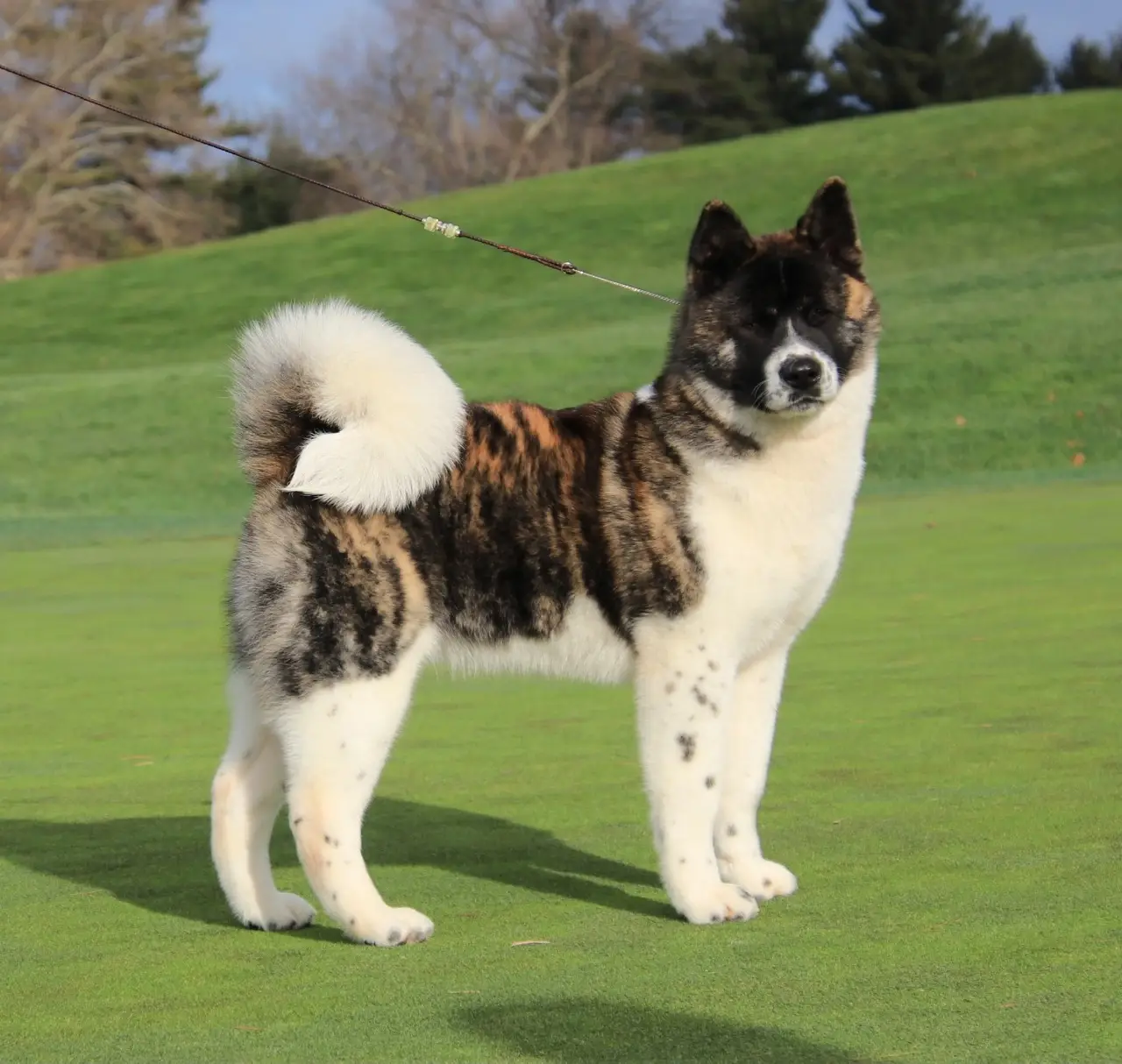
Champion Bengal, gold brindle
Champion Bengal is the opposite end of the brindle spectrum. Her coat is a gold brindle mixed with white, arranged so delicately that people assume she was painted. Where Stone's brindle is dark and intense, Bengal's is light and airy. The striping sits over a warm gold base and the white portions of her coat break up the pattern in a way that is genuinely unique.
The contrast between these two dogs illustrates something important about brindle in American Akitas. Calling a dog "brindle" tells you almost nothing about what it actually looks like. You need to see it. Stone and Bengal are both brindle. They could not look more different.
Pinto American Akitas: White Base with Colored Patches

Champion Torro, multi Best of Breed winner, pinto
Pinto is one of the most searched and most visually striking patterns in the American Akita. A pinto dog has a white base coat with large colored patches covering at least one third of the body. The patches can be any color, including red, brindle, fawn, or black.
Champion Torro is a multi Best of Breed winner and a perfect example of the pinto pattern. His patches are a dark orange red distributed across a white base, with white socks and a light black mask framing his face. What makes Torro's coat especially interesting is the black etching visible at the transitions where his red patches meet the white portions of his coat. That etching adds definition and precision to the color breaks that you do not see on every pinto dog.
White American Akitas: Striking, Correct, and Misunderstood

Starlight, solid white American Akita
The solid white American Akita is one of the most searched color varieties in the breed, and it is one of the most misunderstood. Let me clear up the biggest myth right now. White American Akitas are not albino. They have full pigment in their nose, lips, and eye rims. Albinism is a complete absence of pigment, which is extremely rare in this breed. A white Akita with a black nose and dark eyes is simply a white dog, not an albino.
Starlight is one of the finest white American Akitas I have produced. In this photo she is at an AKC dog show displaying her solid white coat in a professional stack. Her nose is black, her eyes are dark, and her coat is a clean, bright white. She is the same dog underneath as every other dog in this guide. Same structure. Same temperament. Same health testing. The only difference is the color of her coat.
The other myth worth addressing is that white Akitas are more prone to health problems. There is no evidence for this in the breed. Health is determined by OFA testing, pedigree depth, and responsible breeding decisions. Not by color.
Fawn American Akitas: The Warm Golden Middle Ground

Prosha, fawn American Akita, Winter 2026 sire
Fawn is one of the most commonly confused colors in the American Akita. People see a fawn dog and call it a "light red" or a "cream." It is neither. Fawn is its own distinct color with a warm, golden undertone that separates it from both red and white.
Prosha is an active sire in our breeding program and a strong example of what true fawn looks like. His coat has a warmth to it that reads golden in sunlight. It is not washed out. It is not diluted. It is a specific, intentional color that sits between the deeper reds and the lighter creams on the American Akita color spectrum.
If you are looking at an Akita and you are not sure whether it is a light red or a fawn, look at the overall tone. Red, even light red, has a warmth that pulls toward orange or copper. Fawn pulls toward gold. The difference is subtle in photos but unmistakable in person.
Silver American Akitas: Cool Toned and Uncommon

Champion Lara, silver American Akita
Silver is one of the less common colors in the American Akita and one of the most visually distinctive. A silver dog has a cool grey base coat with no red or fawn undertone. The overall impression is steel or ash rather than warm or golden.
Champion Lara is our silver example. Her coat reads as a cool, neutral grey with a defined black mask and white chest markings. In a breed dominated by warm tones like red and fawn, a silver dog stands out immediately because the temperature of the color is completely different. Everything about her reads cool where most Akitas read warm.
Silver with Black Overlay: Depth and Dimension

Champion Aurora, silver with black overlay
Silver with black overlay takes the cool silver base and adds another layer. The outer guard hairs are tipped in black, creating a depth effect that shifts as the dog moves. In direct sunlight, you can see the silver base and the dark tips as separate layers. In shade, the overlay blends and the dog appears darker overall.
Champion Aurora carries this combination beautifully. She also has white socks, a black mask, and the black etching at her color transitions. The overlay gives her coat a richness that flat silver does not have. It is subtle. Most people would simply call her "grey." But when you understand what you are looking at, the layering is remarkable.
Sable American Akitas: When Red Meets Black Overlay

Champion Astra (Apexx Flavor of the Woods), sable
Sable is one of the most complex colors in the American Akita. A sable dog has a red or orange base coat with diffused black tipping across the guard hairs. The result is a mixed, shifting appearance that does not fit neatly into any other category. Sable is not brindle. Brindle has distinct stripes. Sable has a diffused, blended overlay that changes the look of the coat depending on the light and the angle.
Champion Astra, whose registered name is Apexx Flavor of the Woods, is our sable representative. Her reddish orange base is overlaid with a light black tipping that creates what I describe as a sable appearance. In direct sunlight, the orange base dominates and she looks warm and bright. In shade or overcast light, the black tips come forward and she appears darker and more complex. She has a black mask, white socks, and the black etching where her white markings meet the colored portions of her coat.
Sable is sometimes confused with brindle by people who are not familiar with both patterns. The distinction is in the pattern structure. Brindle has visible, defined stripes. Sable does not. Sable is a wash of dark tipping across the entire coat surface without any striping pattern.
The Black Etching: A Detail Most People Never Notice

Champion Lara showing the black etching detail on her silver coat
There is a detail on many of my dogs that most people walk right past without seeing. I call it the black etching. It is a thin, dark line that appears at the exact point where white markings meet the colored portions of the coat. It shows up across multiple color families in my program. You can see it on red dogs, silver dogs, sable dogs, pinto dogs, and fawn dogs. The etching adds a crisp, precise definition to the color transitions that gives the coat a finished, polished look.
Champion Ash (mahogany red) and Katana (silver) showing black etching side by side
In the video above, you can see Champion Ash and Katana standing side by side. Ash is a mahogany red. Katana is a silver. Two completely different base colors. But look at where the white meets the color on both dogs. The same thin dark line is present at the transition on each of them. That is the etching.
The black etching is not required by the AKC standard. Many American Akitas do not have it. But when it is present, it adds a level of definition that I look for when I evaluate coat quality. It is one of the first things I notice on a dog, and it is a detail that separates a good looking coat from an exceptional one.
Do American Akita Puppies Change Color as They Grow?
Yes. Significantly. And Champion Ash is the proof.

Champion Ash: color change documented from 3 weeks old to adult champion
At three weeks old, Ash was nearly black. His face was solid dark, his body was charcoal and grey, and the only break in the darkness was the white on his chest and paws. If you had seen him at that age and tried to guess what color he would be as an adult, you would have been wrong.
By four weeks, the first hints of brown started appearing through the dark puppy coat. By six weeks, he had lightened dramatically to a soft fawn with a defined black mask. By eight weeks, the age most puppies go to their new homes, he looked like a completely different dog than the one born three weeks earlier.
The real transformation happened between four months and eleven months. During that window his coat deepened steadily from light fawn into the rich, saturated mahogany red that defines him today. He won Best in Show at four months old, when his adult color was only beginning to emerge. By eleven months he was already a champion.
The lesson here is simple. The color you see at eight weeks is not the color you will have at two years. Puppy coat and adult coat are different in texture, density, and often in color. This is normal. It is not a sign of anything wrong. It is genetics doing exactly what genetics does.
If you are choosing a puppy and you have a specific color preference, I understand that. Tell me what you are hoping for and I will do my best. But I also tell every applicant the same thing. Choose the dog, not the color. The puppy with the right temperament for your family may not be the color you came in looking for. In over 20 years and more than 150 placements, the families who listened to that advice have never once regretted it.
Multiple Colors in One Litter: What to Expect
One litter from Apexx Akitas showing multiple colors from the same parents
One of the most common questions I get from first time applicants is "what color will my puppy be?" The honest answer is that it depends on genetics, and genetics does not always cooperate with preferences. A single litter from the same dam and sire can produce puppies in red, brindle, fawn, pinto, and white. All siblings. All from the same parents. This is normal and it is one of the things that makes the American Akita such a fascinating breed.
In the video above, you are looking at a single litter from my program running on a golf course green. Count the colors. Those puppies share the same mother and the same father. The range of colors they produced is a direct result of the genetic diversity that both parents carry.
This is also not a sign of mixed breeding. The genetic mechanisms that produce color variety in American Akitas are well understood. When both parents carry genes for multiple colors, their offspring can express any combination of those genes. It is the same principle that gives human siblings different hair and eye colors. Same parents, different expression.
Color Does Not Determine Temperament, Health, or Value
I want to close with the most important thing in this entire guide. Color is the least important factor in choosing an American Akita.
Temperament is determined by genetics, early socialization, and the breeding decisions made long before a puppy is born. Not by whether the puppy is red or white or brindle. You can read more about how we approach temperament in our guide: Why Temperament Starts Before the Puppy.
Health is determined by OFA testing, documented pedigrees, and responsible breeding. Not by coat color. The myth that certain colors are more prone to health issues is not supported by evidence in the American Akita. Every dog in our program is OFA tested regardless of color. You can learn more about our testing protocol here: OFA Health Testing for American Akitas.
Price should reflect the breeder's investment in health testing, champion bloodlines, early socialization, and the depth of their track record. Not the color of the puppy's coat. If a breeder is marketing a color as "rare" and using that word to justify a higher price, that is a red flag. You can read our full breakdown of pricing in our guide: How Much Does an Akita Puppy Cost.
And if you are not sure how to evaluate a breeder's practices, start here: How to Find a Reputable American Akita Breeder.
American Akita Color Quick Reference
| Color | Description | Apexx Akitas Example |
|---|---|---|
| Red with Black Mask | Deep to golden red, dark muzzle pigment, white markings common | GCH Asa, CH Ash, CH Esther |
| Dark Brindle | Dense striping over mixed brown, black, grey, red base | CH Stone |
| Gold Brindle | Lighter striping over gold base, often with white | CH Bengal |
| Pinto | White base with colored patches covering one third or more of body | CH Torro |
| White | Solid white, full pigment in nose and eye rims | Starlight |
| Fawn | Warm golden tone, distinct from light red | Prosha |
| Silver | Cool grey base, no warm undertone | CH Lara |
| Silver with Black Overlay | Cool grey base, dark tipped guard hairs | CH Aurora |
| Sable | Red or orange base with diffused black tipping | CH Astra |
American Akita Color FAQ
The American Akita is one of the most color diverse large breeds in the world, and every color shown in this guide is represented by a real, named dog from our program. Color is beautiful, and it is the least important factor in choosing the right dog for your family. Temperament, health testing, and breeding quality are what make an American Akita worth living with for the next 12 to 15 years. If you are drawn to a specific color, tell us. But trust the match. The right dog is the one whose temperament fits your household, regardless of coat color.