This is probably the most common question I get from people researching the breed. Are American Akitas aggressive? Are they dangerous? Should I be worried about bringing one into my home?
I have been breeding American Akitas in Sussex County, New Jersey for over twenty years, and I am going to give you a direct answer.
No. American Akitas are not naturally aggressive. They are a powerful, intuitive guardian breed with strong protective instincts, and those instincts are often mistaken for aggression by people who do not understand what they are looking at.
That said, this is not the whole answer, because the breed is not for everyone. A poorly bred Akita raised by an inexperienced owner can absolutely develop into a dangerous dog. The same is true of any large guardian breed. The question is not really whether Akitas are aggressive. The question is whether the dog in front of you came from a serious breeding program and whether the owner is doing the work the breed requires.
What Aggression Actually Looks Like, and What It Doesn't
Most of what gets labeled aggression in this breed is something else entirely. Let me walk you through what people misread, because this matters.
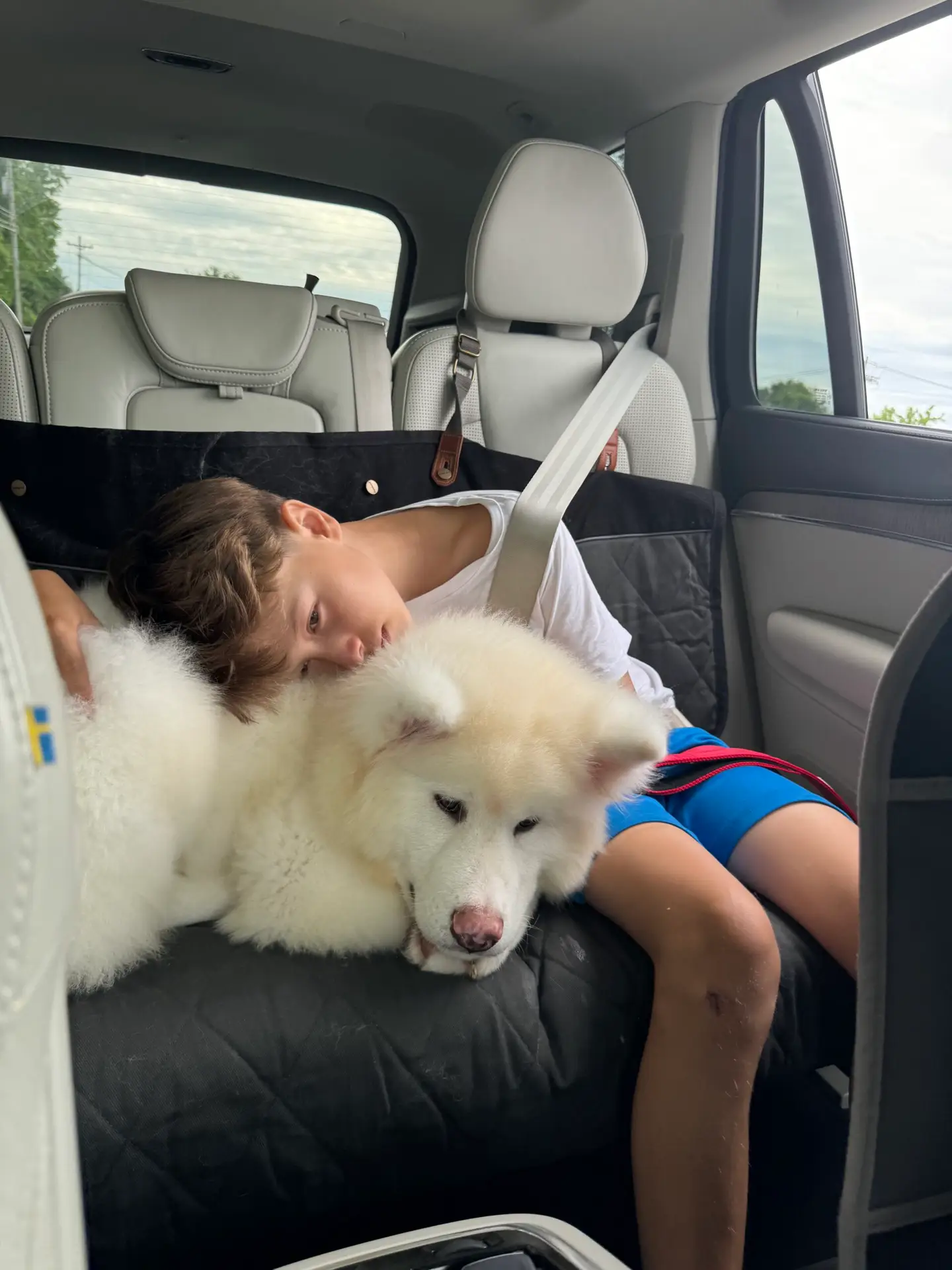
Look at the dog in the photo above. Blizzard is a full grown white Apexx Akita male, riding home in a car with his adolescent companion. There is nothing tense in his body. His eyes are soft. He is paying attention to his surroundings the way Akitas always do, but he is completely relaxed in the presence of his person. That is the breed. That is what we breed for.
An American Akita watching a stranger walk up to your front door with calm, focused attention is not aggressive. That is the breed doing its job. Akitas were developed in Japan as guardians, and that watchful presence is the entire reason the breed exists.
An American Akita that does not run up to strange dogs at the park wagging its tail is not aggressive. That is the breed showing the same-sex selectivity and dignified reserve that has always been part of its character. Akitas tend to prefer the company of their family over the company of unknown dogs. That is a feature, not a flaw.
An American Akita that signals discomfort when a strange child reaches over its head or hugs it tightly is not aggressive. That is a dog using the only language it has to tell you it is uncomfortable, and a smart owner reads that signal and adjusts.
Actual aggression looks like a dog that bites without warning, attacks family members, or shows persistent unprovoked reactivity in normal situations. In twenty years of breeding, I have never produced a dog like that, because the breeding decisions I make are designed to prevent it.
Where Akita Aggression Actually Comes From
When you do see a dangerously aggressive Akita, it almost always traces back to one or more of these failures:
- Poor breeding decisions. Breeding dogs with unstable temperaments to other dogs with unstable temperaments produces puppies that inherit the problem. Reputable breeders screen for temperament as rigorously as they screen for health.
- No early socialization. The window between 8 and 16 weeks is when the dog learns whether the world is a safe place. A puppy raised in isolation during that window will be a fearful, reactive adult.
- Backyard breeders and puppy mills. Volume breeders selling Akitas as a product have no incentive to select for temperament. The dogs that come out of those programs are a coin flip at best.
- Inexperienced owners. An Akita placed with an owner who cannot be the calm, consistent leader the breed needs will struggle. Akitas do not respond well to chaos, harsh corrections, or unpredictable handling.
- Mistaken rescue placements. Rescue Akitas often come with unknown histories, unknown genetics, and unaddressed fear. Calling that aggression and blaming the breed is not fair to the breed.
I explain this in more depth in Why Temperament Starts Before the Puppy, which covers exactly how the breeding decision is the temperament decision.
The Difference a Serious Breeding Program Makes
At Apexx Akitas, every breeding pair is selected for temperament first. Not coat. Not size. Not pedigree alone. Temperament. The dogs I keep in my program have to demonstrate the calm, stable, family-suitable disposition that defines the breed at its best. The ones that do not, no matter how impressive they look on paper, do not get bred.
That selection process compounds. Each generation of Apexx Akitas inherits stable temperament from both sides, and that inheritance shows up in every puppy I produce. Combine that genetic foundation with eight weeks of in-home raising, daily handling, exposure to children, exposure to normal household noise, and the result is a puppy that arrives at its new family already wired for stability.
This is why families with toddlers, school-age children, and other dogs can confidently bring an Apexx Akita into their home. The dog is not a guess. The dog is the product of two decades of decisions designed to produce exactly the temperament their family needs.
Are Akitas Good With Children?
Yes, when the dog comes from sound genetics and is introduced to the children correctly. This is one of the questions where the gap between a well-bred Apexx Akita and a poorly bred dog from an irresponsible breeder is the widest. A properly bred American Akita is one of the most devoted child guardians you will ever own. A poorly bred one is a liability.
I cover the full answer to this question in Are American Akitas Good With Children? A Breeder's Honest Answer, including how to handle the first introduction between your new puppy and your child.
Are Akitas Aggressive With Other Dogs?
This is the one area where the breed's reputation has some truth behind it, and I will be honest about it. American Akitas can show same-sex selectivity, especially between two females or two intact males in the same household. It is in the breed's history as a hunting dog, and even careful breeding does not eliminate it entirely.
What this means practically is that a well-bred Akita is usually fine with the family dog it grew up with, fine with the dogs it meets on a leashed walk, and fine in supervised public settings. The friction tends to show up in two specific situations. Two same-sex dogs sharing a home, and unsupervised interactions with unfamiliar dogs.
This is a manageable trait, not a dealbreaker. A serious breeder will be honest with you about your specific household and whether a particular puppy is the right match for it.
What Owning an American Akita Actually Requires
I am going to be direct with you here, because I would rather you walk away than buy a dog from me you cannot live with for the next twelve years. American Akitas are not the breed for everyone. They require:
- Calm, consistent leadership from the adults in the home
- An owner who can read body language and respect the dog's signals
- Commitment to early socialization in the first four months of life
- A home that is not chaotic, loud, or full of constant unpredictable activity
- Willingness to supervise interactions with unfamiliar people and dogs
- An honest understanding that this is a guardian breed, not a Labrador
If you can offer those things, the American Akita will give you back loyalty, protection, and dignity that no other breed can match. If you cannot, please look at a different breed. Both you and the dog will be better off.
The Bottom Line on Akita Aggression
Are Akitas aggressive? No. They are a powerful guardian breed with strong instincts, and those instincts demand respect from the people who own them. In the wrong hands and from the wrong breeder, any large guardian breed can become dangerous. In the right hands and from a serious breeding program, the American Akita is one of the most stable, trustworthy, and loyal family dogs you will ever own.
That is the honest answer. Twenty years in the breed has not changed it, and twenty more will not either.