The American Akita in Dog Shows: What Titles Mean, How They Are Earned, and Why Buyers Should Care
By Ron Durant, Apexx Akitas. AKC breeder, owner-handler, and exhibitor of champion American Akitas since 2003.

Apexx Akitas champions with their AKC conformation show ribbons. Multiple title winners from one breeding program. Sussex County, New Jersey.
The American Akita's role in AKC conformation dog shows is to be evaluated against the official breed standard by licensed judges. Dogs that meet or exceed the standard in structure, movement, temperament, and breed type earn points toward Championship and Grand Championship titles. These titles are not cosmetic. They are verified proof that a dog's physical structure and temperament have been independently judged as correct for the breed. For breeders, show results guide which dogs should be bred. For buyers, titles on a pedigree are one of the most reliable indicators that a breeder is producing dogs that meet the standard the breed was built on.
What AKC Conformation Shows Actually Are
And Why They Exist in the First Place
A conformation dog show is not a beauty pageant. That is the most common misunderstanding people have about the sport, and it leads to the assumption that showing dogs is about vanity. It is not. Conformation shows exist for a single purpose: to evaluate breeding stock against the written breed standard.
Every AKC-recognized breed has an official standard. It describes in precise detail what the ideal specimen of that breed should look like, how it should move, and what its temperament should be. The standard exists because breed-specific structure is directly connected to breed-specific function. An American Akita that is built correctly moves efficiently, carries weight properly on its joints, breathes without restriction, and ages soundly. A dog that deviates significantly from the standard is more likely to develop structural problems that affect its health and quality of life.
At a conformation show, a licensed AKC judge physically examines each dog. They evaluate the head, the bite, the body proportions, the coat, the bone structure, and the overall silhouette. Then the dogs move around the ring so the judge can assess gait. How a dog moves reveals how it is built underneath the coat. A dog with correct structure moves smoothly and effortlessly. A dog with structural faults compensates, and a trained eye sees that compensation immediately.
The judge then places the dogs in order of how closely each one adheres to the breed standard. The dog that best represents the standard on that day, in that ring, against that competition, wins.
This process exists to protect the breed. Without a mechanism for evaluating breeding stock against a standard, there is no objective way to determine which dogs should be producing the next generation. Breeders who show their dogs are submitting their breeding program to independent, public evaluation. That takes confidence in what you are producing. It also takes a willingness to be told your dog is not good enough, which happens to every exhibitor and is part of how the system works.
How the American Akita Is Judged
The Breed Standard, Point by Point
The AKC breed standard for the American Akita describes a large, powerful dog with heavy bone, a broad head, and a balanced, ground-covering gait. The judge evaluates every dog in the ring against this written description. Here is what they are looking for.
Head. The head is one of the most distinguishing features of the American Akita. The standard calls for a massive but balanced skull, a broad, blunt muzzle, and small, dark, deeply set triangular eyes. The ears are small relative to the head, set wide, and carried erect, tilting slightly forward. A correct Akita head communicates power, alertness, and intelligence. An incorrect head immediately tells a judge that something fundamental about the dog's type is off.
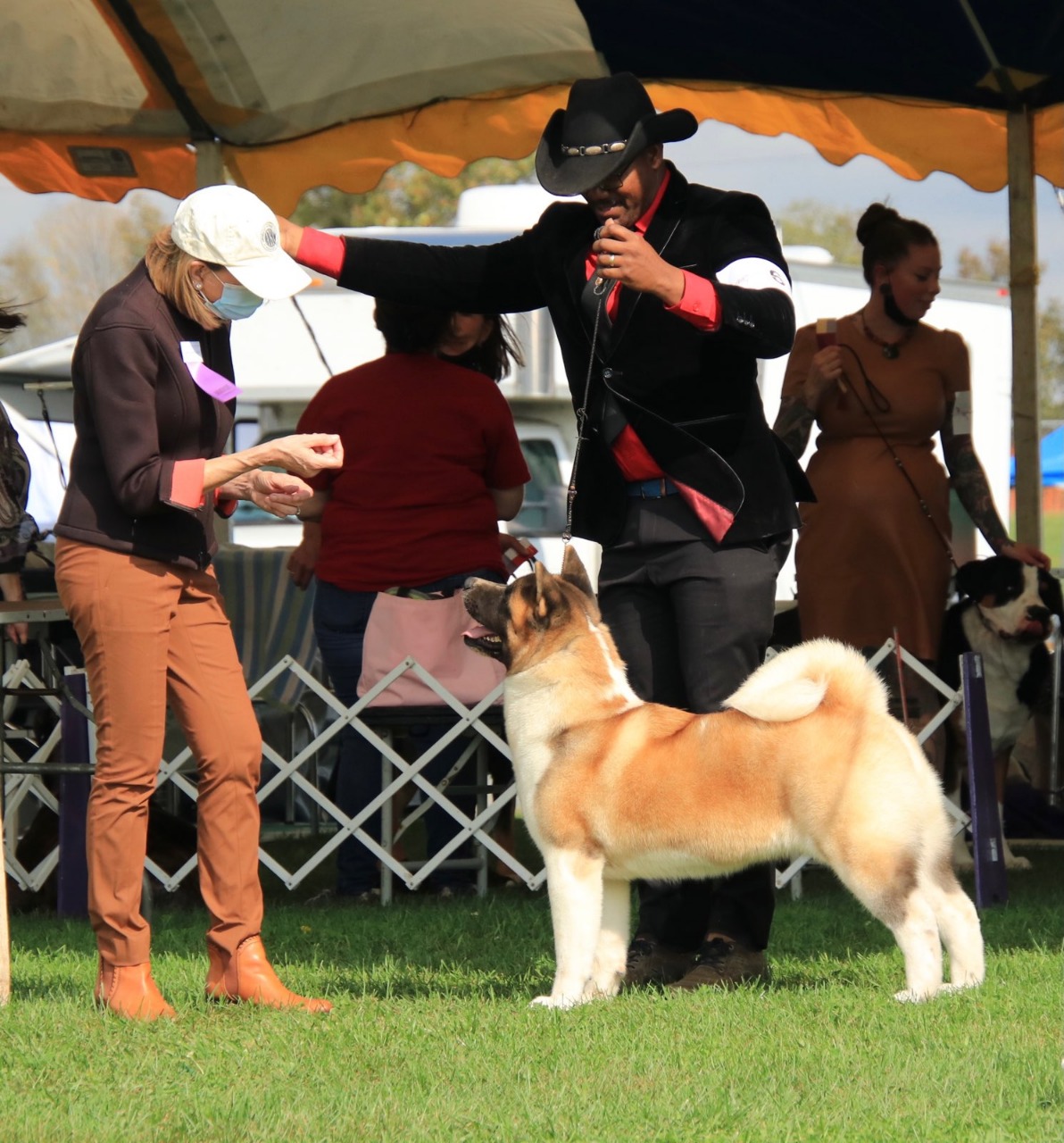
An AKC judge takes a final look at Champion Esther's head before awarding her Best of Breed. The head is one of the most critical evaluation points in the breed standard. Esther's rare golden orange coat commands immediate attention in the ring.
Body and Structure. The body should be slightly longer than tall, with a level topline, a deep chest that reaches to the elbow, and well-sprung ribs. The tail is large and full, carried over the back in a curl. Bone should be heavy throughout. The overall impression should be of a substantial, well-balanced dog that could work all day without breaking down structurally.
Movement. This is where structural truth is revealed. The standard calls for a brisk, powerful gait with moderate reach and drive. The dog should move in a straight line with no wasted motion. Crossing over, crabbing, pacing, or any irregularity in gait signals a structural fault. A judge watching an Akita move around the ring can identify hip issues, shoulder problems, and rear angulation faults in seconds.
Temperament. The standard describes the Akita's temperament as alert, responsive, dignified, and courageous. In the ring, this translates to a dog that stands calmly while being examined by a stranger, moves confidently alongside its handler, and shows no aggression or extreme shyness. A dog that cannot be examined by a judge or that shows fear or hostility is excused from the ring. Temperament is not a separate trait from structure. It is part of the evaluation.
Coat and Color. The double coat should be harsh and straight on the outer layer, with a dense, soft undercoat. Any color or pattern is acceptable in the American Akita, including white, brindle, pinto, and any combination. The coat's condition reflects the dog's overall health and care.
Every one of these elements matters because every one of them affects how the dog lives. Correct structure means correct movement. Correct movement means less stress on joints. Less stress on joints means a longer, more comfortable life. The breed standard is not an aesthetic preference. It is a blueprint for a healthy, functional dog.
What It Takes to Earn an AKC Championship
The Process Most People Never See
An AKC Championship title requires a minimum of 15 points earned under at least three different judges, including two major wins of 3 to 5 points each under two different judges. That sounds simple. It is not.
Points are awarded based on the number of dogs defeated in the breed ring on a given day. The AKC publishes a point schedule that varies by region and by breed, because the number of competitors differs across the country. In a competitive breed like the American Akita, earning a single point means defeating multiple dogs. Earning a major means defeating a significant number. The bar is high because it is supposed to be.
A dog cannot earn its Championship by winning in weak competition. The system is specifically designed so that titles require defeating quality dogs at multiple shows under multiple judges. One judge having a preference for your dog is not enough. Three separate judges, at minimum, must agree that your dog is excellent.
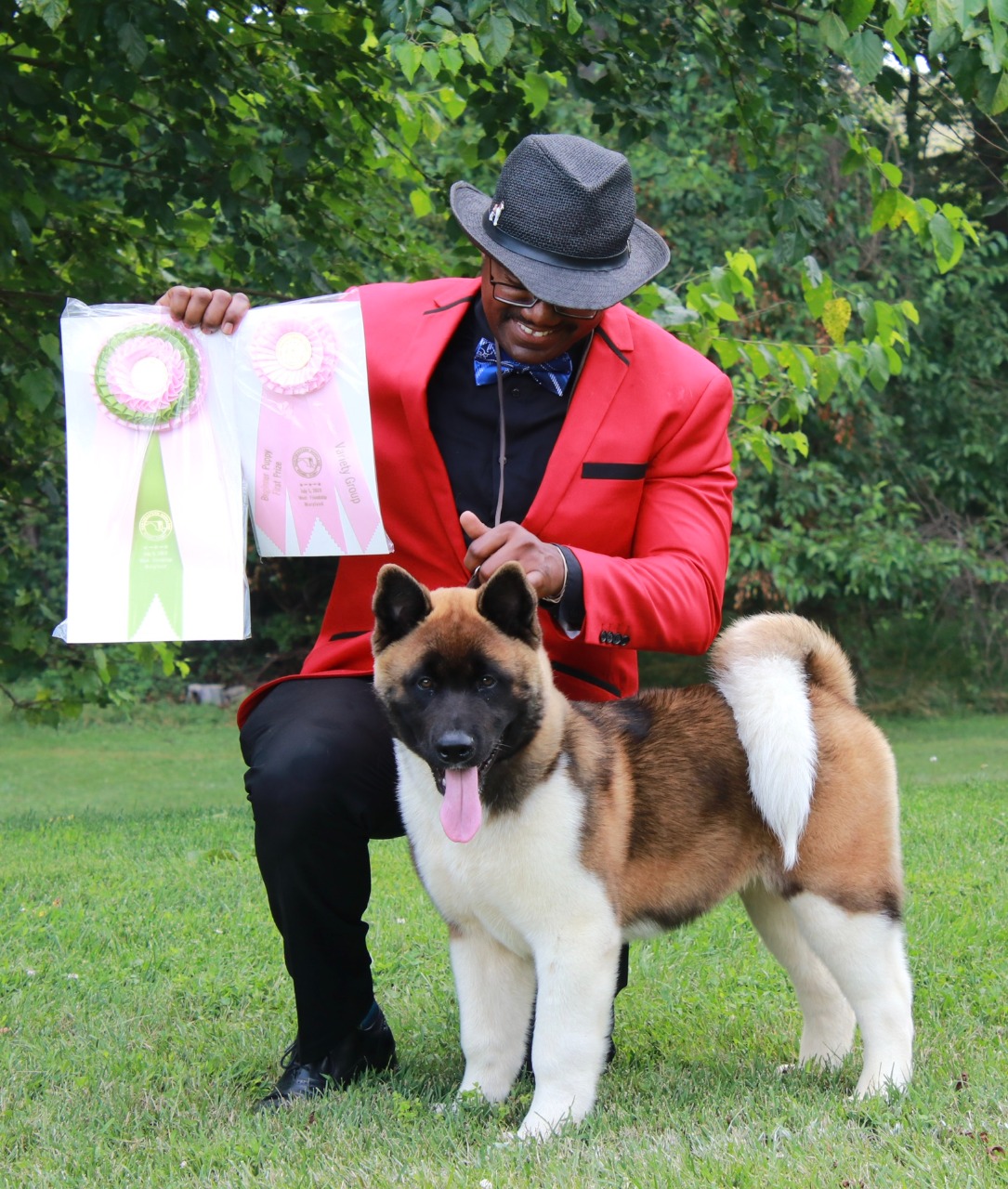
Champion Ash at just 4 months old with his Best of Breed and Best in Show ribbons. Some dogs show you what they are before they are old enough to understand what they have done.
What most people outside the sport do not realize is the investment behind each of those points. Every show requires entry fees, travel, handler fees if you are not owner-handling, grooming and conditioning, and time away from everything else. Many dogs are shown for one to two years before finishing their Championship. Some never finish because they do not meet the standard closely enough to win consistently. The dogs that do finish have been independently verified as correct specimens of their breed. That verification is not something any breeder can give themselves.
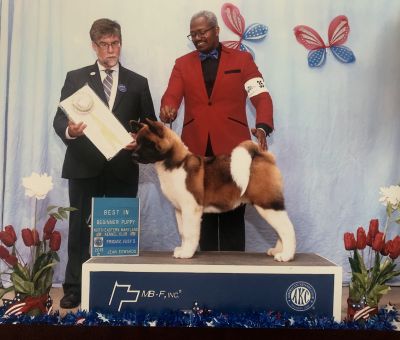
Ron Durant with the presiding judge and 4-month-old Ash after winning Best in Show against 76 entered puppies. Best in Show is the highest award a dog can earn at a conformation event.
What a Grand Championship Means
And Why So Few Dogs Earn One
The AKC Grand Championship goes beyond the Championship. A Grand Champion has not only finished its Championship but has continued to compete and win against other champions. The Grand Championship requires 25 additional points earned in Best of Breed or Best of Opposite Sex competition, including at least three major wins at the Grand Championship level.
At this level, the dog is no longer competing against all breed entries. It is competing against other champions. The dogs in the ring have already proven they meet the standard. Now the question is which champion best represents the breed on that day. The judging is more nuanced. The margins are smaller. The competition is more experienced.
Earning a Grand Championship is a statement that a dog is not just correct. It is exceptional. It has been evaluated repeatedly by multiple judges at the highest level of breed competition and has consistently been selected as the best representative of the American Akita in the ring.
For a breeding program, a Grand Champion is a cornerstone. It means the dog's structure, movement, temperament, and breed type have been verified beyond any reasonable question. When I say Grand Champion Asa is the foundation of the Apexx Akitas program, that is not marketing language. That is a documented, verifiable fact backed by judges across the country who examined him, watched him move, and placed him above his competition.
How Show Results Shape Breeding Decisions at Apexx Akitas
The Part of the Process Buyers Never See
Showing dogs is not a hobby I pursue separately from breeding. It is part of the breeding process. The show ring is where my breeding decisions are tested publicly, and the results directly inform which dogs I breed and which pairings I plan.
Here is how it works in practice. Before I breed any dog, I need to know that its structure is correct. I can evaluate structure myself after 20 years of experience, but my evaluation alone is not enough. The show ring provides independent confirmation from people who have spent their careers studying breed structure across thousands of dogs. When a judge puts my dog up, they are confirming what I see. When a judge does not, they are telling me something I need to look at more carefully.
This feedback loop is what separates show breeders from breeders who never compete. A breeder who never shows is making breeding decisions based entirely on their own evaluation. They may be experienced. They may be talented. But they are operating without external checks. The show ring is that external check.
Champion Bengal in the Group ring after winning Best of Breed. Group competition means your dog has already been selected as the best representative of its breed and is now competing against the best of every other breed in the Working Group.
At Apexx Akitas, every dog in my breeding program has earned its place through competition. Champion Torro earned his Championship by demonstrating correct breed type, sound structure, and stable temperament in the ring. Champion Bengal did the same, and then advanced to the Group ring to compete against the best dogs from every other breed in the Working Group. Grand Champion Asa did it at the highest level. Champion Esther earned a Best of Opposite Sex win at the Westminster Kennel Club Dog Show, the most prestigious conformation event in the United States. These titles tell the next generation's buyers that the parents of their puppy were independently verified as correct specimens of the breed. That is not something I can give my dogs. It is something they have to earn.
Apexx Akitas Champions
The Dogs Behind the Titles

Grand Champion Asa
Asa is the foundation sire of the Apexx Akitas program. His Grand Championship was earned competing against champions across the northeast and mid-Atlantic regions. Judges consistently noted his correct breed type, powerful movement, and exceptional head piece. Beyond the ring, Asa's temperament is what every American Akita should be: calm, confident, watchful, and completely reliable with his family. His offspring carry his structure, his movement, and his temperament forward into the next generation.
Full OFA clearances: hips, elbows, thyroid, eyes, and cardiac.
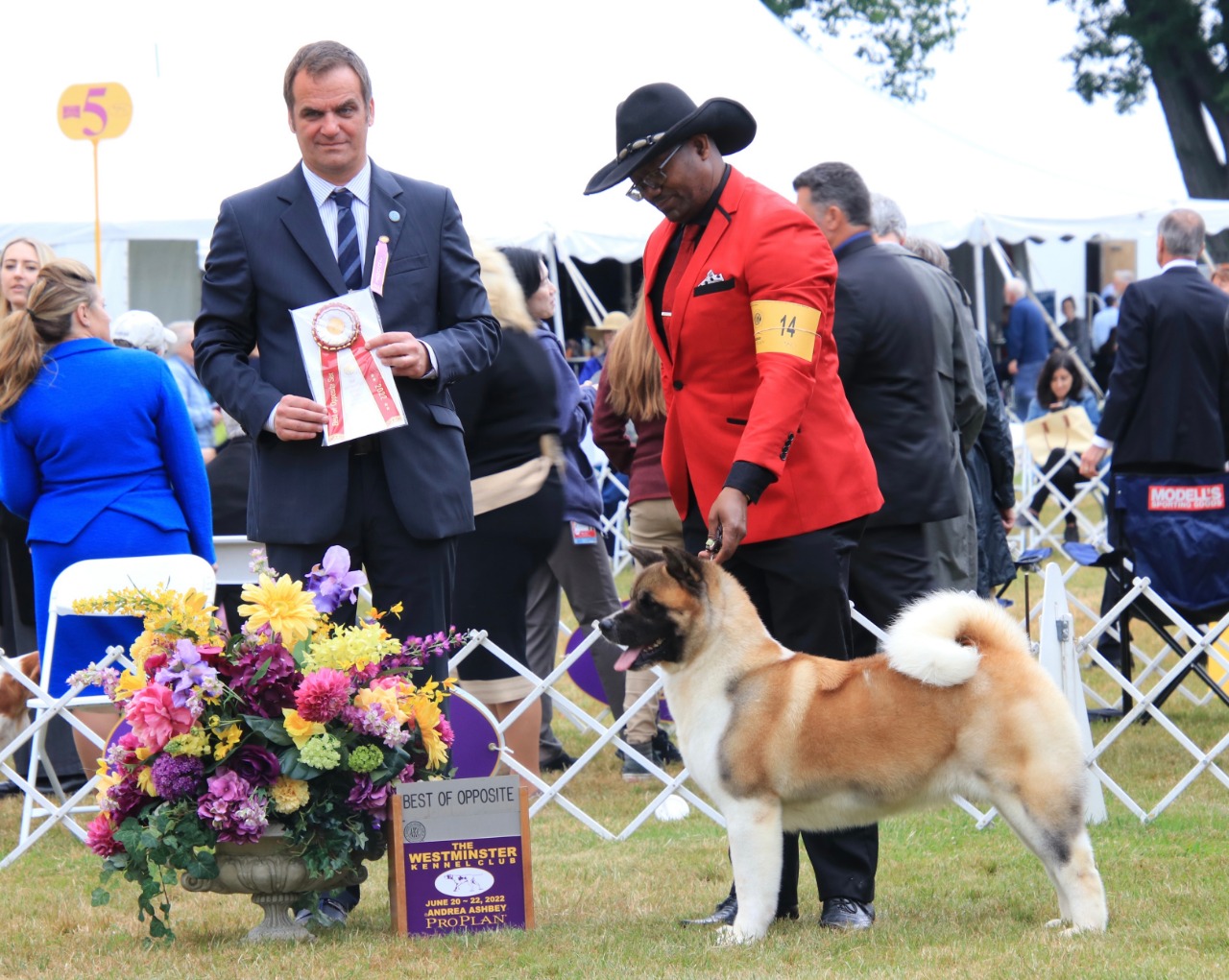
Champion Esther
Esther earned a Best of Opposite Sex win at the Westminster Kennel Club Dog Show, the most recognized and prestigious conformation event in the United States. Westminster draws the top dogs from across the country, and a BOS placement at that level confirms a dog's excellence against the strongest competition the breed has to offer. Her rare golden orange coat is a standout in the ring, but it was her structure, movement, and breed type that earned the placement. Westminster judges are evaluating correctness, not color.
Full OFA clearances: hips, elbows, thyroid, eyes, and cardiac.

Champion Torro
Torro finished his Championship with decisive wins that reflected his powerful build and commanding presence in the ring. He carries heavy bone, a correct topline, and a ground-covering gait that judges reward because it demonstrates proper structure underneath. At home, Torro is one of the most stable dogs I have ever produced. He is currently the sire of our Torro x Bengal litter, passing his structure and temperament to the next generation of Apexx Akitas.
Full OFA clearances: hips, elbows, thyroid, eyes, and cardiac.
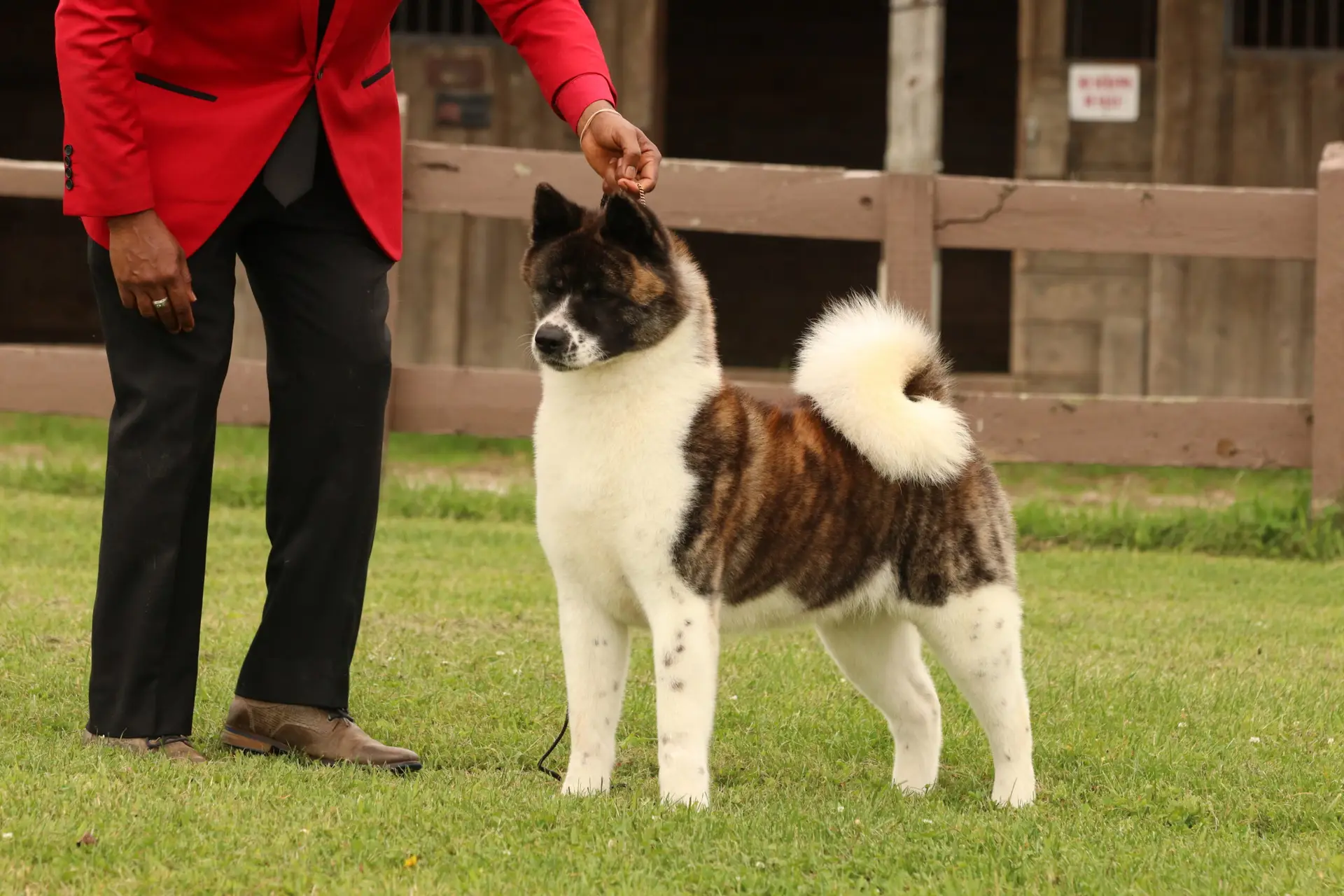
Champion Bengal
Bengal earned her Championship by combining correct breed type with beautiful movement and an unmistakable presence in the ring. She advanced to compete in the Group ring after winning Best of Breed, going head to head against the best dogs from every breed in the Working Group. She is feminine without being fine-boned, powerful without being coarse. That balance is what the breed standard calls for in a female American Akita, and Bengal delivers it consistently. As the dam of the current Torro x Bengal litter, she contributes the structural correctness and temperament stability that every Apexx Akitas puppy is built on.
Full OFA clearances: hips, elbows, thyroid, eyes, and cardiac.

Champion Ash
Ash showed what he was before he was old enough to understand what he had done. At just 4 months old, he won Best in Show against 76 entered puppies. That is not a breed win. That is the highest award at the entire show, and he earned it as a baby going up against every breed entered that day. Best in Show at any level is rare. Winning it at 4 months old, against a field of 76, is the kind of result that tells you the breeding program behind the dog is producing exceptional quality from the ground up. Ash went on to finish his full AKC Championship title.
Full OFA clearances: hips, elbows, thyroid, eyes, and cardiac.
Why Buyers Should Care About Championship Titles
What the Letters on a Pedigree Actually Tell You
If you are researching American Akita puppies, you will see breeders use phrases like "champion bloodlines" and "champion sired." Some of those claims are real. Many are not. Understanding what titles actually mean gives you the ability to verify what a breeder is telling you and to distinguish between a program that has been tested and one that has not.
When you see CH or GCH on a pedigree, you can verify that title on the AKC website. It is a public record. The dog either earned the title or it did not. There is no gray area. No breeder can claim a Championship that does not exist in the AKC database.
Here is what titles tell you as a buyer.
Titled Parents
Structure has been independently verified by multiple licensed judges.
Temperament was evaluated under the stress of a show environment and found stable.
The breeder submitted their dogs to public evaluation and competition.
The dog's physical structure is documented and verifiable through AKC records.
Breeding decisions are informed by objective external feedback.
Untitled Parents
Structure has only been evaluated by the breeder themselves.
Temperament has not been tested in a controlled, public environment.
The breeder's program has not been publicly evaluated by independent experts.
There is no external verification of the dog's structural correctness.
Breeding decisions are based solely on the breeder's personal assessment.
This does not mean every untitled dog is a bad dog. There are excellent dogs that have never been shown. But titles remove the guesswork. They replace a breeder's personal opinion with documented, independent verification. When you are spending $2,000 to $3,500 on a puppy that will be part of your family for the next decade, that verification matters.
For a deeper look at how to evaluate what breeders tell you, read 15 Questions to Ask an American Akita Breeder Before You Buy.
Show Breeder vs Backyard Breeder
What the Titles Actually Reveal About a Program
A show breeder is a breeder who submits their dogs to independent evaluation through AKC conformation shows and OFA health testing before breeding. A backyard breeder is a breeder who produces puppies without any form of external verification that their dogs are structurally correct, healthy, or suitable for breeding. The difference between the two determines the quality, health, and temperament of the puppies they produce.
The term "backyard breeder" gets used loosely online, and it has lost some of its meaning. Let me be specific about what it means and why it matters.
A backyard breeder produces puppies without submitting their dogs to any form of independent evaluation. No conformation showing. No health testing through OFA. No working titles. No external verification of any kind that the dogs being bred are correct, healthy, or suitable for producing the next generation. The breeder decides for themselves that their dogs are good enough, breeds them, and sells the puppies.
A show breeder operates differently. Before a dog enters the breeding program, it is shown in AKC conformation to confirm that its structure meets the breed standard. It is health tested through OFA to confirm that its hips, elbows, thyroid, eyes, and heart are clear. The breeder's work is public, documented, and verifiable. Every title earned, every health clearance recorded, and every breeding decision is backed by evidence that anyone can check.
The difference shows up in the puppies. Puppies from structurally correct, health-tested parents are more likely to grow into sound, healthy adults. They are more likely to have the stable temperament that the breed standard requires. They are more likely to look and act like American Akitas should look and act, because their parents were verified against the standard that defines the breed.
At Apexx Akitas, every breeding dog carries both AKC Championship titles and full OFA health clearances. That combination is not common. Many breeders show but do not health test. Others health test but never show. Doing both means the dogs are verified structurally by judges in the ring and verified medically by veterinary specialists in the clinic. The puppy you take home is the product of both systems working together.
To understand the health testing side of this equation, read OFA Health Testing for American Akitas: What Every Buyer Must Know.
The Connection Between the Show Ring and Health Testing
Two Systems, One Goal
Conformation showing and OFA health testing are two sides of the same coin. The show ring evaluates what a judge can see and feel. Health testing evaluates what they cannot.
A judge can identify correct structure by watching a dog move. They can assess bone, proportion, and breed type by examining the dog on the table and on the ground. But they cannot see inside the hip joint. They cannot detect a thyroid condition. They cannot identify early cardiac changes. That is what OFA testing does.
A truly responsible breeding program uses both systems. The show ring confirms that the dog's external structure is correct. OFA testing confirms that the internal structure is sound. Together, they provide the most complete picture available of whether a dog should be producing puppies.
At Apexx Akitas, every breeding dog is evaluated through both systems before it is ever bred. Grand Champion Asa, Champion Esther, Champion Torro, Champion Bengal, and Champion Ash have all earned their titles in the ring and passed all five OFA health clearances under the care of Dr. Jonathan King, VMD, at Steinbach Veterinary Hospital. That combination is what "champion bloodlines" actually means when I use the phrase. It is not a marketing term. It is a documented standard of breeding practice.
For buyers, this matters because it means the puppy you are considering is not the product of guesswork. It is the product of a breeding program that has been tested externally at every level and has the documentation to prove it. That is the standard every serious buyer should expect, and it is the standard every responsible breeder should meet.
To learn more about what makes a responsible breeder, read How to Find a Reputable American Akita Breeder.
Looking for a Champion-Bred American Akita?
Every Apexx Akitas puppy comes from AKC Champion or Grand Champion parents with full OFA health clearances. Our breeding program has been independently verified in the show ring and the veterinary clinic for over 20 years. Champion Esther earned Best of Opposite Sex at the Westminster Kennel Club Dog Show. Champion Ash won Best in Show at 4 months old against 76 puppies. That is the level of quality behind every Apexx Akitas litter.
VIEW AVAILABLE PUPPIES