OFA Health Testing for American Akitas: What Every Buyer Must Know
A complete guide to what OFA clearances mean, how to read the ratings, how to verify results yourself, and what to ask any breeder before committing.
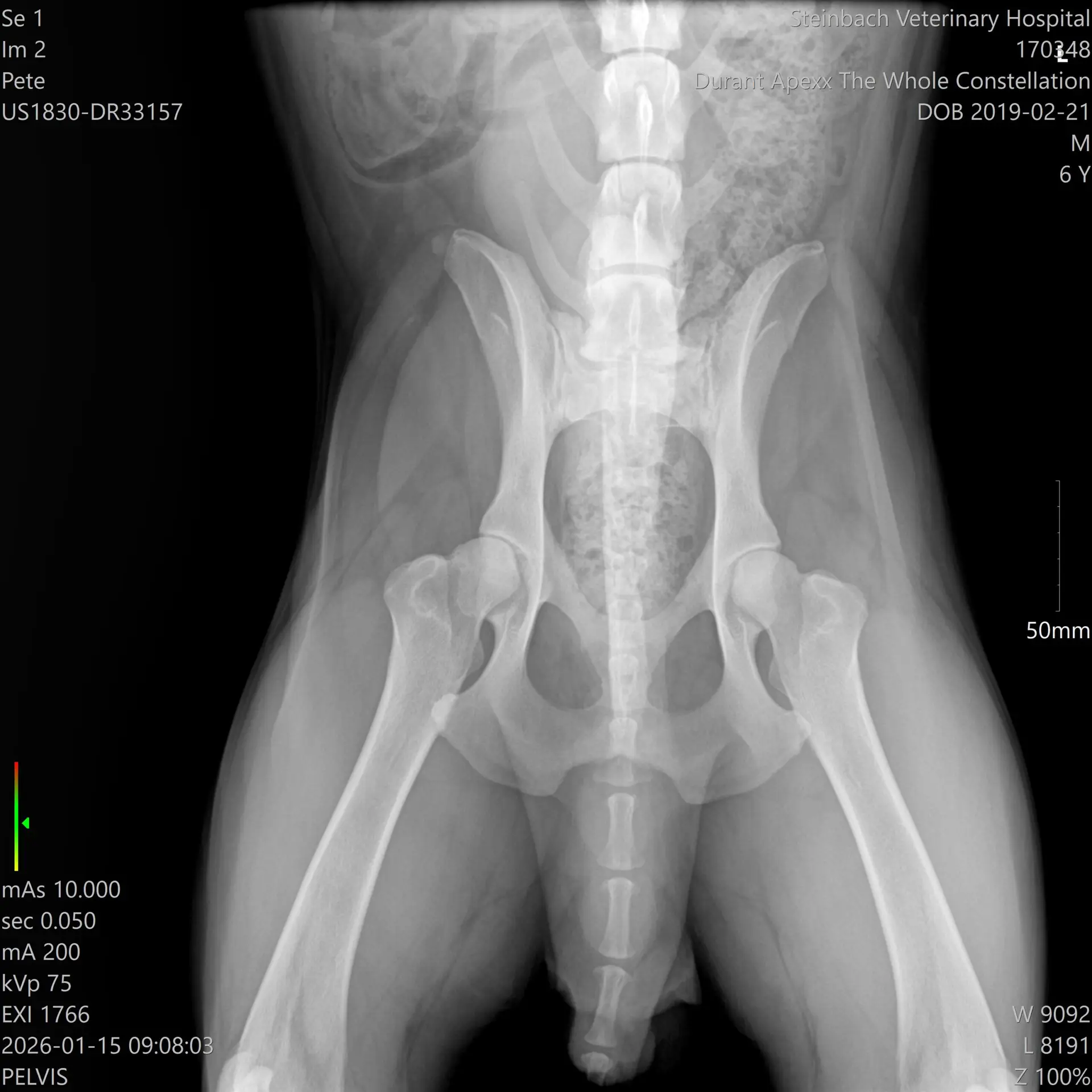
OFA hip radiograph: Durant Apexx The Whole Constellation (“Ash”), male, DOB 2019-02-21. Evaluated January 15, 2026 at Steinbach Veterinary Hospital. This is what verified OFA documentation looks like.
If you are researching American Akita breeders, you have almost certainly seen the phrase “OFA health tested” in a breeder’s marketing. But what does it actually mean? How do you verify it? And what should you do if a breeder cannot or will not show you the documentation?
This guide answers every one of those questions in plain language. After more than 20 years breeding American Akitas, completing OFA clearances on every breeding dog in my program, and watching the long-term health outcomes of over 150 placed dogs, I can tell you that OFA testing is not a formality. It is the single most reliable predictor of whether your future Akita will live a long, comfortable, mobile life.
Read this before you talk to any breeder.
What Is OFA and Why Does It Matter for American Akitas
The Orthopedic Foundation for Animals (OFA) is a nonprofit organization founded in 1966 with a specific mission: to reduce the prevalence of inherited disease in companion animals through research, education, and open health databases. Their registry is the gold standard for canine health evaluation in the United States.
For American Akitas specifically, OFA testing matters more than it does for many other breeds. American Akitas are a large, heavy-boned working breed that grows rapidly and carries significant weight on their joints throughout their lives. According to OFA data, nearly one in four Akitas evaluated for hip dysplasia show evidence of the condition. That is a 24-plus percent rate in a breed where hip replacement surgery runs between $5,000 and $7,000 per hip. Elbow dysplasia affects roughly 15 percent of evaluated dogs. Autoimmune thyroid disease is common. Inherited eye conditions occur with enough frequency that annual ophthalmology screening is considered essential by responsible breeders.
None of these conditions are visible to the naked eye in a healthy-looking puppy. A dog can look and move perfectly normally at 8 weeks old and develop debilitating hip dysplasia by age two. The only way to know whether a puppy’s parents carry these risks is through documented, third-party health evaluations completed before those breeding dogs are ever paired.
The Five Core OFA Tests for American Akita Breeders
Responsible American Akita breeding programs complete the following evaluations before pairing any two dogs. Each test addresses a specific inherited vulnerability in the breed.
1. Hip Dysplasia Evaluation (OFA or PennHIP)
Hip dysplasia is the most prevalent and costly inherited condition in American Akitas. The hip joint is a ball-and-socket joint, and dysplasia occurs when the ball does not fit correctly into the socket, causing abnormal wear, progressive arthritis, pain, and reduced mobility over time.
The x-ray at the top of this page is Ash’s actual OFA hip radiograph taken January 15, 2026. The clear, well-seated ball-and-socket joint visible on both sides is what a structurally sound Akita hip looks like. This is the standard every Apexx Akitas breeding dog is evaluated against.
OFA hip evaluations work as follows. Radiographs are taken by the dog’s veterinarian and submitted to OFA, where three independently selected radiologists evaluate them. The dog must be at least 24 months old for a permanent certification.
| OFA Hip Rating | What It Means | Breeding Suitability |
|---|---|---|
| Excellent | Tight joint conformation, no evidence of dysplasia | Ideal. Actively sought in responsible programs. |
| Good | Slightly less than perfect but within normal range | Acceptable for breeding when paired thoughtfully. |
| Fair | Minor irregularities, borderline normal range | Acceptable only if paired with Excellent or Good. |
| Borderline | Cannot classify as normal or dysplastic | Retest at a later date recommended. |
| Mild Dysplasia | Evidence of disease present but not severe | Should not be bred. |
| Moderate Dysplasia | Significant evidence of disease | Should not be bred. |
| Severe Dysplasia | Extensive joint abnormality | Should not be bred. |
Important: Preliminary hip evaluations taken before 24 months do not count as OFA clearances and are not assigned a number. Always verify the dog has a permanent OFA number, meaning the dog was at least 24 months old at evaluation.
PennHIP is an alternative hip evaluation method developed at the University of Pennsylvania. It measures hip laxity and can be performed as early as 16 weeks. PennHIP results are expressed as a Distraction Index score compared against the breed median.

Ash at Apexx Akitas. The same dog whose OFA hip radiograph appears above. Correct structure produces correct movement.
2. Elbow Dysplasia Evaluation
Elbow dysplasia covers several inherited conditions affecting the elbow joint. In Akitas, elbow dysplasia is the most common cause of front limb lameness and affects approximately 15 percent of evaluated dogs.
| OFA Elbow Rating | What It Means |
|---|---|
| Normal (Grade 0) | No evidence of elbow dysplasia. Required for responsible breeding. |
| Grade I | Minimal bone change. Dog should not be bred. |
| Grade II | Moderate bone change or defined bone defect. Dog should not be bred. |
| Grade III | Well-developed bone change. Dog should not be bred. |
Because hip and elbow radiographs are almost always taken at the same veterinary appointment, both results should carry the same test date. If a breeder shows you hip results but cannot explain why elbow results are absent from the same date, ask directly.
3. Thyroid Panel (Autoimmune Thyroiditis)
Autoimmune thyroiditis is one of the most common inherited conditions in American Akitas. The disease causes the immune system to attack the thyroid gland, leading to progressive destruction of thyroid tissue and eventually hypothyroidism. It tends to appear between 2 and 5 years of age, long after most puppies have been placed.
OFA thyroid testing evaluates T3, T4, Free T4, and thyroglobulin antibody (TgAA). Positive TgAA results indicate active autoimmune disease. Dogs with positive TgAA should not be bred.
Thyroid evaluations are time-sensitive. OFA recommends annual testing for breeding dogs. A thyroid clearance from three years ago is not current documentation.
4. CAER Eye Examination (Companion Animal Eye Registry)
OFA’s Companion Animal Eye Registry (CAER) replaced the older CERF certification system. Eye examinations are performed by board-certified veterinary ophthalmologists and screen for inherited eye diseases including progressive retinal atrophy, juvenile cataracts, iris coloboma, and other heritable conditions.
CAER certifications are valid for 12 months only. Responsible breeders obtain annual eye clearances for all active breeding dogs. A certification from two years ago is not current eye clearance.
5. Cardiac Evaluation
Cardiac evaluations screen breeding dogs for inherited heart conditions. There are two levels of OFA cardiac evaluation:
- Basic cardiac exam: Performed by a general practitioner or specialist through auscultation. Available from 12 months of age.
- Advanced cardiac exam: Performed by a board-certified veterinary cardiologist using echocardiography. Preferred in serious breeding programs.
The OFA cardiac number suffix tells you who performed the exam. P indicates a general practitioner, S indicates a specialist, and C indicates a board-certified cardiologist.
How to Read an OFA Number
Every dog that receives a normal OFA evaluation is assigned a registration number. Learning to read these numbers protects you from misrepresentation.
| Segment | What It Means |
|---|---|
| AKIT | Breed abbreviation. AKIT = Akita. |
| 1234 | Sequential number. The 1,234th Akita to receive this rating. |
| G | Hip rating. E = Excellent, G = Good, F = Fair. |
| 24 | Age in months when tested. 24 means 2 years old, the minimum for permanent certification. |
| F | Sex. M = Male, F = Female. |
| VPI | Permanent identification verified. The dog has a microchip or tattoo confirmed by the examining vet. |
The age segment is the most important number to check. If you see a 16 or 18 in that position on a hip clearance, the dog was not yet two years old when evaluated. That is a preliminary result, not a certification.
How to Verify OFA Results Yourself on ofa.org
This is the most important skill in this entire guide. You do not have to take a breeder’s word for their health clearances. Every normal OFA result is posted to a public database at ofa.org, and you can search it in under two minutes.
- Go to ofa.org and click Search in the top navigation.
- Enter the dog’s registered name or AKC registration number. Get this from the breeder before you search.
- Review the results. You will see all evaluations on file for that dog including the test type, date, rating, and OFA number.
- Check the dates. Thyroid and eye clearances expire. Confirm they are current for the breeding you are considering.
- Verify both parents. Not just one. Responsible breeders test every breeding dog on both sides of every pairing.
What to Ask a Breeder About Their OFA Clearances
Once you understand OFA testing, asking the right questions becomes straightforward.
A transparent breeder will hand you these numbers without hesitation. Any reluctance or redirection is a red flag.
The answer should be 24 months or older for a permanent certification. Earlier evaluations are preliminary results only.
Thyroid clearances should be current, meaning within the past 12 months for actively breeding dogs.
Eye certifications are valid for 12 months. Responsible breeders complete them annually for every dog they breed.
Ideally a board-certified cardiologist. The documentation should include the OFA number.
Breeders who follow up with families and track real-world health outcomes know things that no database captures.
Red Flags That Should End the Conversation
A routine veterinary examination is not OFA testing. This response means the testing has not been done.
Preliminaries are not certifications. Ask for the permanent OFA numbers. If they do not exist, the dogs do not have clearances.
DNA panels test for specific gene variants but cannot evaluate hip structure, elbow development, thyroid function, cardiac anatomy, or eye health. Neither replaces the other.
No one can see hip dysplasia, autoimmune thyroid disease, or inherited eye conditions in a dog that has not yet developed symptoms.
Champion bloodlines can and do produce heritable conditions. Bloodline reputation is not documentation. OFA numbers are documentation.
If a breeder claims to health test but cannot provide registration numbers you can verify on ofa.org, the testing either has not been done or produced abnormal results.
How Apexx Akitas Approaches OFA Testing
At Apexx Akitas, every breeding dog in our program has completed OFA hip and elbow evaluations, thyroid panels, CAER eye examinations, and cardiac evaluation before being considered for any breeding. This is not a minimum standard for us. It is a floor we have maintained without exception for over 20 years.
We verify OFA clearances on both sides of every pairing and we do not breed dogs whose results fall outside acceptable ranges, regardless of other qualities they may possess. A structurally impressive dog with Fair hips does not improve the breed.
This level of testing is also one of the biggest reasons a responsibly bred Akita is priced the way it is. If you want to understand the full picture, here is what a health-tested American Akita actually costs and why.
We also maintain long-term contact with our placed families and track health outcomes across our dogs’ lifetimes. If you are considering a puppy from Apexx Akitas, every parent’s OFA registration numbers are available for your verification. We expect you to check.
Summary: OFA Testing Checklist for American Akita Buyers
| Test | Minimum Acceptable | Verify at ofa.org |
|---|---|---|
| Hip evaluation (OFA or PennHIP) | Fair or better. Dog 24 months or older. | ✓ Yes |
| Elbow evaluation | Normal (Grade 0) | ✓ Yes |
| Thyroid panel (with TgAA) | Normal. Within past 12 months. | ✓ Yes |
| CAER eye examination | Normal. Within past 12 months. | ✓ Yes |
| Cardiac evaluation | Normal. Cardiologist preferred. | ✓ Yes |
If any of these evaluations are missing, outdated, or cannot be verified on ofa.org, you are not looking at a fully health-tested litter. That gap in testing is a financial and emotional risk that follows you for the full lifetime of the dog.
The Bottom Line
OFA health testing is not complicated once you understand what each evaluation covers, what the ratings mean, and how to verify them. The breeders who resist explaining their testing in detail are the ones you should walk away from. The breeders who hand you OFA numbers, encourage you to verify them, and can walk you through every evaluation are the ones worth your trust.
The American Akita is a magnificent, powerful, deeply loyal breed. When bred responsibly, they can be extraordinary lifelong companions. When bred carelessly, the health consequences fall entirely on the families who love them.
Know what you are buying. Verify what you are told. And choose a breeder who expects you to do both.
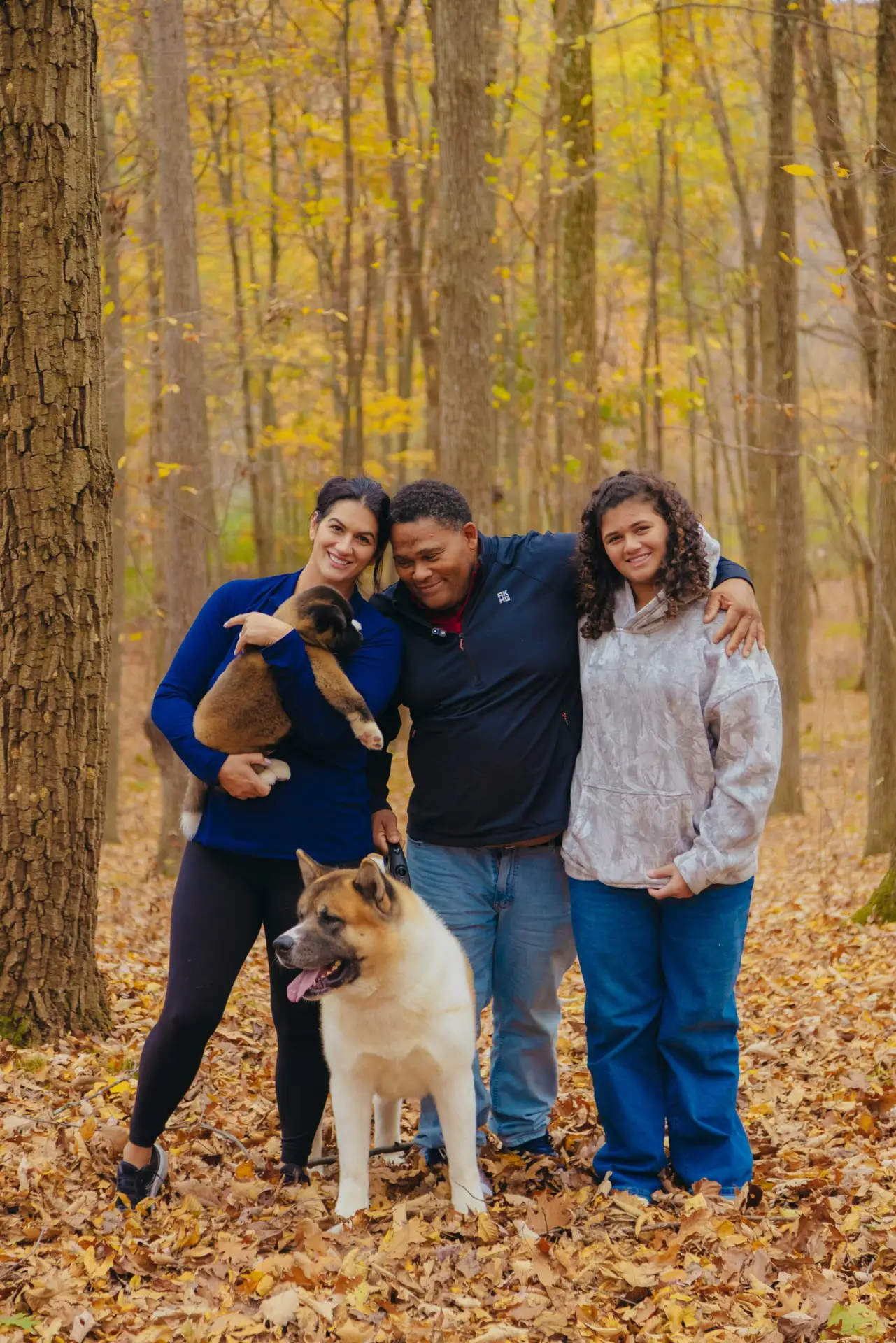
An Apexx Akitas family. Behind this moment: OFA-cleared hips, elbows, thyroid, eyes, and cardiac on both parents. Health testing is what makes moments like this possible for a lifetime.
Frequently Asked Questions: OFA Health Testing for American Akitas
A responsible American Akita breeder should have OFA clearances for hips, elbows, thyroid including TgAA, CAER eye examination, and cardiac evaluation on every breeding dog before any pairing.
Go to ofa.org, click Search, and enter the dog’s registered name or AKC registration number. All normal OFA results from dogs 24 months and older are posted publicly. If results do not appear, they either do not exist or were abnormal.
OFA hip ratings of Excellent, Good, or Fair are considered passing and acceptable for breeding. The dog must also be at least 24 months old for a permanent certification. Borderline, Mild, Moderate, and Severe Dysplasia ratings are not acceptable for breeding.
OFA recommends annual thyroid testing for breeding dogs. A thyroid clearance older than 12 months is not current documentation. The panel must include thyroglobulin antibody testing, not just T3 and T4 values.
An OFA number like AKIT-1234G24F-VPI breaks down as: AKIT is the breed abbreviation, 1234 is the sequential number, G is the hip rating (E for Excellent, G for Good, F for Fair), 24 is the age in months when tested, F is the sex, and VPI confirms permanent identification was verified.
Ready to meet an OFA-tested litter?
Every Apexx Akitas breeding dog carries full verifiable health clearances. Apply today and we will walk you through every number.
Apply for a Puppy